Know what to say
in the hard moments of dementia care.
An illustrated handbook for families caring for a parent with dementia. 40 hard moments, each on one page: what's happening, what to say, what not to say, and how to prevent it next time. eBook, spiral-bound book, or both.
The book on the kitchen table, the PDF on your phone · $64.99
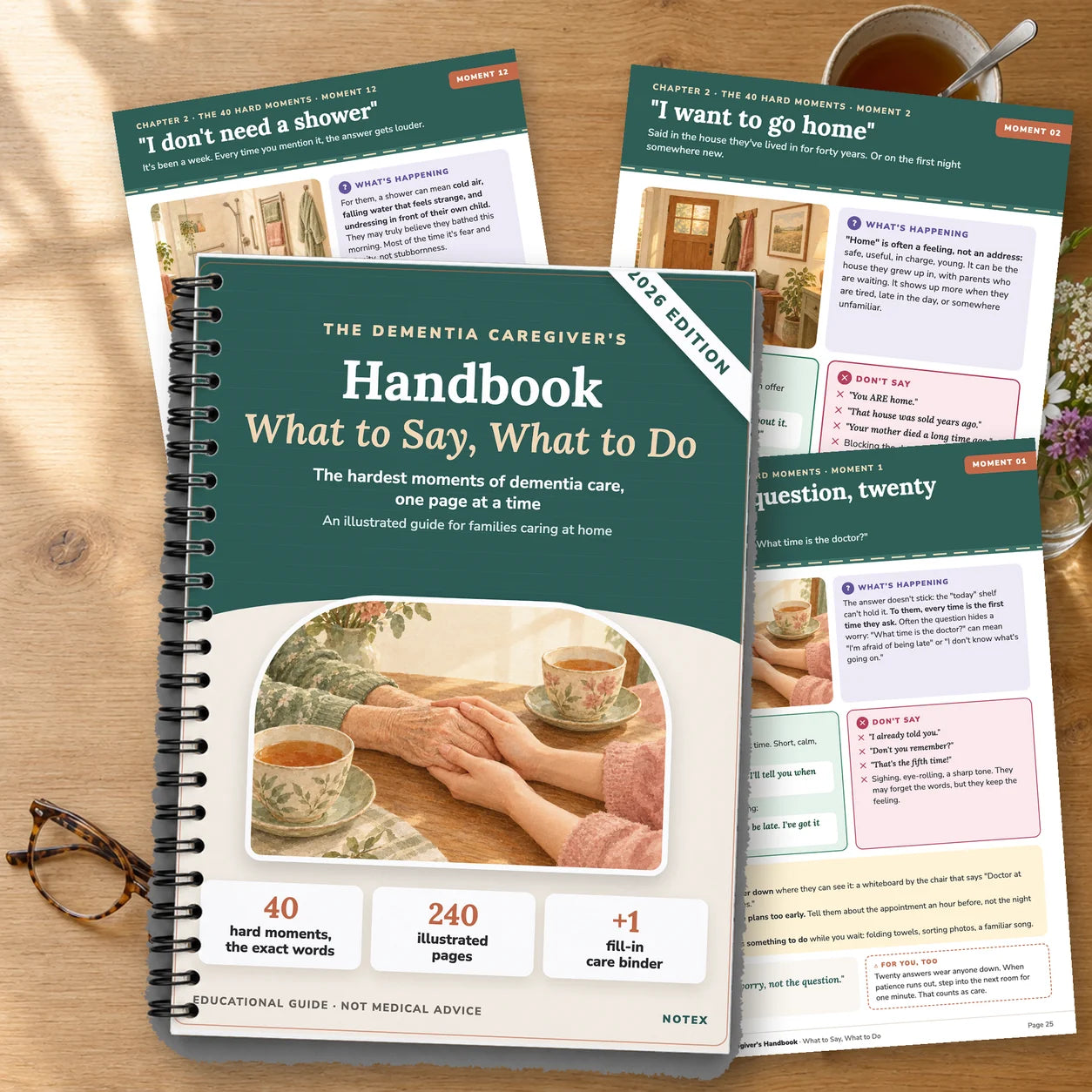
Not "be patient." The actual words.
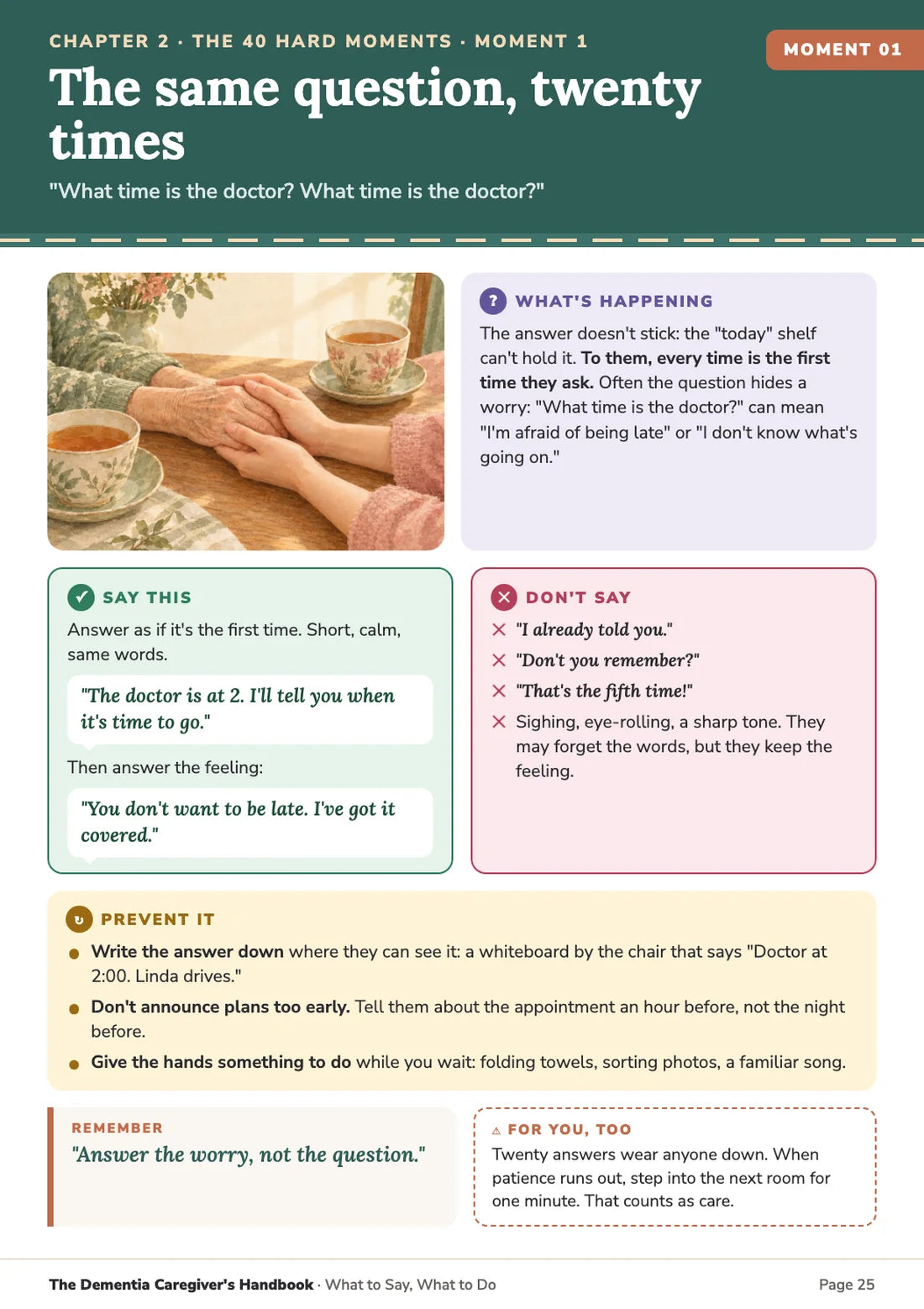
Every hard moment follows the same four boxes, so in a tense minute you know exactly where to look.
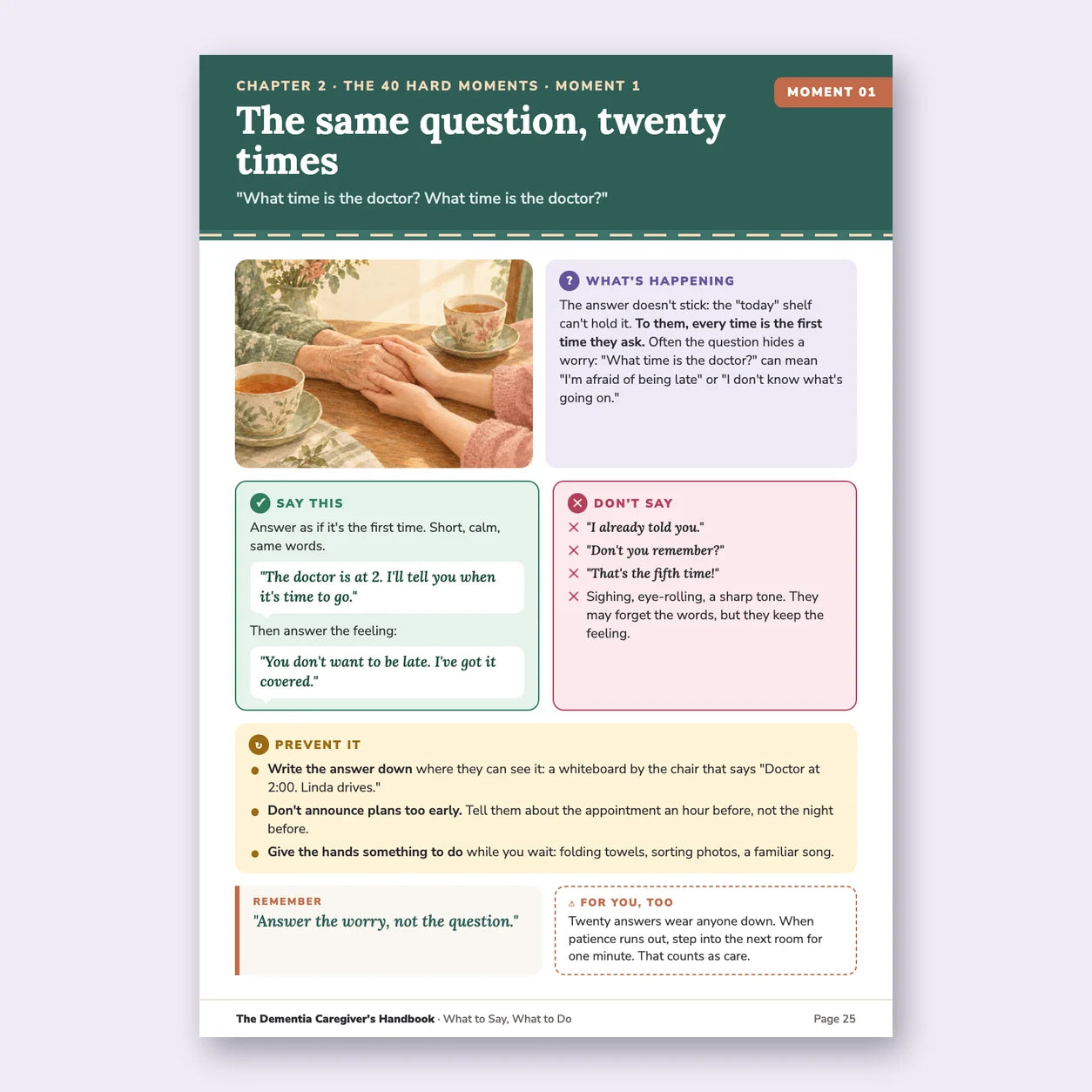
This is what the pages look like.
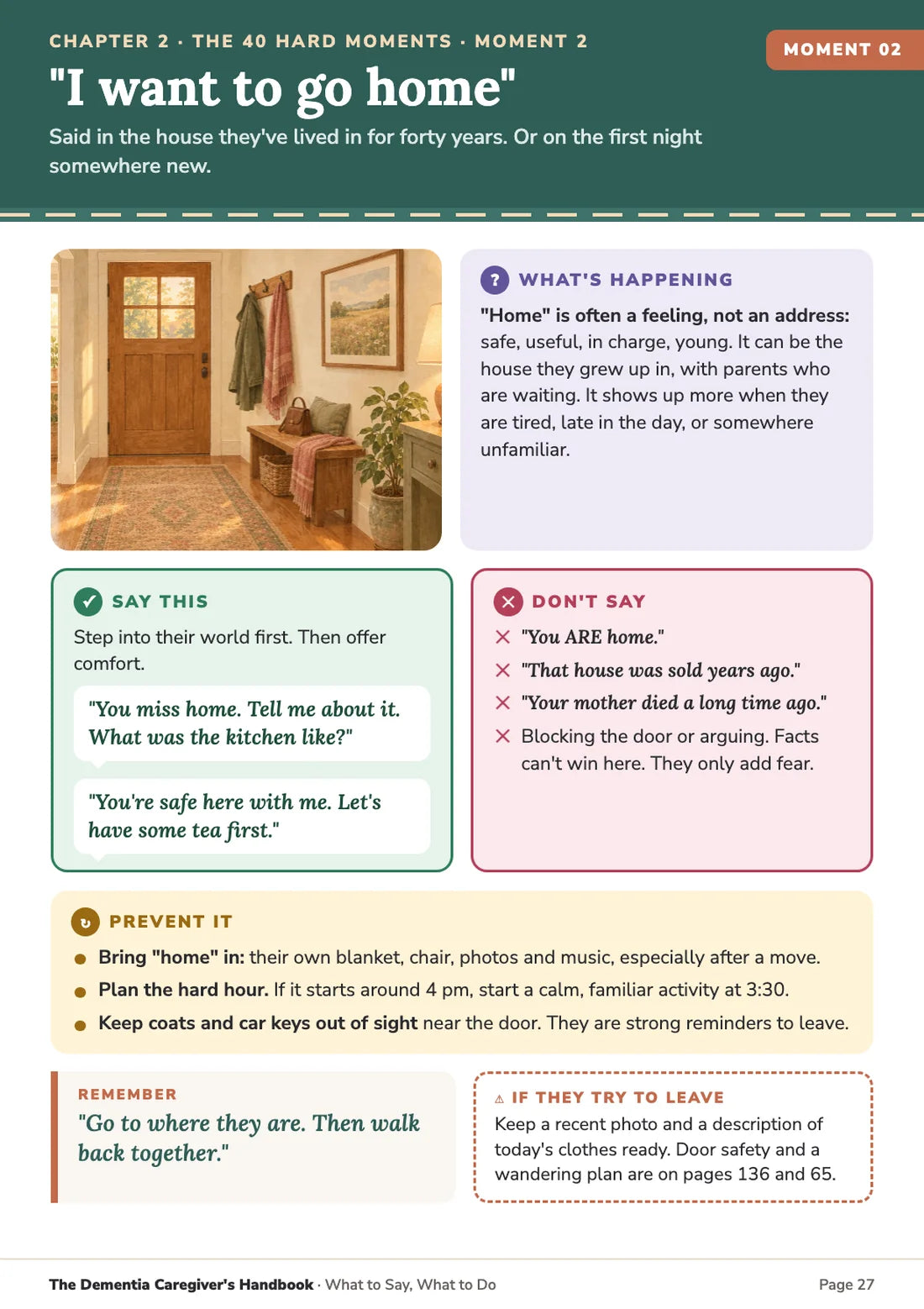
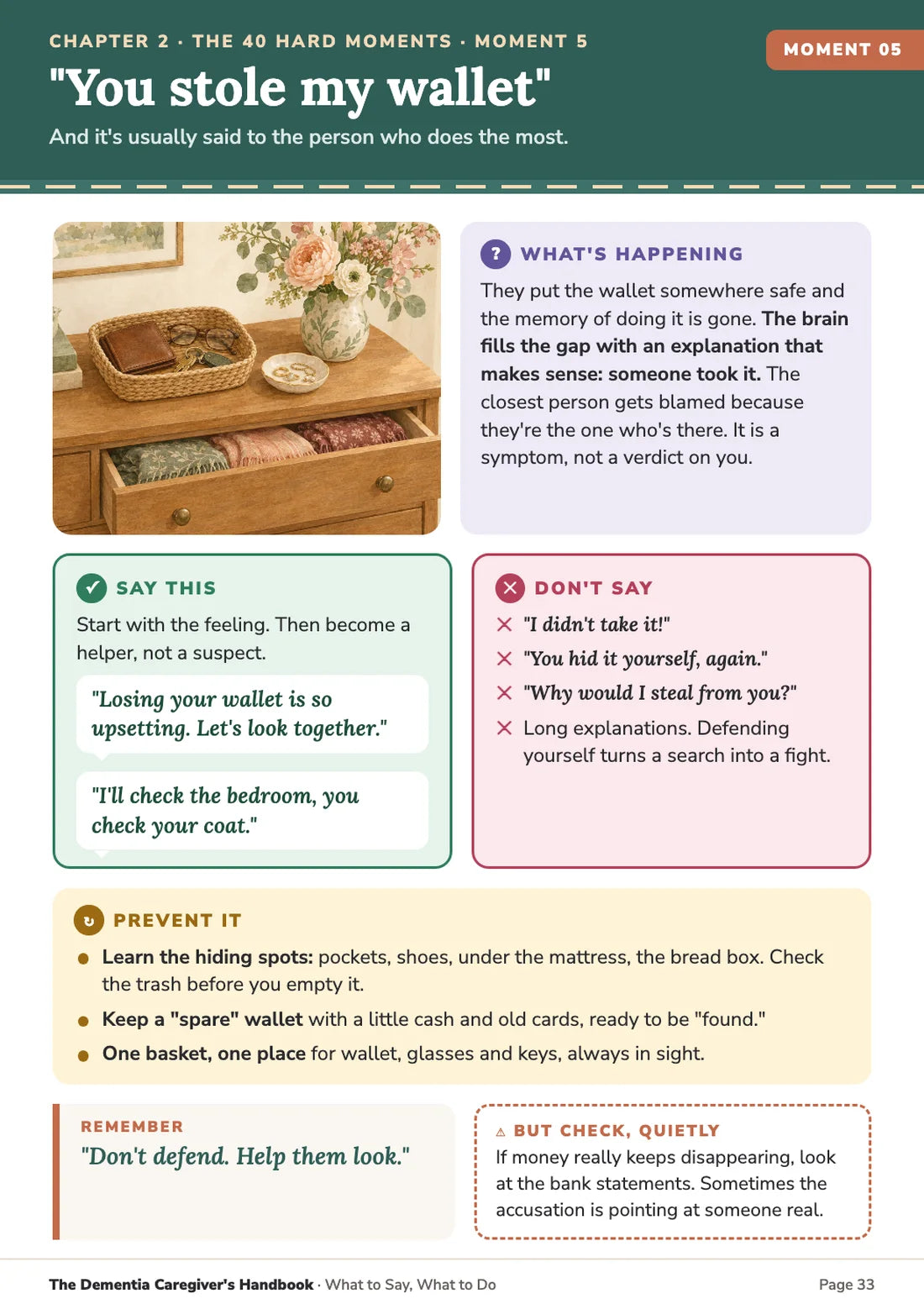
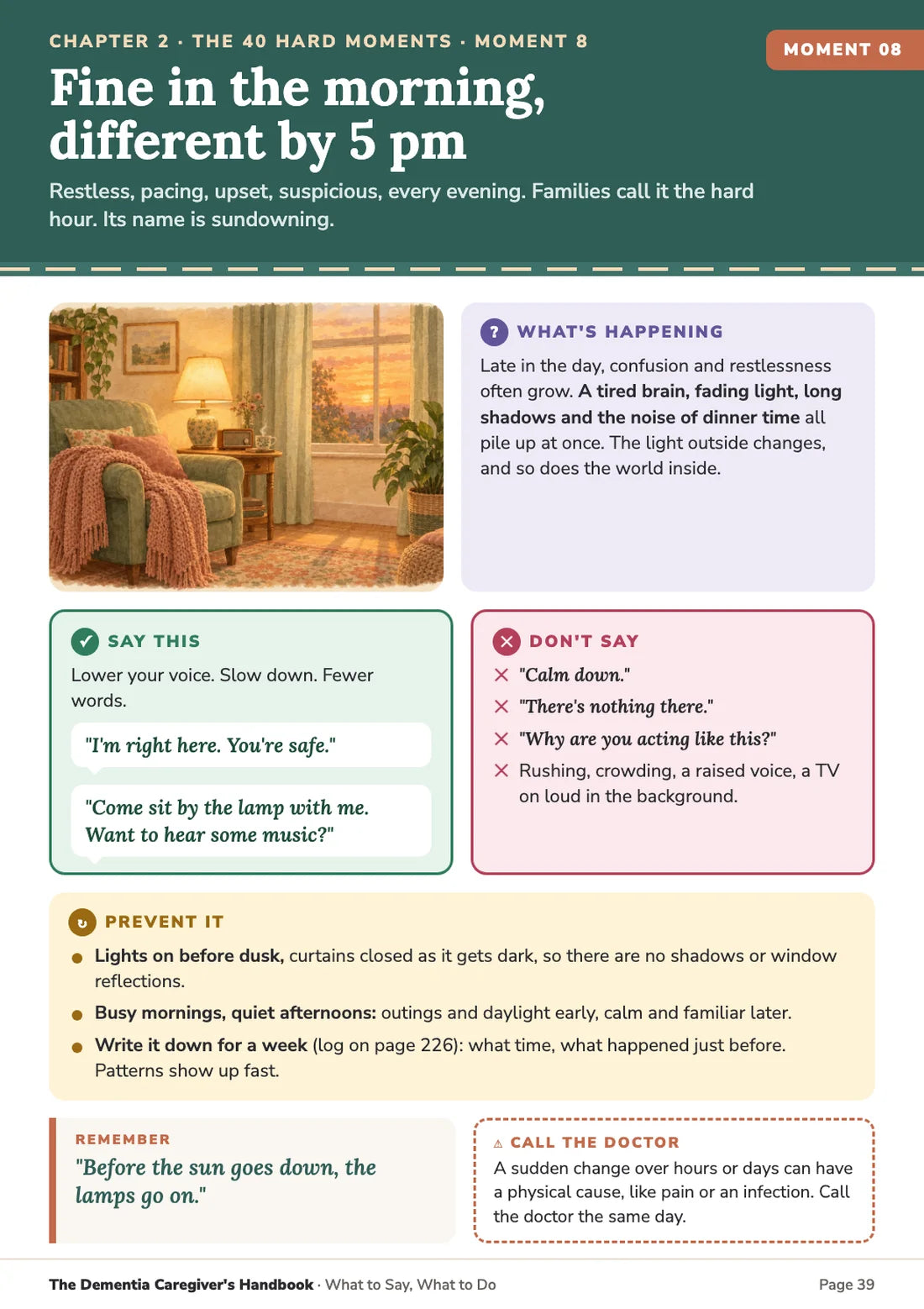
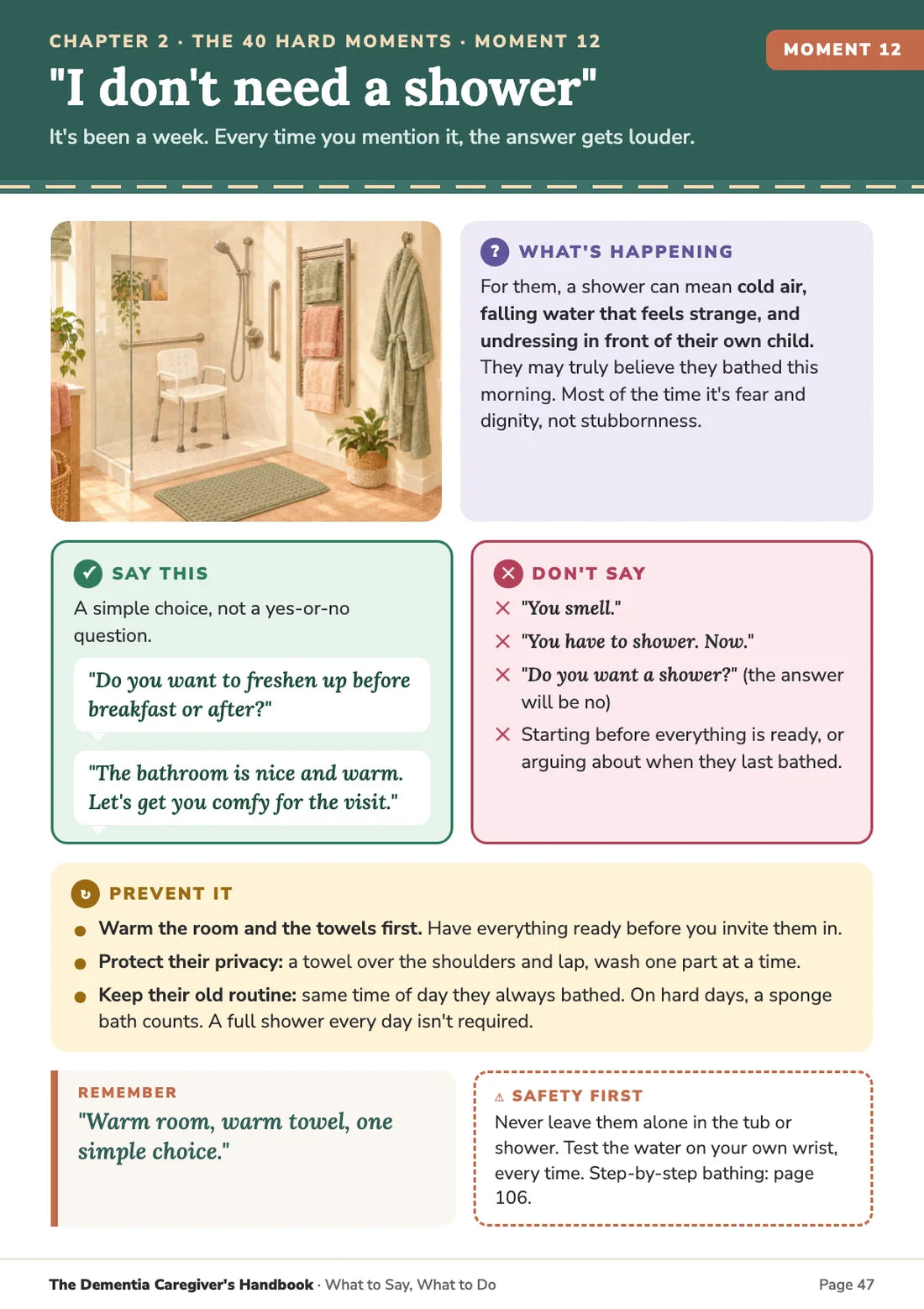
For the family member doing the caring.
The one who's there every day
For the daughter, son or spouse who handles the meals, the questions, the appointments and the nights. A book that stays open on the kitchen table, with the words ready when you need them.
The sibling a plane ride away
Understand what the day really looks like, share the same words, and take real jobs off the main caregiver's plate. Chapter 8 shows how to split them.
New to someone's routine
The 40 moments and the "All about" binder sheet help anyone who steps in, from a home aide to a weekend helper, respond the same calm way.
Nearly 13 million Americans are doing this right now.
Most of them never got a manual. These are the numbers from the Alzheimer's Association 2026 Facts and Figures report.
7.4 million people aged 65+
That's Alzheimer's alone, before counting the other types of dementia. The number is expected to keep growing for decades.
Nearly 13 million
Family and friends who give their time for free. About two out of three are women, and more than one in three is a daughter.
59% feel high stress
Most caregivers report high or very high emotional stress. Feeling tired, angry or guilty doesn't make you a bad caregiver. It makes you a human one.
One hard moment per spread.
Each moment has its own spread: the four boxes on one page, and the variations, "if it keeps happening" and space for your own notes on the next.
- The same question again and again, "I want to go home," asking for a spouse who has died
- Accusations of stealing, not recognizing family, anger and aggression
- Refusing to bathe, eat or take medicine, wandering at night, sundowning
- Accidents, undressing in public, inappropriate behavior, and more
For the moments that hurt.
Accusations usually land on the person who does the most. The book explains why, gives you the words that turn a fight into a search, and tells you when to check quietly that nothing is really wrong.
- Why the brain "fills the gap" with someone to blame
- The usual hiding spots, and the spare-wallet trick
- What to say when they don't recognize you
- When money really disappears: what to check
Bathing, toileting, accidents. Step by step.
The part nobody warns you about, explained with respect for the person and for you: how to get ready, what to say, and how to protect their dignity.
- Bathing step by step, and why a sponge bath can count
- Toileting routines and the bathroom set-up
- Incontinence: supplies, skin care basics, clean-up without shame
- Dressing, teeth and hair, with simple choices
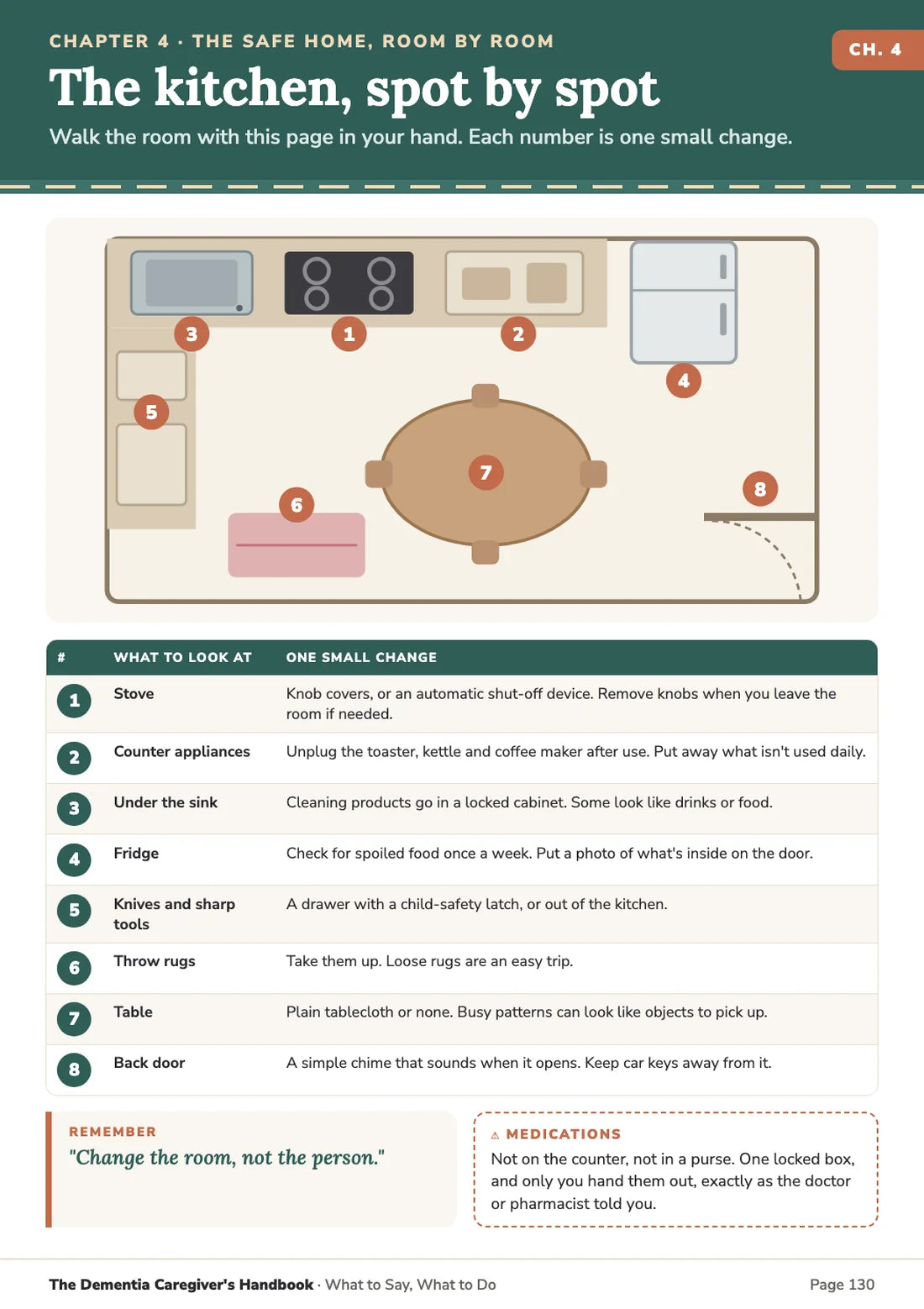
Walk the house with the book in your hand.
Each room drawn from above, with numbered spots and one small change for each. No remodeling: latches, lights, chimes and moving a few things.
- Kitchen, bathroom, bedroom, stairs, doors and the garage
- Stove, water temperature, cleaning products, medications
- Night lighting and a clear path to the bathroom
- Doors and a plan for wandering
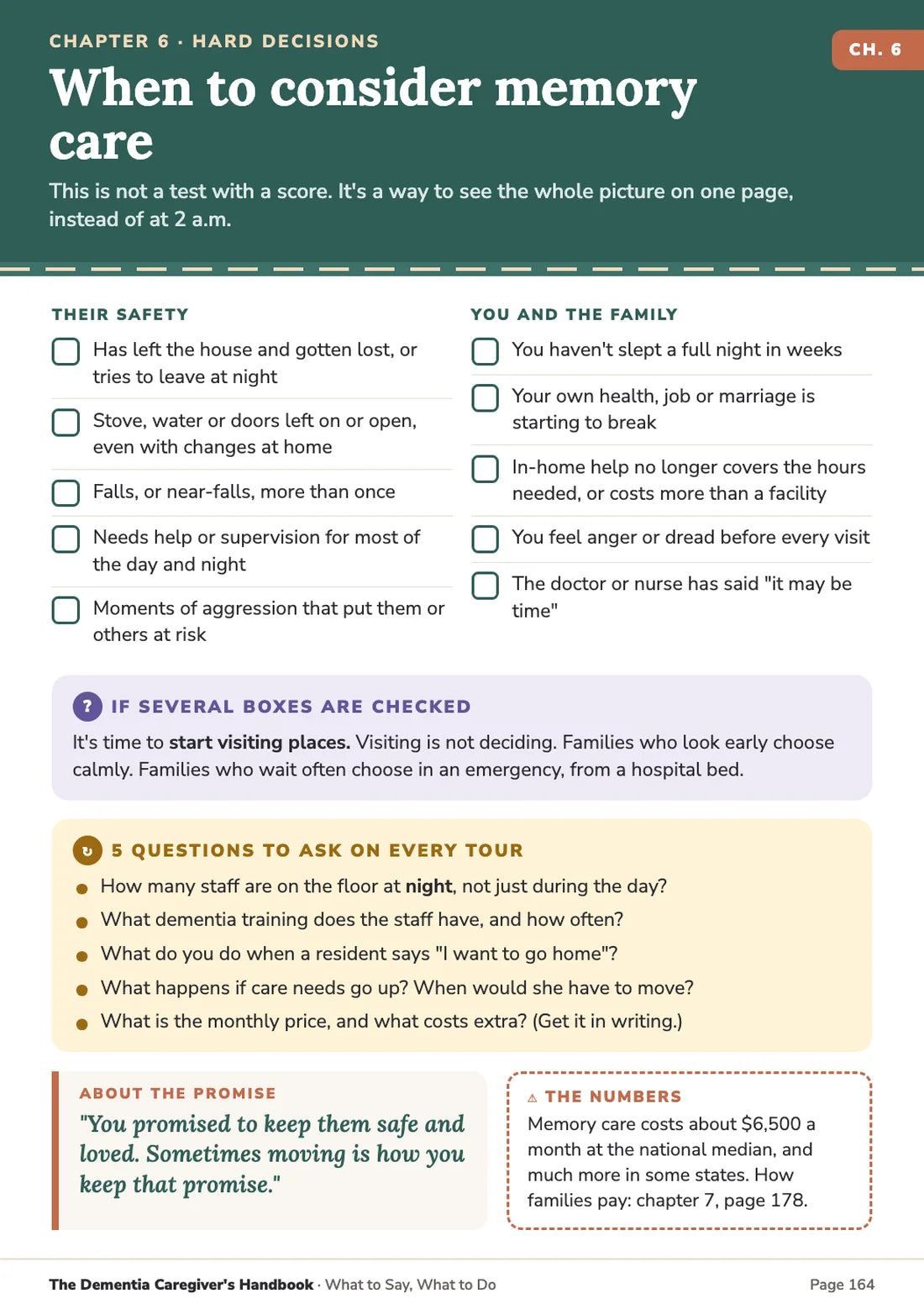
The big decisions, as checklists.
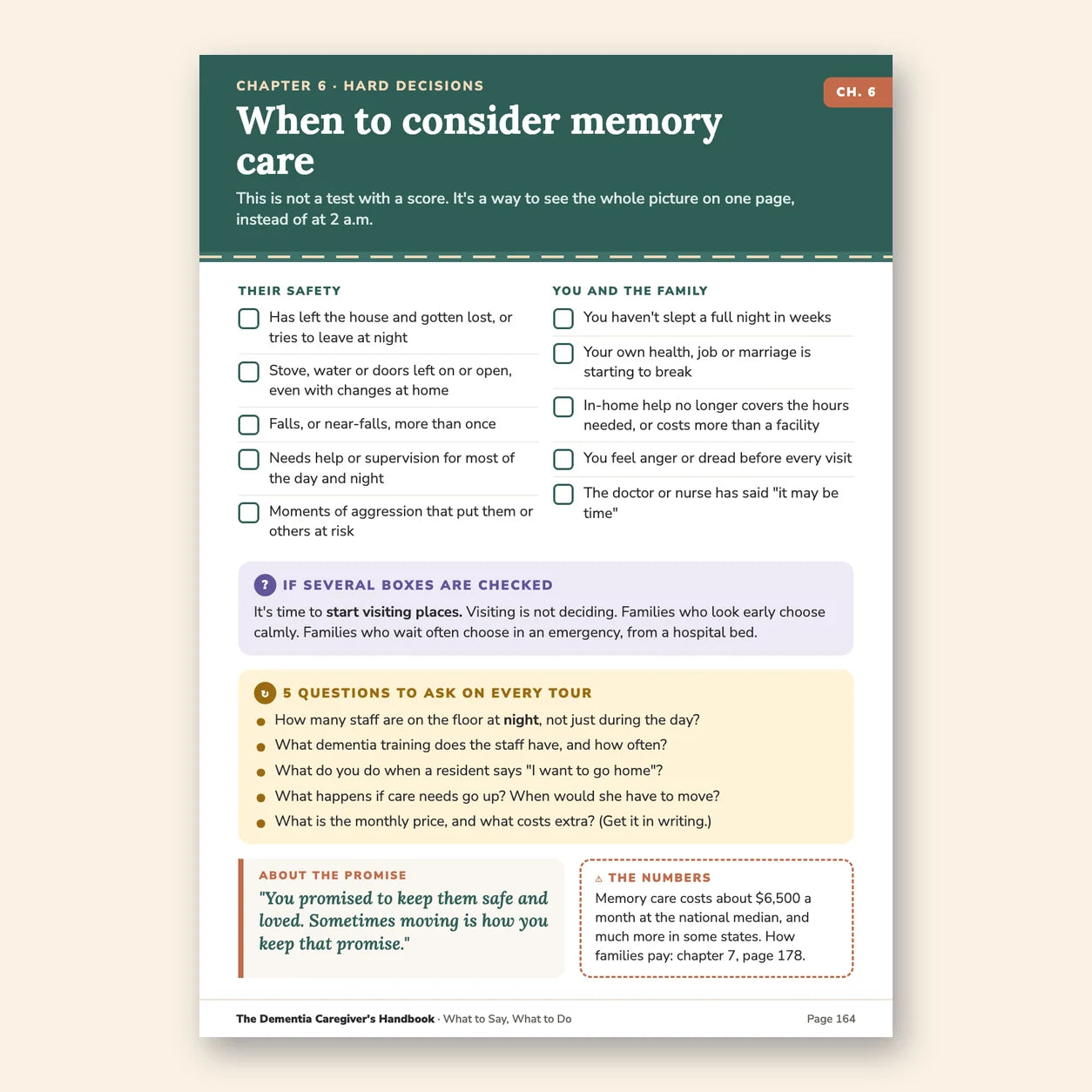
Driving, memory care, hospital stays and hospice. Not someone telling you what to do, but the whole picture on one page, so you can decide calmly and without guilt.
- When to consider memory care, and what to ask on every tour
- Talking about the car keys
- The hospital bag and what to tell the staff
- Hospice and comfort care: what it is, questions for the doctor
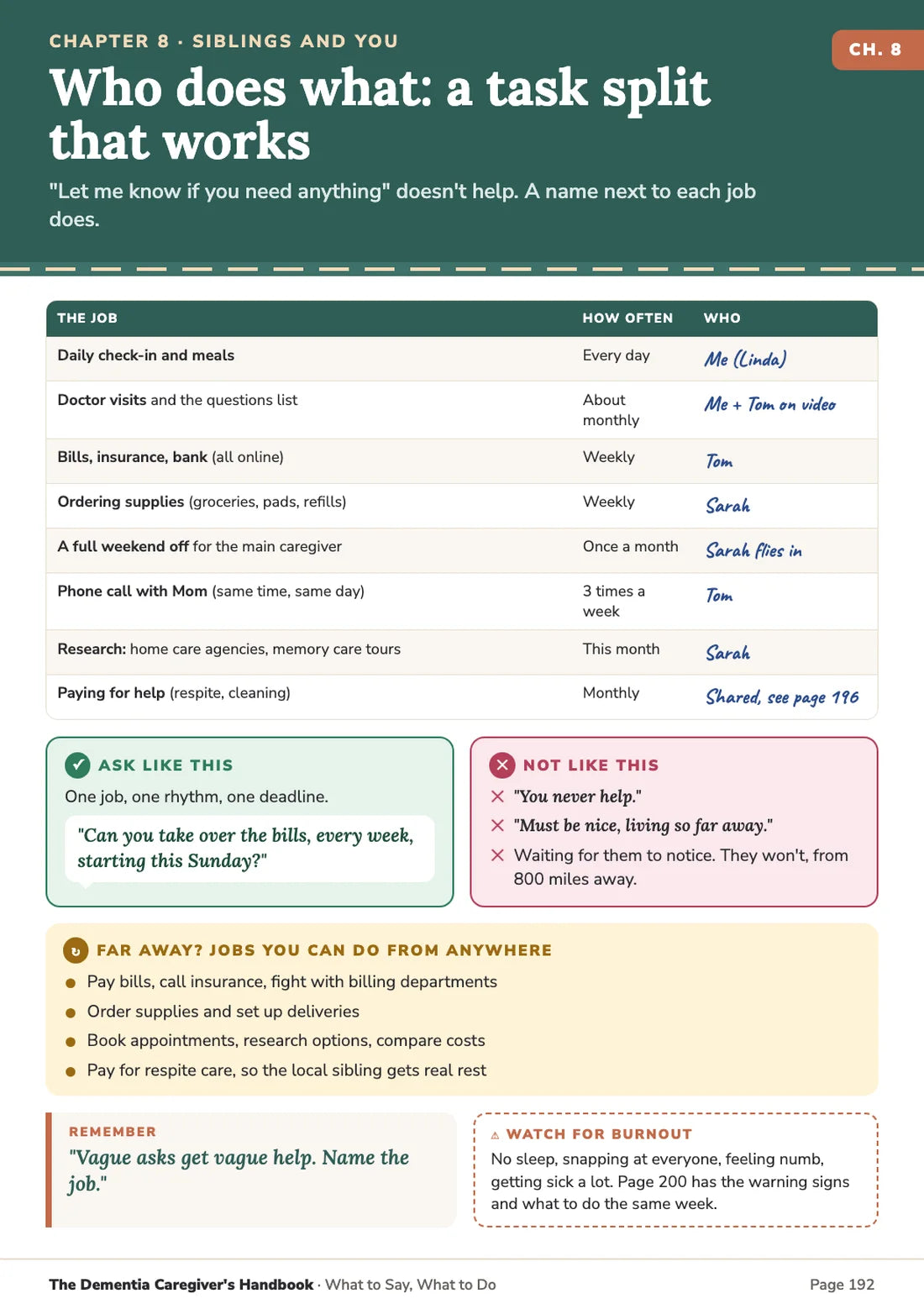
The money questions and the family table.
How families usually pay for care, explained simply, with the questions to bring to an elder-law attorney. Then the hardest conversation of all: who does what.
- Memory care costs about $6,500 a month at the national median: how families plan for it
- Medicare, Medicaid, long-term care insurance, VA benefits: the basics and the questions to ask
- A task-split sheet and a family meeting plan
- Burnout: the warning signs and how to ask for help

Ten minutes with a cup of tea. Ready for tonight.
You don't need to read 240 pages first. Open the moment you're facing, read one page, and try the words the next time it happens.
- Built on the communication approach taught in dementia care
- Warm, honest, no judgment: exhaustion and guilt are part of it
- Facts checked against the Alzheimer's Association 2026 report
The handbook families wish they'd had on day one.
Full table of contents
On your phone, on the kitchen table, or both.
Full-color PDF, instantly
Open it on your phone, tablet or computer, and search it in seconds. The binder pages are included as a printable PDF.
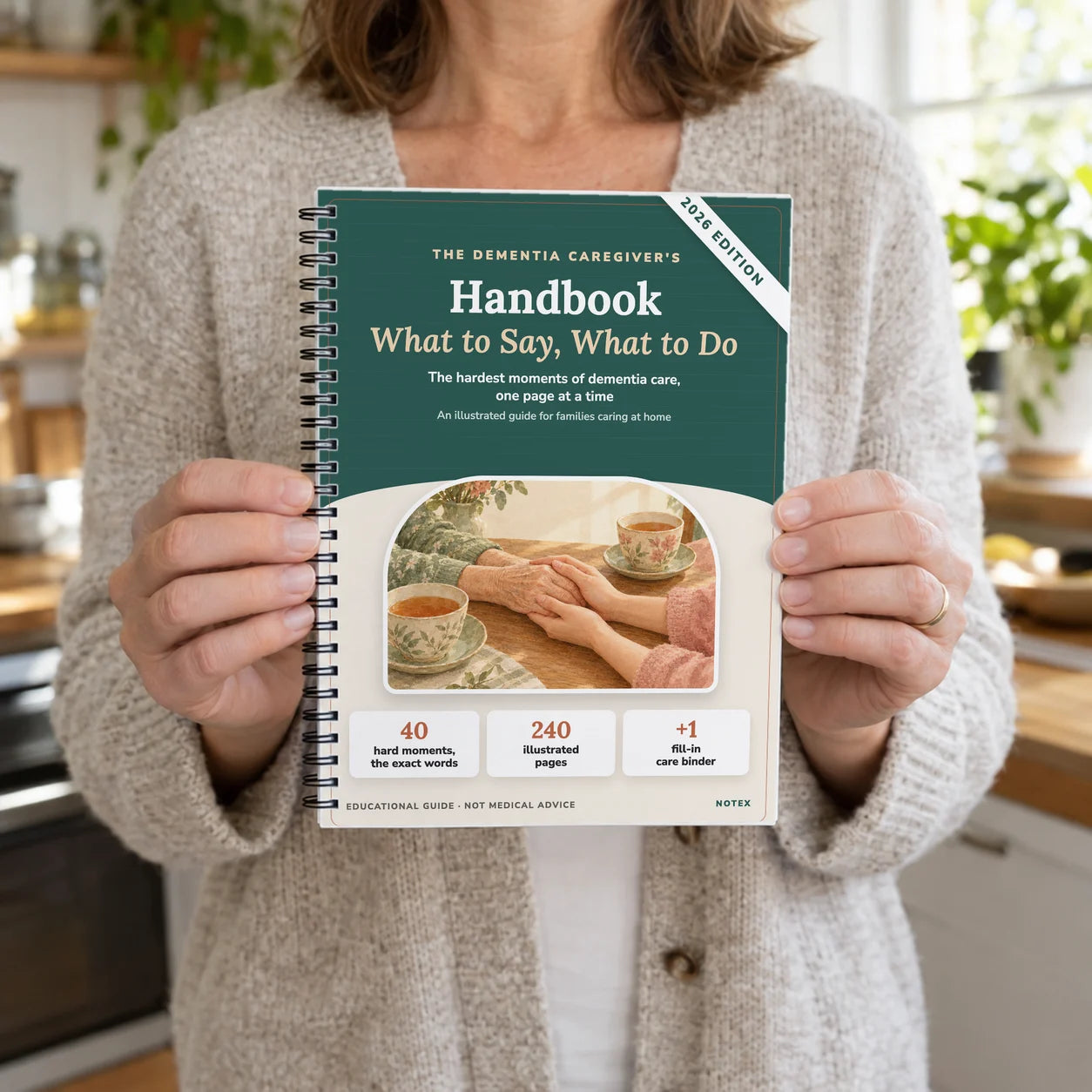
240 pages that lie flat
Stays open on the counter while you cook or talk. Free shipping in the US, about 5 to 8 business days. Want both? Printed + eBook for $64.99.
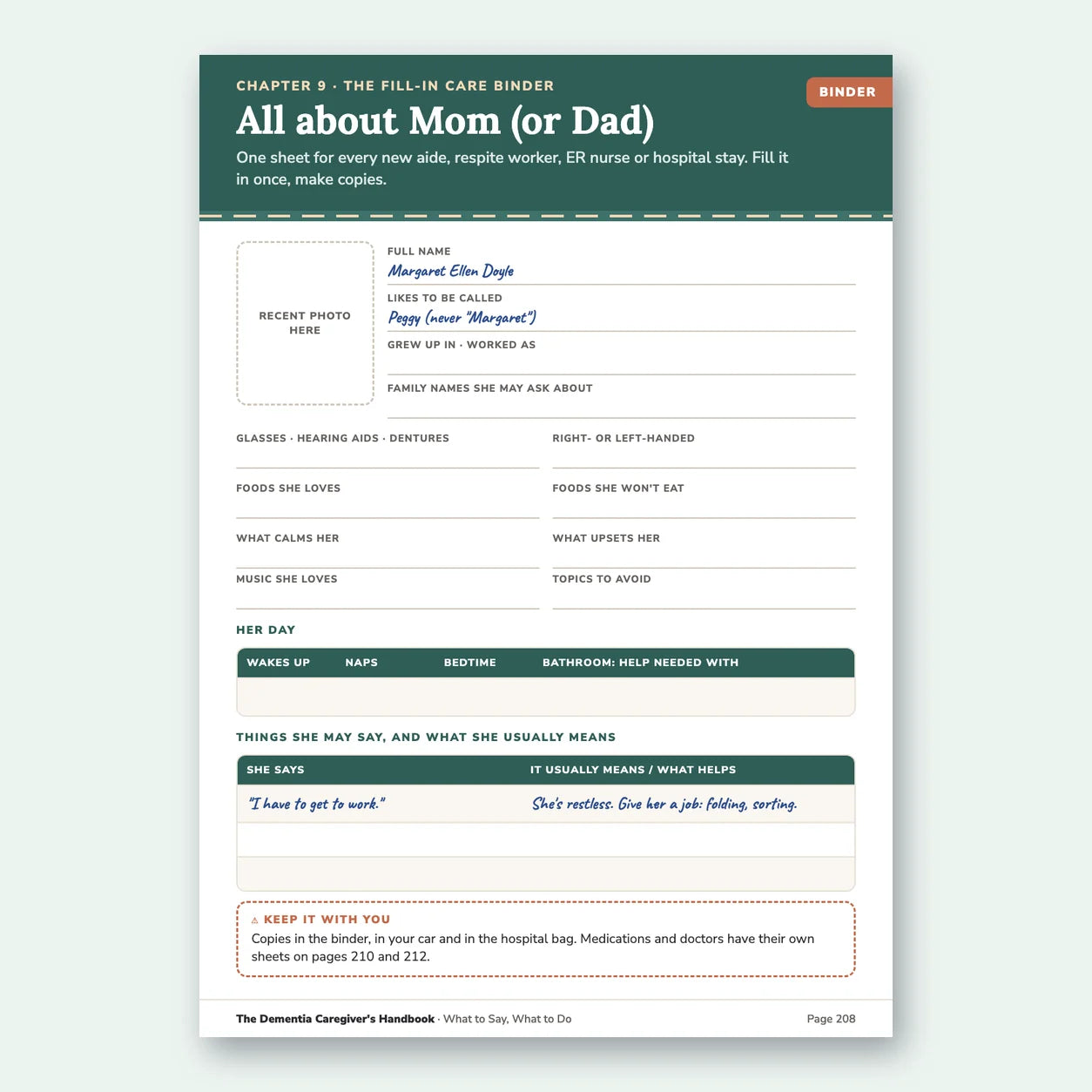
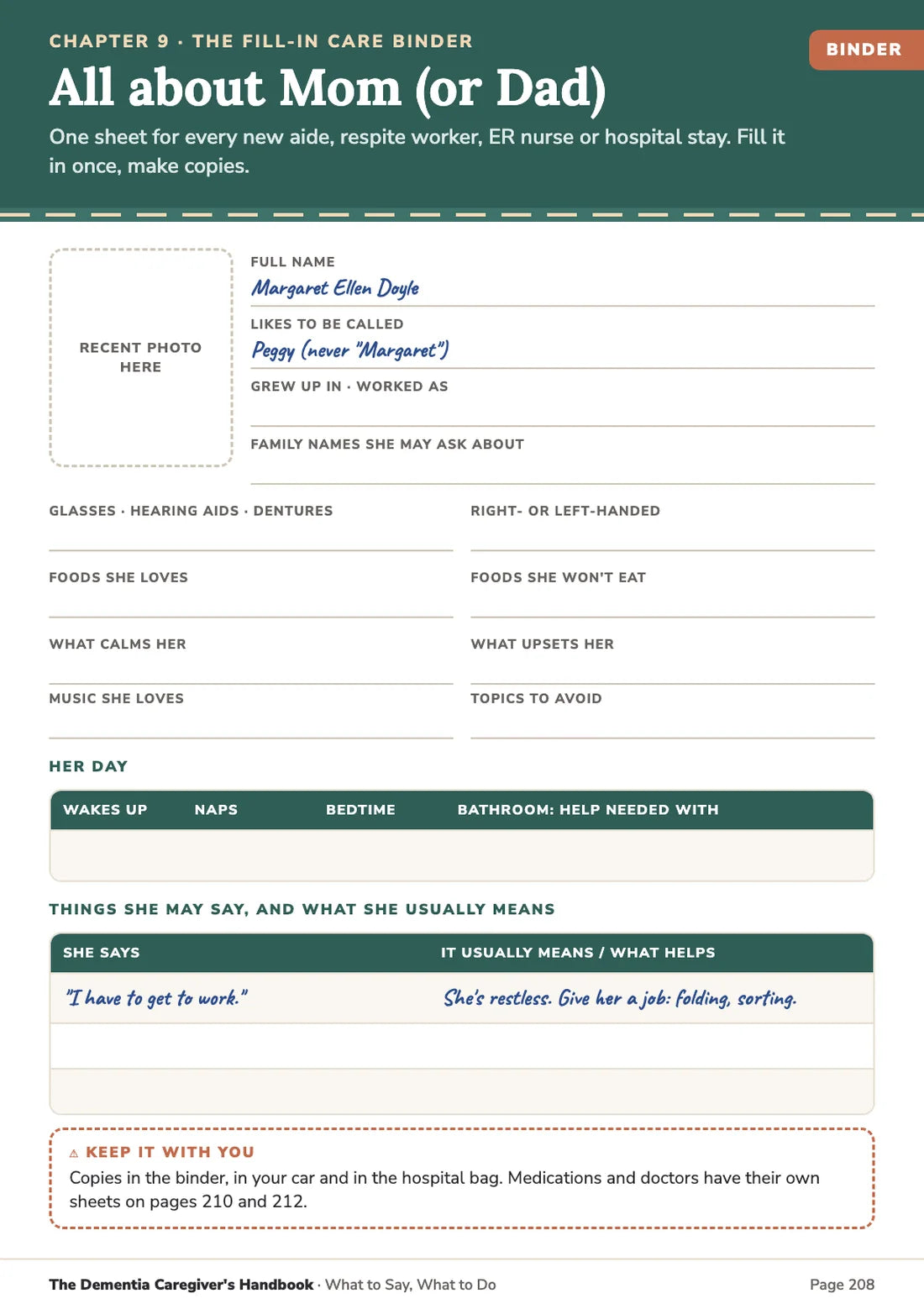
The binder pages, ready to print again.
Medication lists change. Aides change. Hospital stays happen. With the PDF you print a fresh sheet whenever you need it, and keep copies in the car and the hospital bag.
- "All about Mom (or Dad)" for aides and hospital staff
- Medications, doctors, insurance, emergency contacts
- Behavior log to bring to the doctor
- Included with the eBook and with Printed + eBook
See 10 real pages, free.
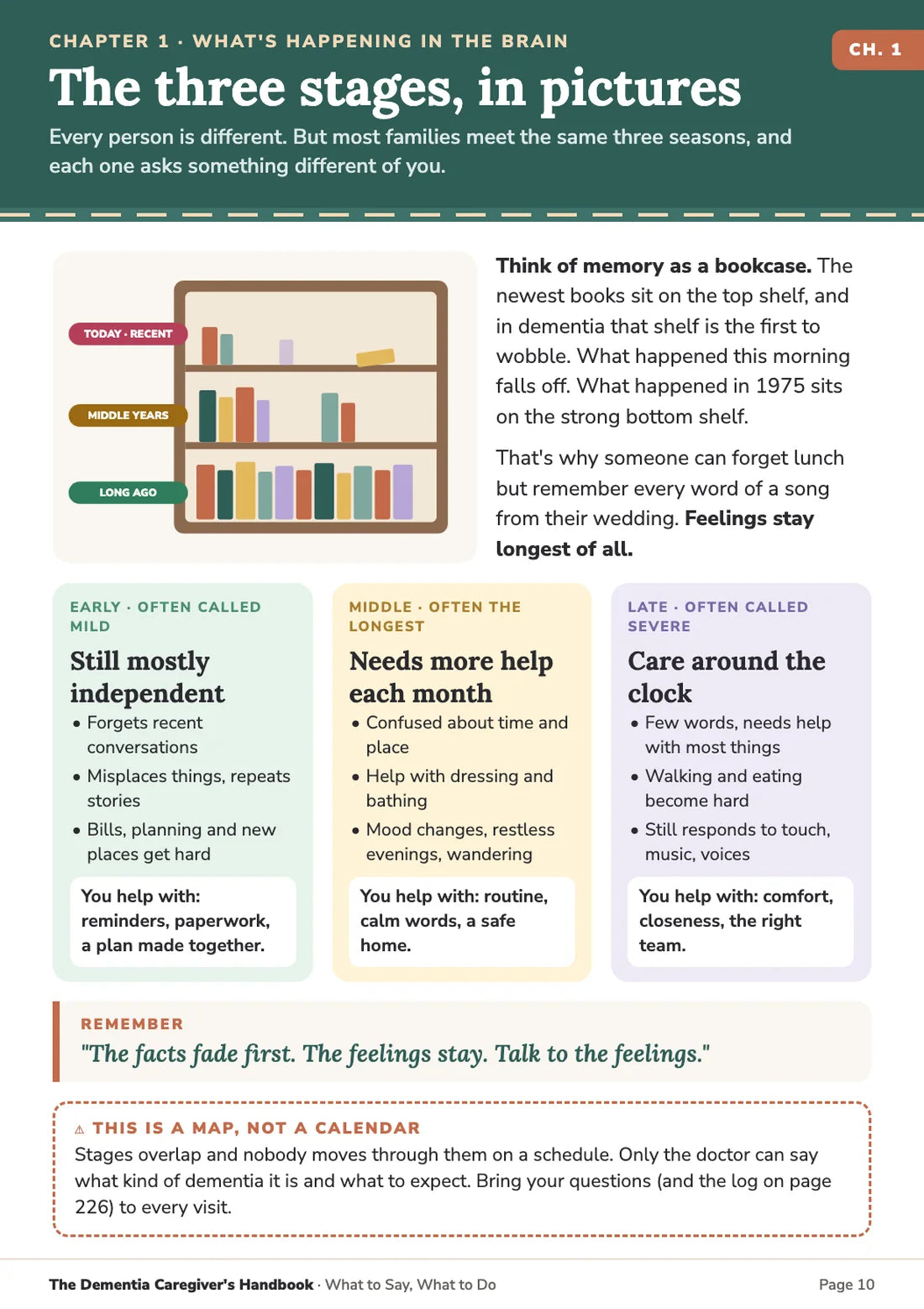
The three stages, five hard moments (the same question, "I want to go home," "you stole my wallet," the evening hours, the shower), the kitchen safety map, the memory care checklist, the sibling task split and the "All about" binder sheet. Read them, then decide.
See the 10 pages ↓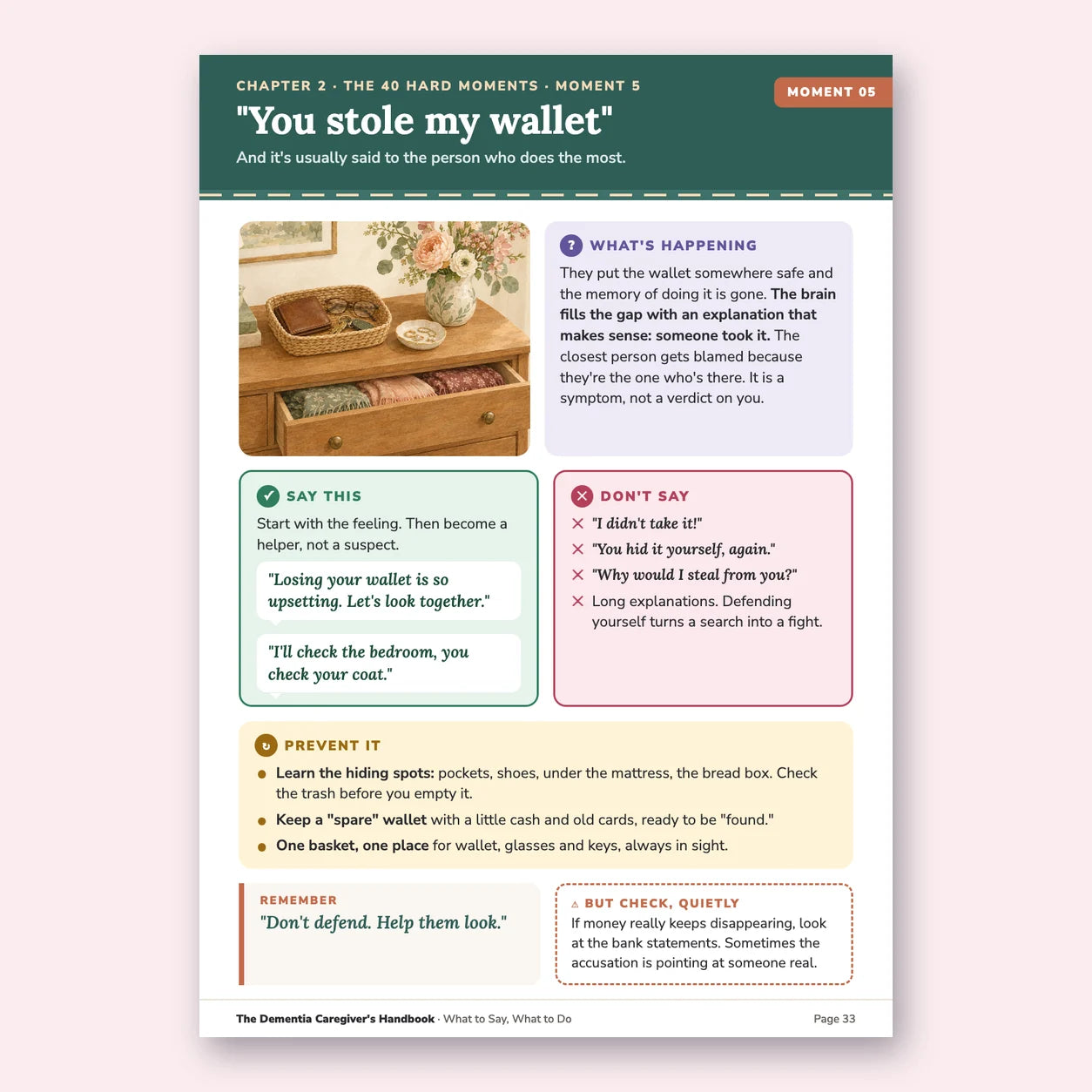
How is it different?
| What it has | This handbook | Free articles online | Text-only caregiver books | Printable planners |
|---|---|---|---|---|
| The exact words for each hard moment, and what not to say | ✓ (40 moments) | Scattered | Varies | ✗ |
| Illustrated, one moment per spread | ✓ | ✗ | Mostly text | ✗ |
| Bathing, toileting and incontinence step by step | ✓ | Varies | Varies | ✗ |
| Memory care checklist and money questions | ✓ | Varies | Varies | ✗ |
| Fill-in care binder | ✓ | ✗ | ✗ | ✓ |
| Lies flat on the table | ✓ Spiral-bound | — | Rarely | You print it |
| Price | From $29.99 | Free | About $10 to $25 | Varies |
You can start tonight.
Check out
Secure payment, no account needed, no subscription. One payment.
Open the eBook
If you chose the eBook, the download link arrives by email. Open it on your phone or computer and go straight to the moment you need.
The book arrives
If you chose the spiral-bound book, it ships free to any US address.
Everything in one place, for the long road.
- 240 illustrated, full-color pages in 9 chapters
- 40 hard moments: what's happening, what to say, what not to say, how to prevent it
- Bathing, toileting and incontinence, step by step
- The safe home, room by room, and a day that works
- Memory care, driving, hospital and hospice, as checklists
- How families pay for care, with questions for an elder-law attorney
- Siblings: a task split and a family meeting plan
- 36-page fill-in care binder (printable PDF with the eBook)
- Printed book: free shipping in the US
What families ask before buying
Is this medical advice?
No. It's an educational guide about everyday care and communication. It doesn't diagnose, doesn't recommend medications or doses, and doesn't replace the doctor. Whenever something changes suddenly, or you're worried about health or safety, call the doctor. In an emergency, call 911.
Does it work for other types of dementia, not just Alzheimer's?
Yes. The hard moments and the calm-communication approach apply to the common types: Alzheimer's, vascular, Lewy body, frontotemporal and mixed dementia. Each type can bring its own changes, so ask the doctor what to expect for the person you care for.
Is it for paid caregivers and home aides too?
Yes. Many of the pages work as a shared playbook: when the family and the aide use the same words, the person hears the same calm answers. The "All about Mom (or Dad)" sheet is made to hand to anyone new.
Will it make the difficult behaviors stop?
Honestly, nobody can promise that. Dementia changes over time. What the book gives you is a calmer way through each moment, routines that often make the hard moments less frequent, and a clear signal for when to call the doctor.
The diagnosis is new. Is it too early?
It's a good time. Start with chapter 1 (the stages), set up the binder while everyone can still help fill it in, and read the money chapter early, when there's still time to plan.
Does it tell me how to pay for memory care or Medicaid?
Chapter 7 explains the basics of how families usually pay for care and gives you a list of questions for an elder-law attorney and for the facility. It's general information, not legal or financial advice: rules change by state.
Who made it? Is it official?
It's an independent handbook from NOTEX, built on the communication approach commonly taught to families and care staff, with facts checked against the Alzheimer's Association 2026 Facts and Figures report. It is not affiliated with or endorsed by the Alzheimer's Association or any government agency.
I live far away. Is it useful for me?
Yes. Read the moments to use the same words on the phone and during visits, and use chapter 8 to take real jobs off the main caregiver: bills, insurance, supplies, research, paying for respite.
Why spiral-bound?
It lies flat on the counter or the kitchen table, so you can read the right page while you're in the middle of the moment. The binder pages are easy to write on.
When will the printed book arrive?
It ships free to any US address and usually arrives in about 5 to 8 business days. The eBook arrives by email right after payment.
Can I read it on my phone?
Yes. The eBook is a full-color PDF: open it on your phone, tablet or computer, and print any page you need.
What if it's not for me?
You have a 30-day guarantee. Write to us within 30 days and we'll refund you. No questions, no forms.
Be ready for the next hard moment.
240 illustrated pages, 40 hard moments word for word, a fill-in care binder. 30-day guarantee.
From $29.99 · eBook or printed