Someone has to settle a parent's estate.
Here's the job, step by step.
An illustrated guide for the adult child named executor or administrator in the U.S.: probate, the estate account, creditors and debts, taxes and closing, in order. 208 pages with 2026–2027 numbers and the law behind each one. eBook or printed book.
The book on the desk, the PDF for the brother or sister who lives far away · $79.99
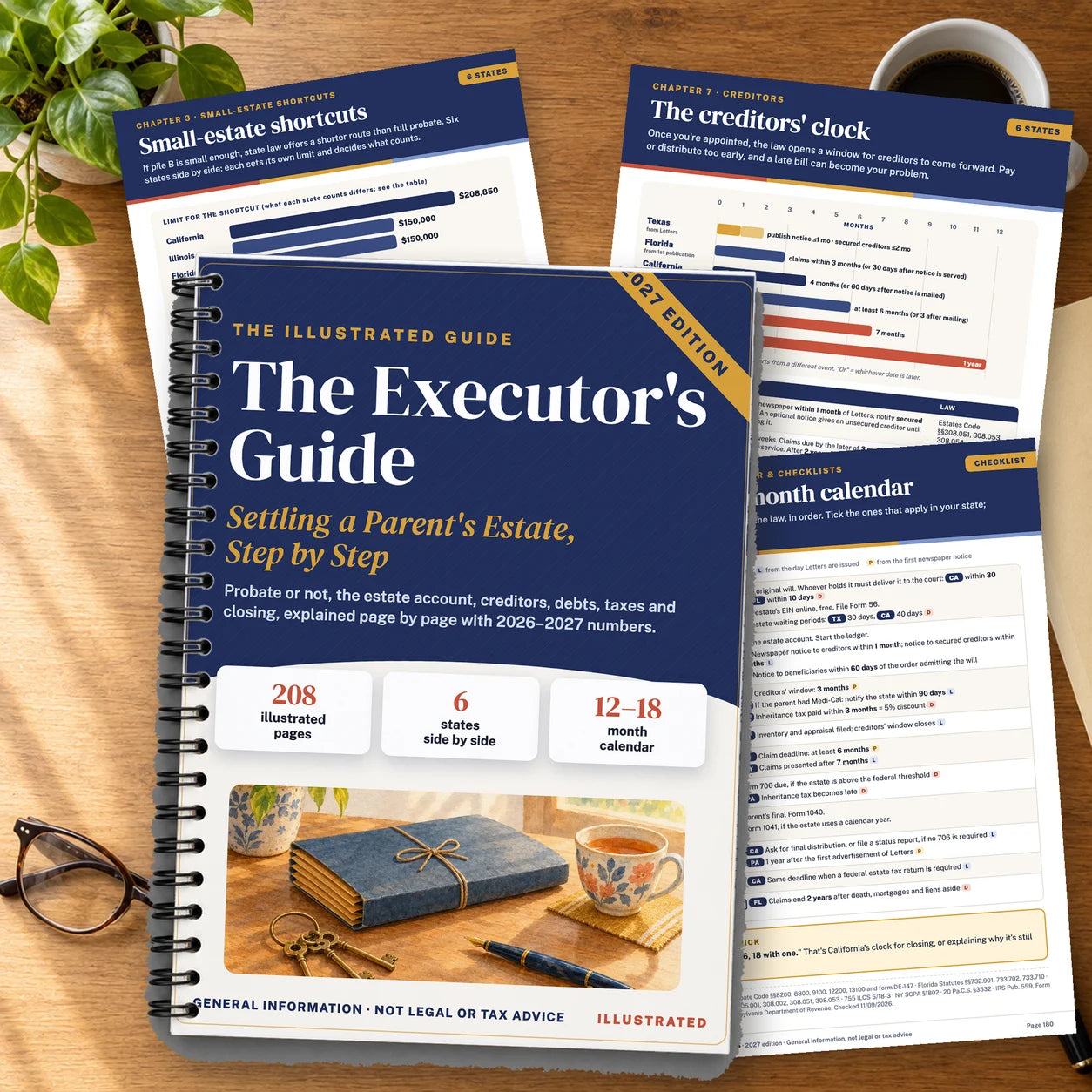
Not a wall of legal text. One task per page.
Every page works the same way, so the executor can find the rule, the deadline and the next step in two minutes, between phone calls.
This is what the pages look like.
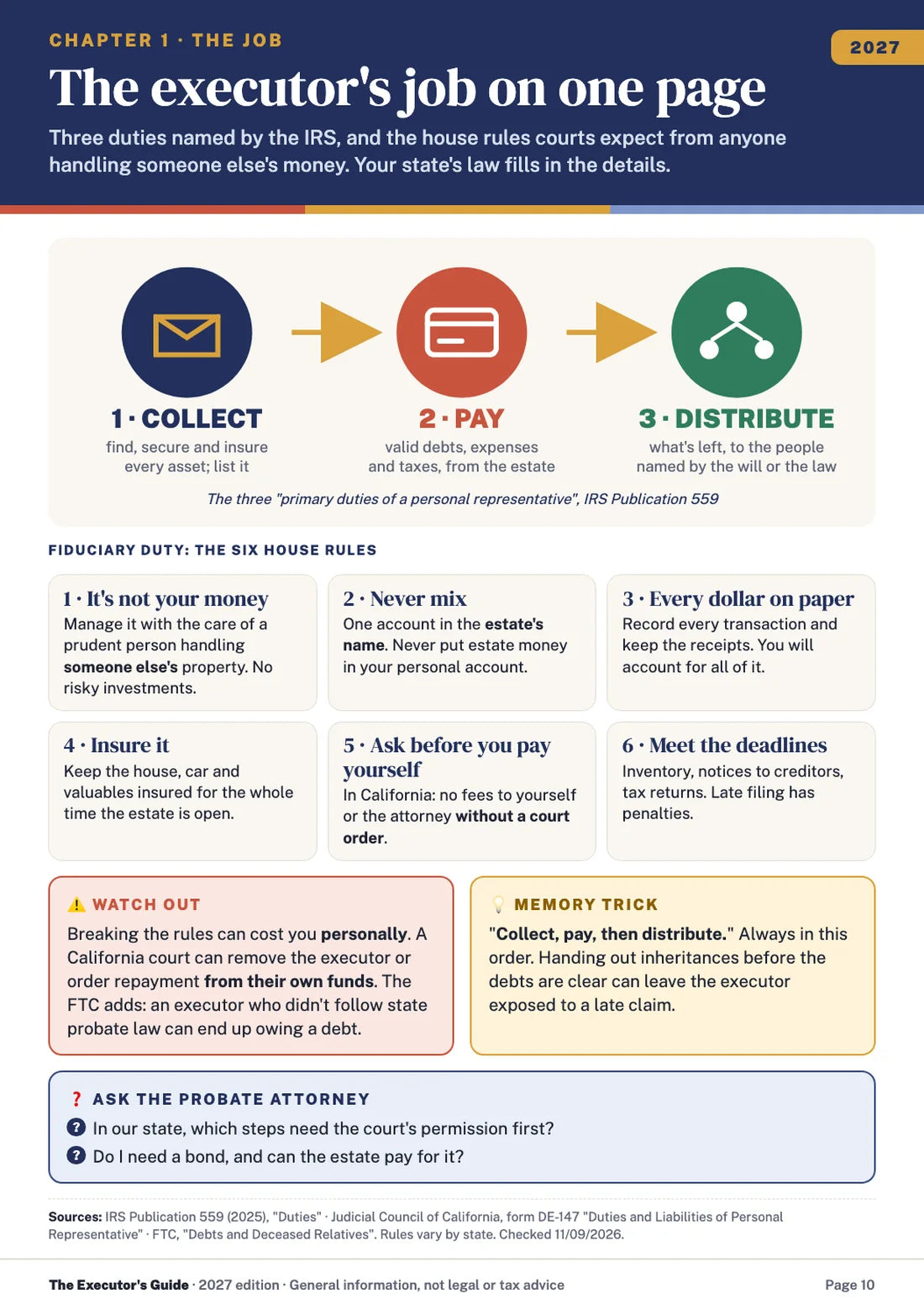
For the adult child who ends up handling the estate.
Before the first call to the court
What the job is, which assets need probate, whether a small-estate shortcut applies, and what to bring to the first meeting with an attorney.
Letters in hand
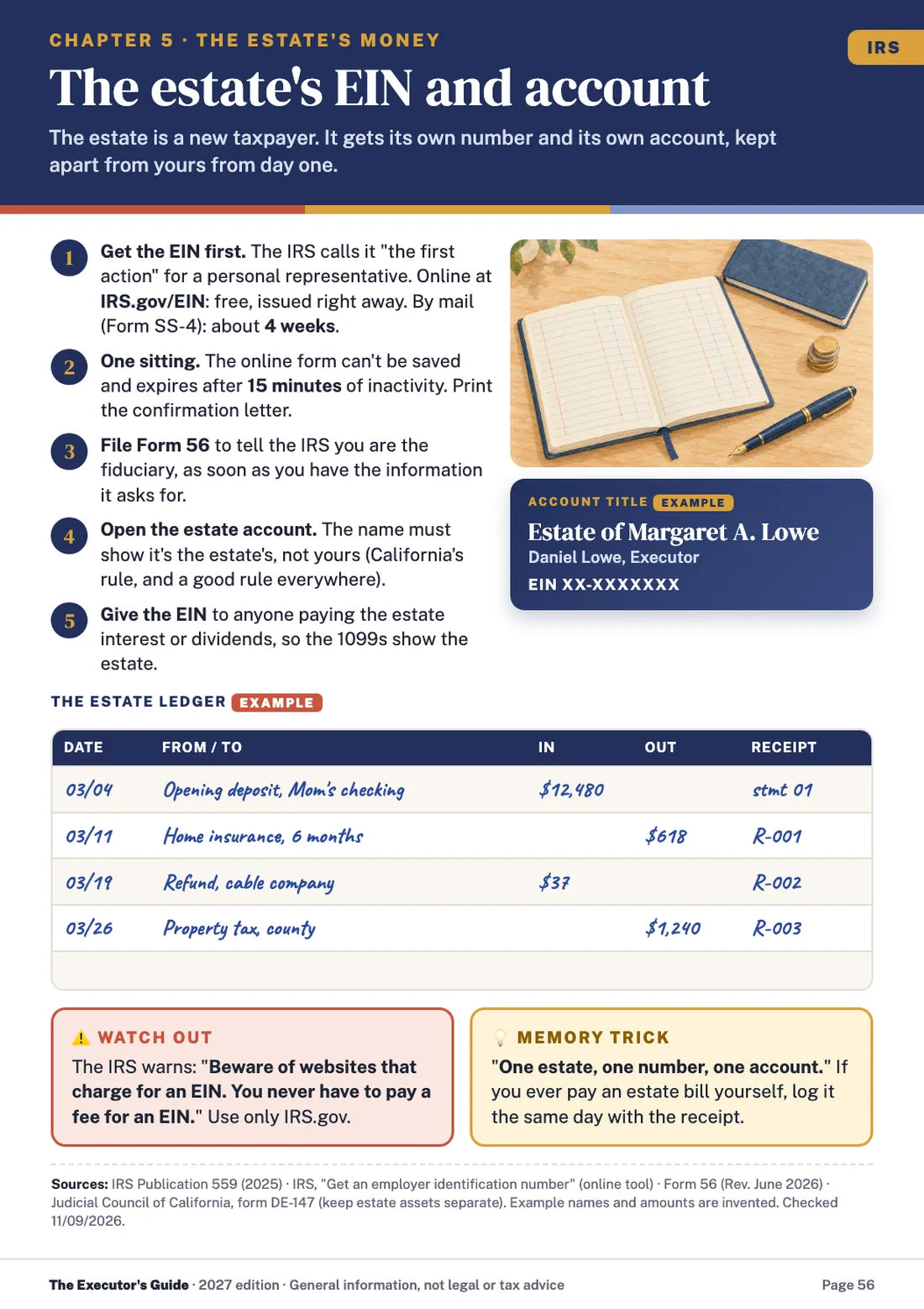
The EIN, the estate account, the inventory, the notices to creditors and the calls from collectors, in the order they come up.
Taxes, the house and closing
The four tax returns, the step-up in basis, selling or keeping the house, the executor's fee and the final distribution.
What's worth knowing before the first check is written.
These rules are written down in state law and IRS publications. The book explains each one with a diagram and the source.
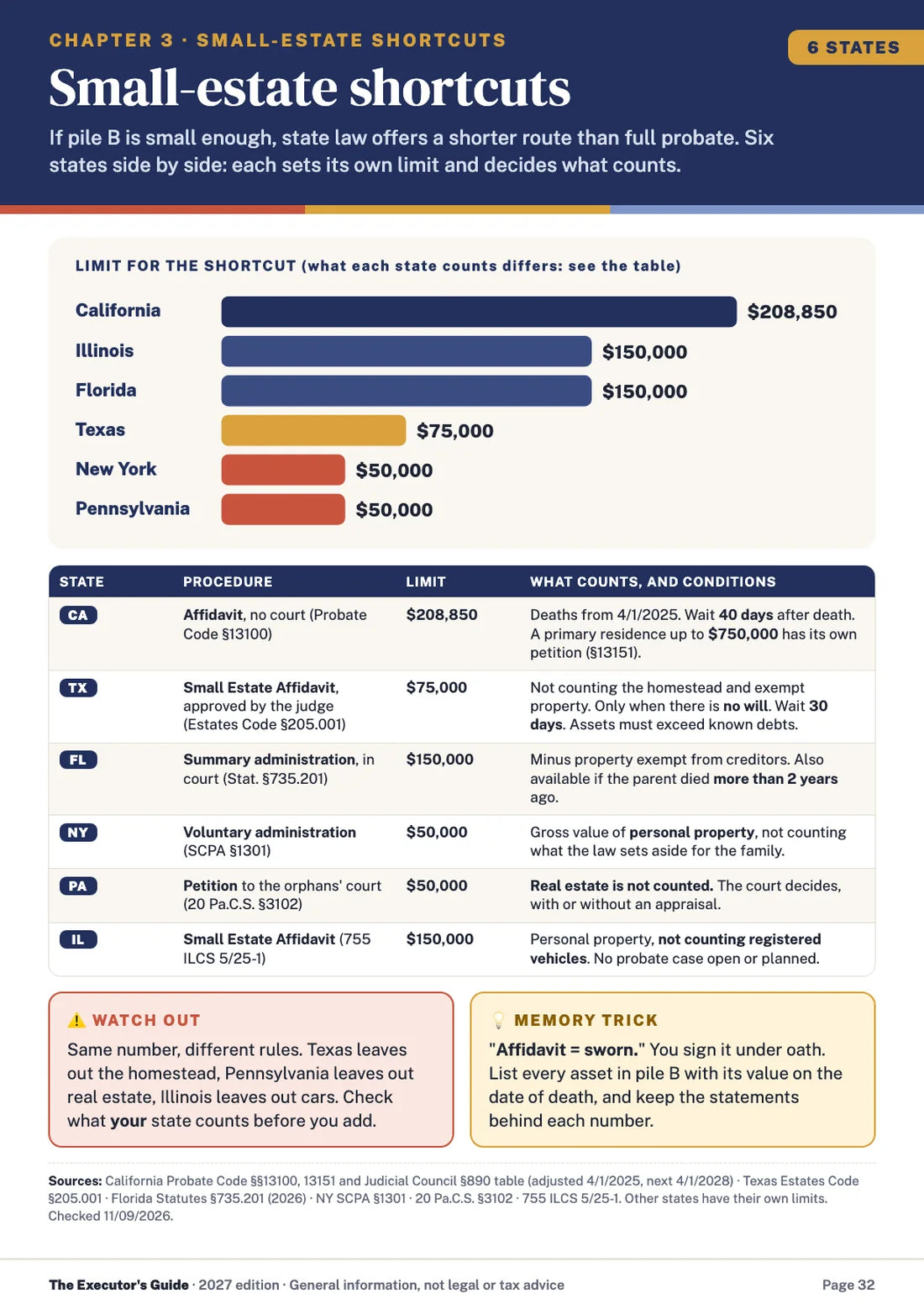
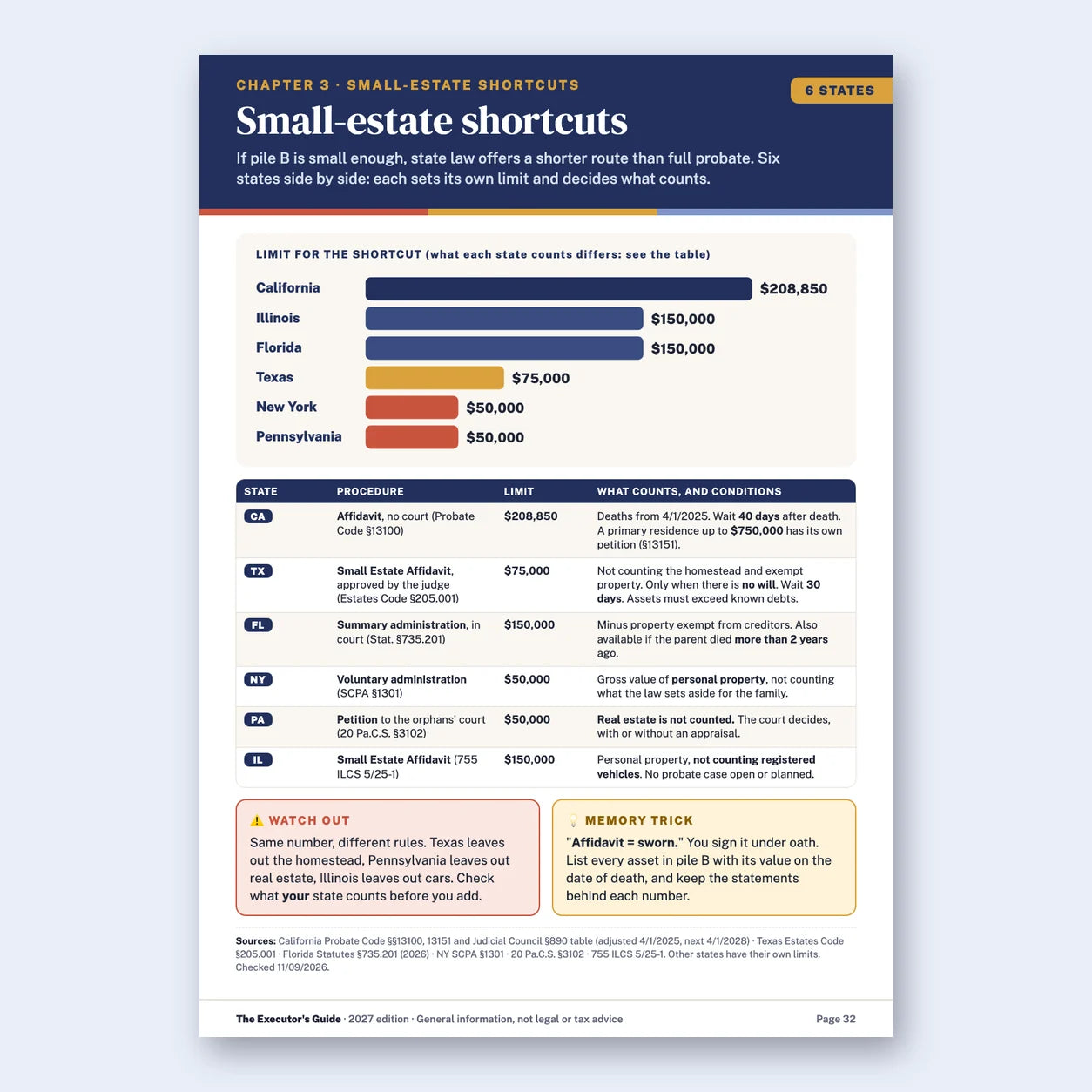
The shortcut limit isn't the same anywhere
$208,850 in California, $150,000 in Florida and Illinois, $75,000 in Texas, $50,000 in New York and Pennsylvania. And each state counts different things.
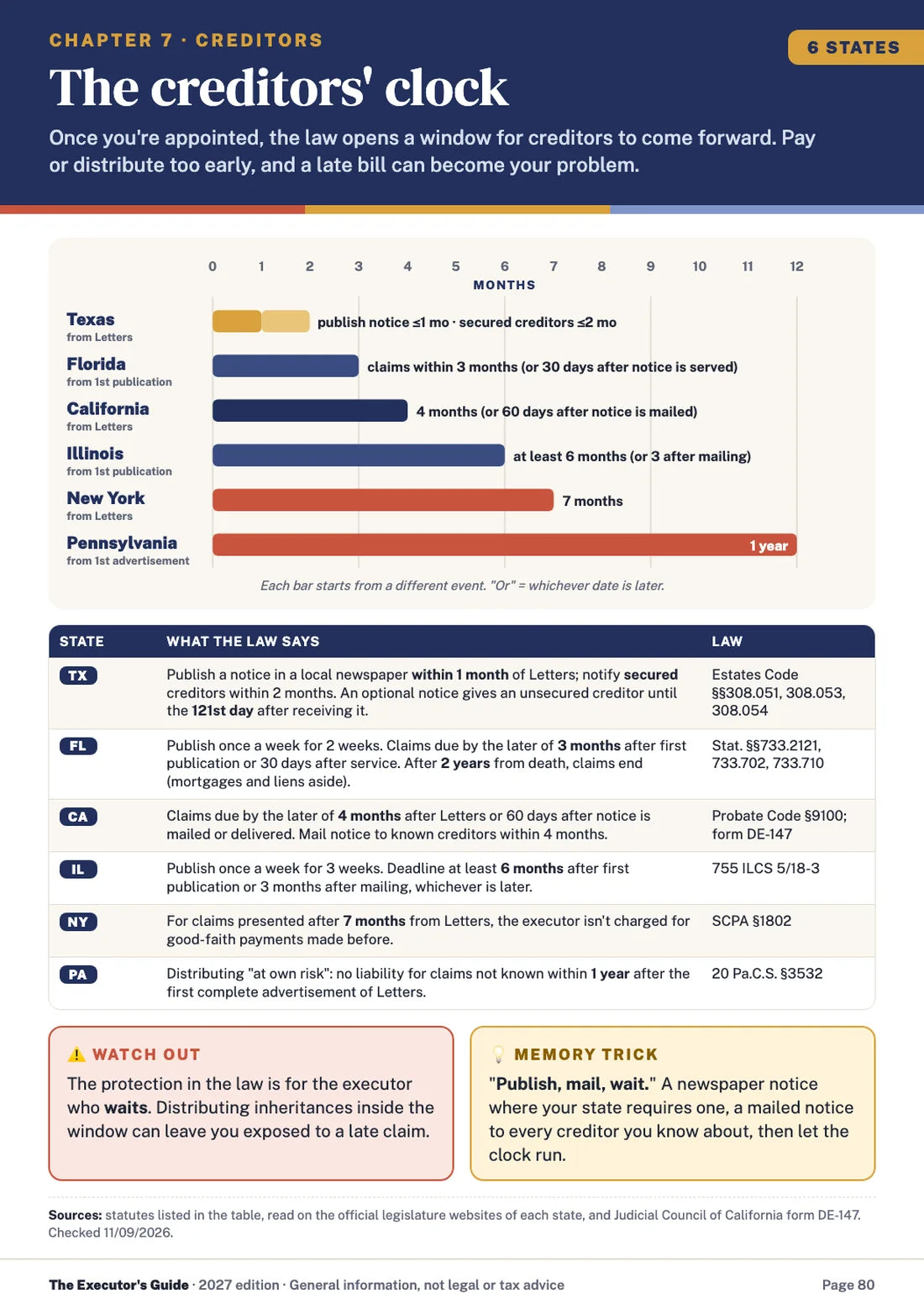
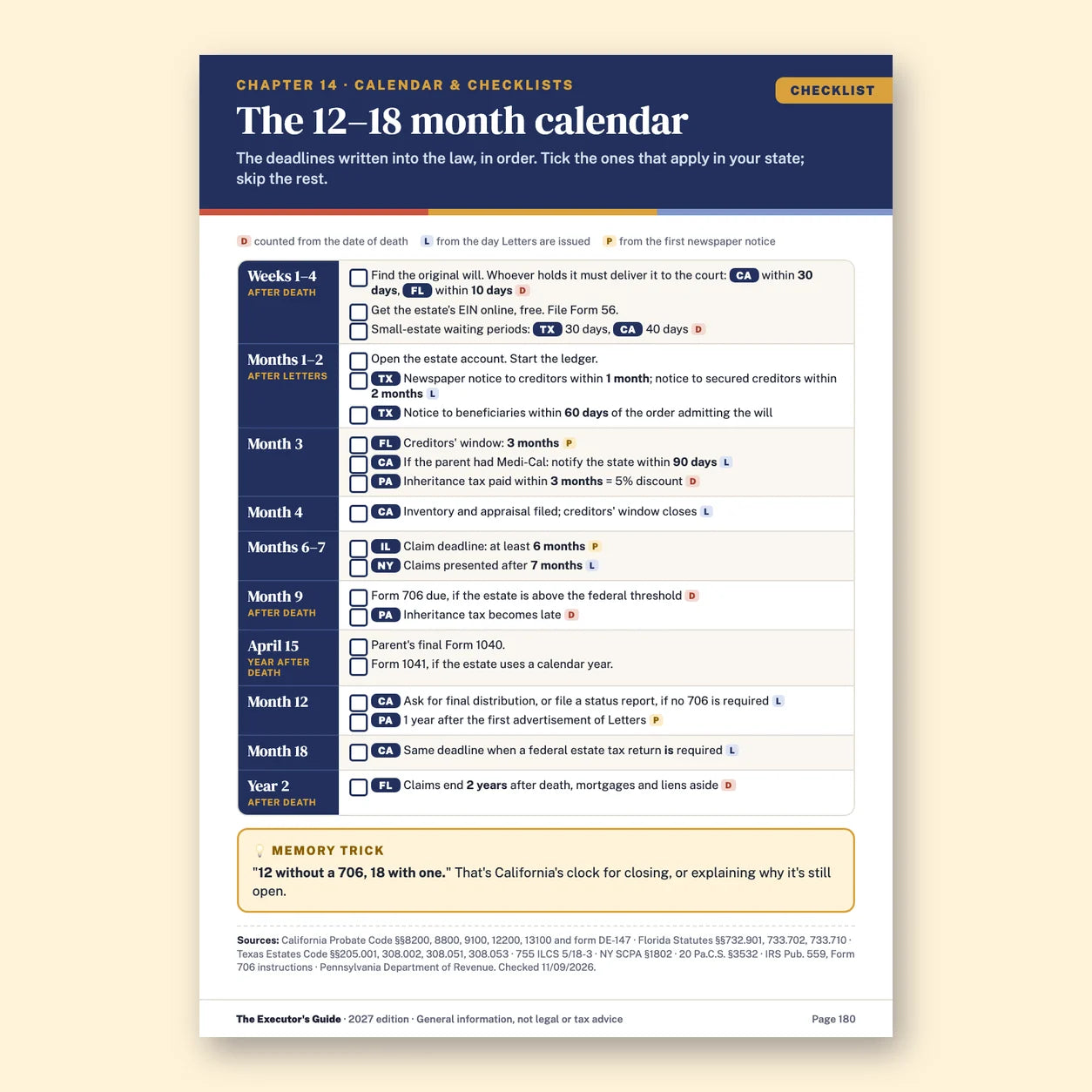
The law sets a clock
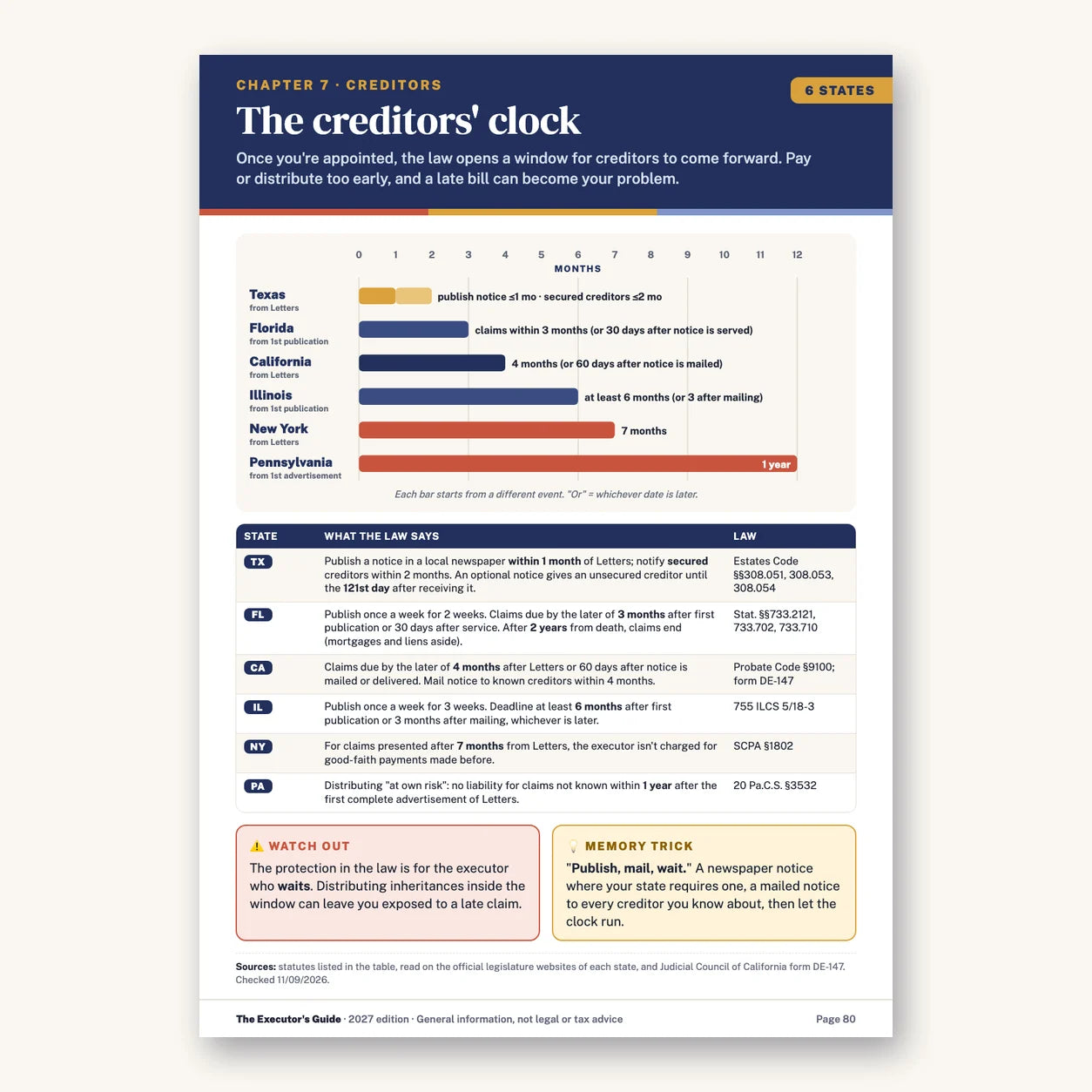
From 3 months after the first notice in Florida to 1 year in Pennsylvania. The protection in the law is for the executor who waits before handing out inheritances.
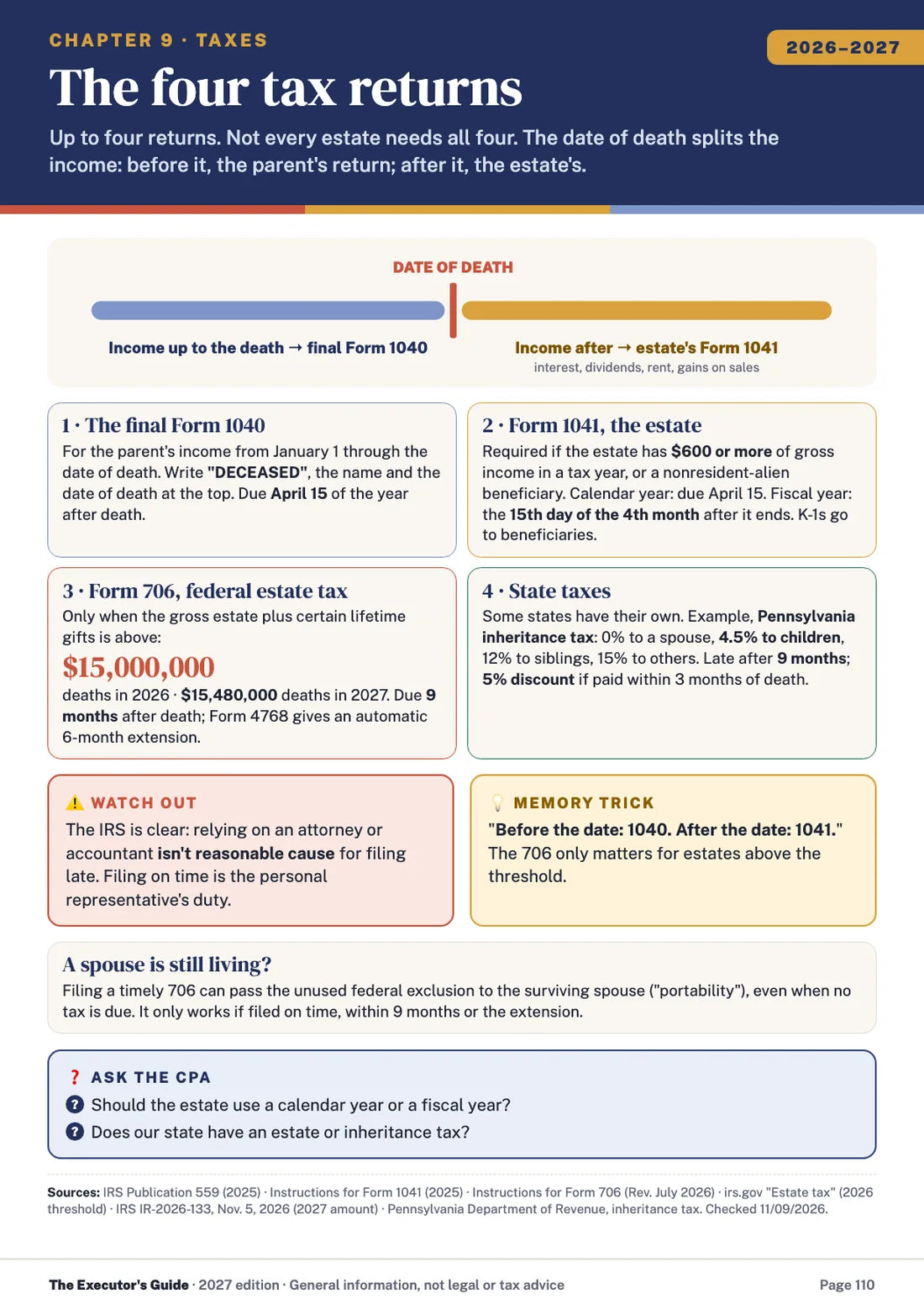
Up to four returns
The parent's final 1040, the estate's 1041 at $600 of income, the federal 706 above $15,000,000 (deaths in 2026) or $15,480,000 (2027), and some states' own taxes.
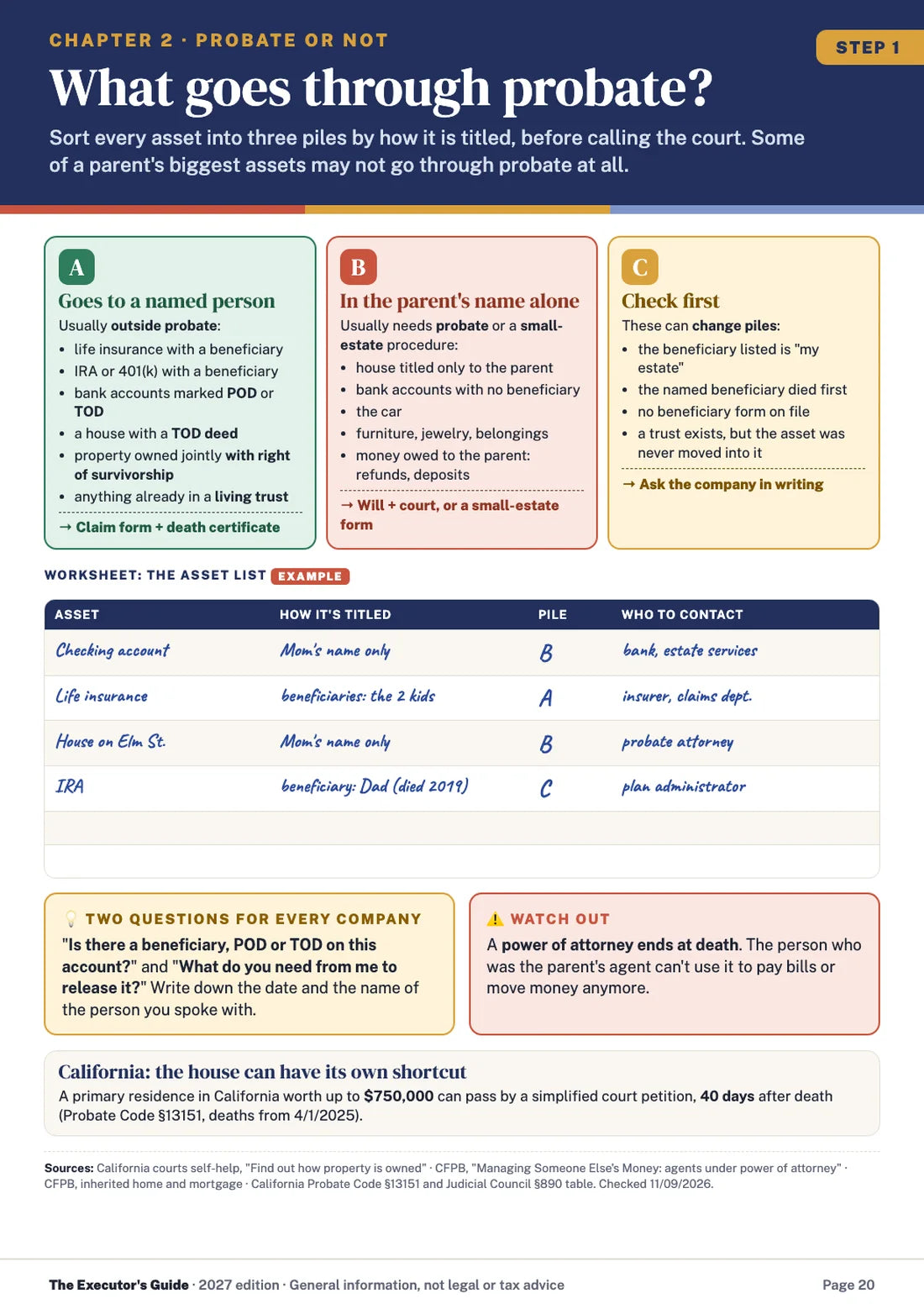
Find out if the estate needs full probate.
Sort the assets into three piles, then check the small-estate shortcut in your state.
- What usually passes outside probate: beneficiaries, POD/TOD, survivorship, trusts
- Small-estate limits in six states, with what each one counts
- California: a primary residence up to $750,000 by simplified petition
- A worksheet to list every asset and who to call
The creditors' clock, on one chart.
When notices go out, how long creditors have, and why paying too early is risky.
- Texas: newspaper notice within 1 month of Letters
- California: 4 months after Letters, or 60 days after a mailed notice
- New York 7 months, Illinois at least 6, Pennsylvania 1 year
- Florida: claims end 2 years after death, mortgages and liens aside
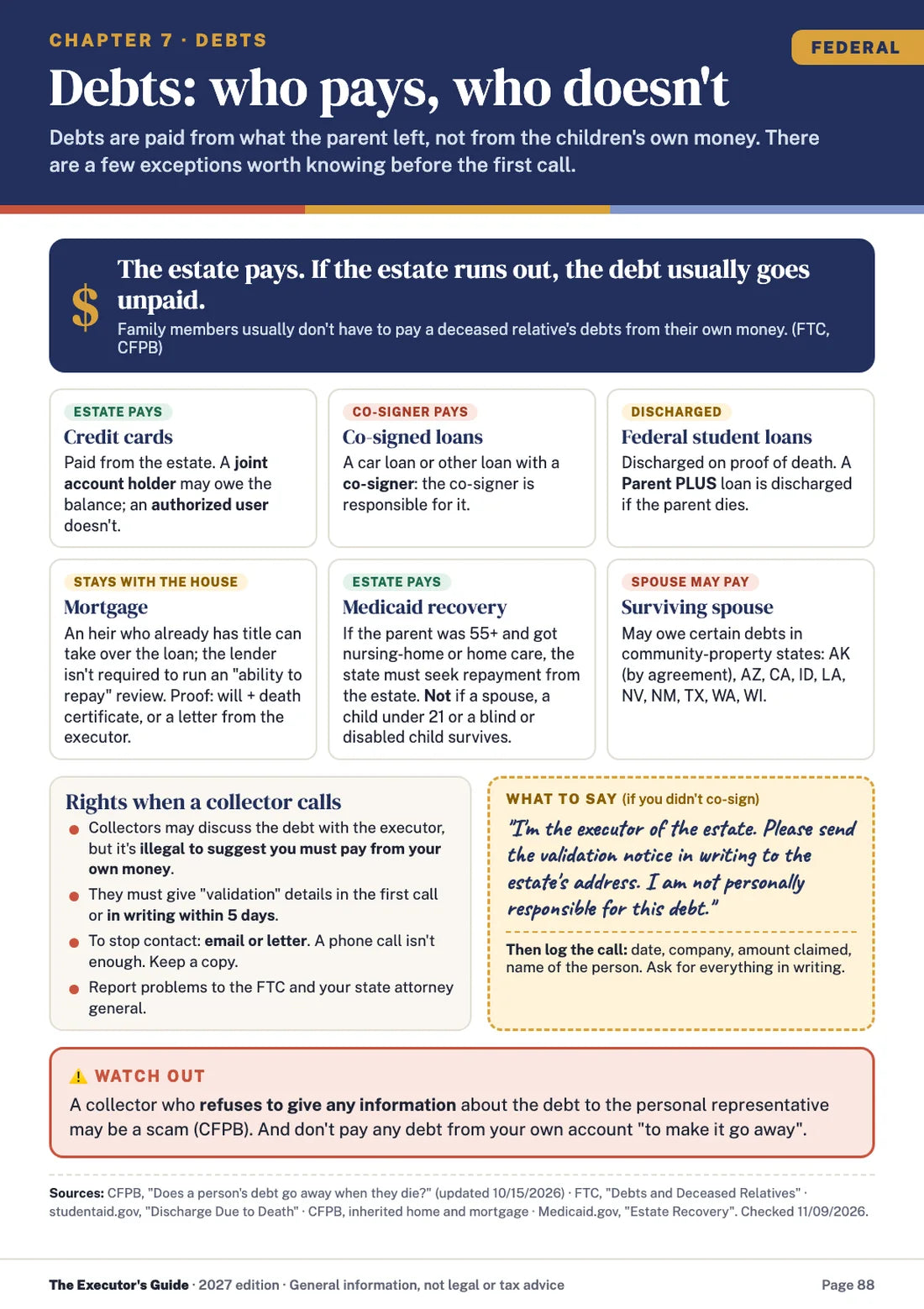
Who pays the debts, and who doesn't.
The estate pays. The exceptions, from co-signed loans to Medicaid recovery, are on one page.
- Joint account holder vs. authorized user on a credit card
- Federal student loans and Parent PLUS: discharged on proof of death
- The mortgage on an inherited house
- What collectors can and can't say, and what to answer
The four tax returns, and who files them.
The date of death splits the income. The book shows which returns apply and when they're due.
- The parent's final Form 1040, due April 15 of the year after death
- Form 1041 when the estate has $600 or more of gross income
- Form 706: $15,000,000 for 2026 deaths, $15,480,000 for 2027
- Pennsylvania inheritance tax: 4.5% for children, 5% discount within 3 months
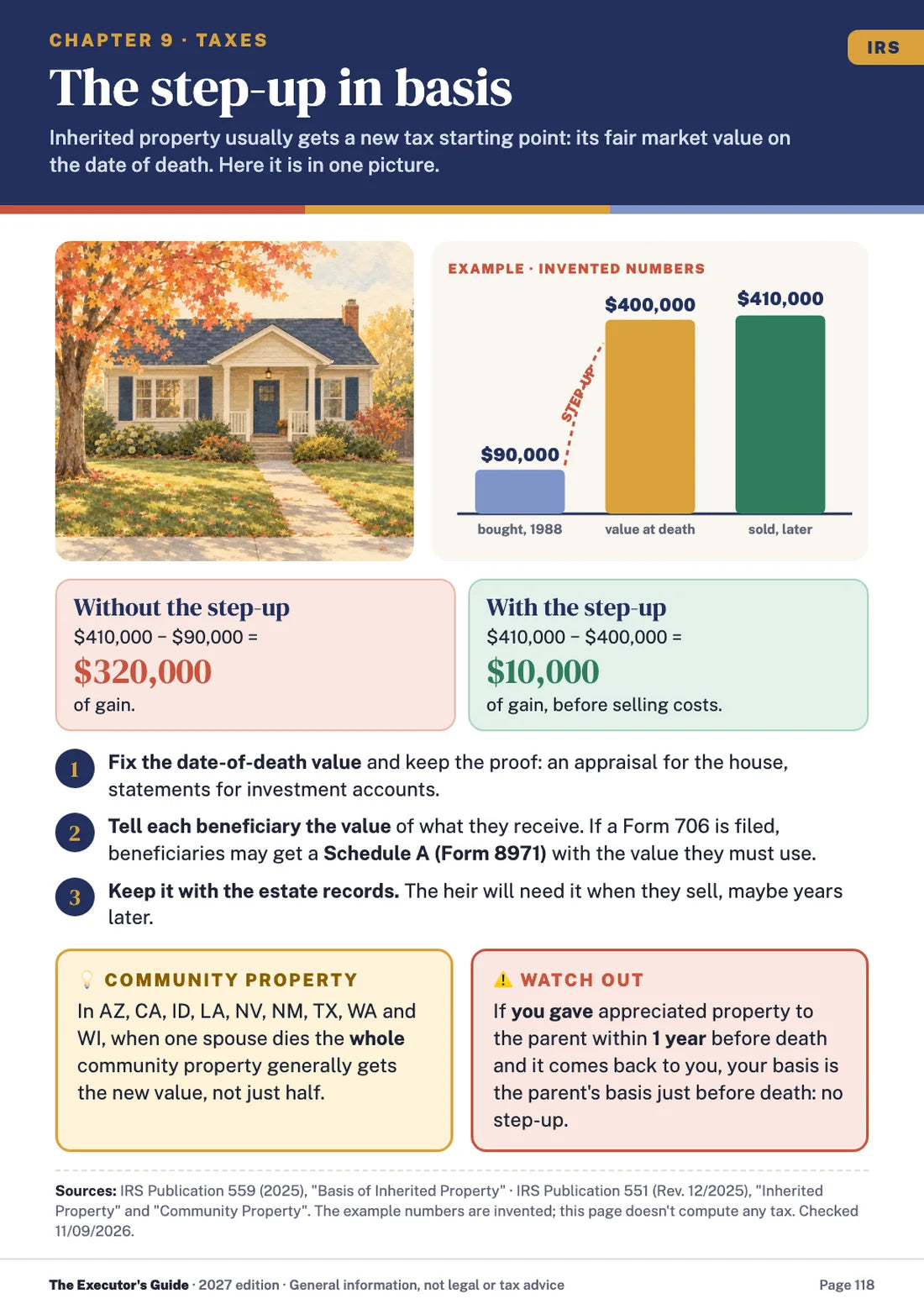
Why the date-of-death value matters when the house is sold.
Inherited property usually gets a new tax starting point. One picture shows the difference.
- What proof of value to keep, and for how long
- Community-property states: when the whole property gets the new value
- The 1-year exception for property given to the parent
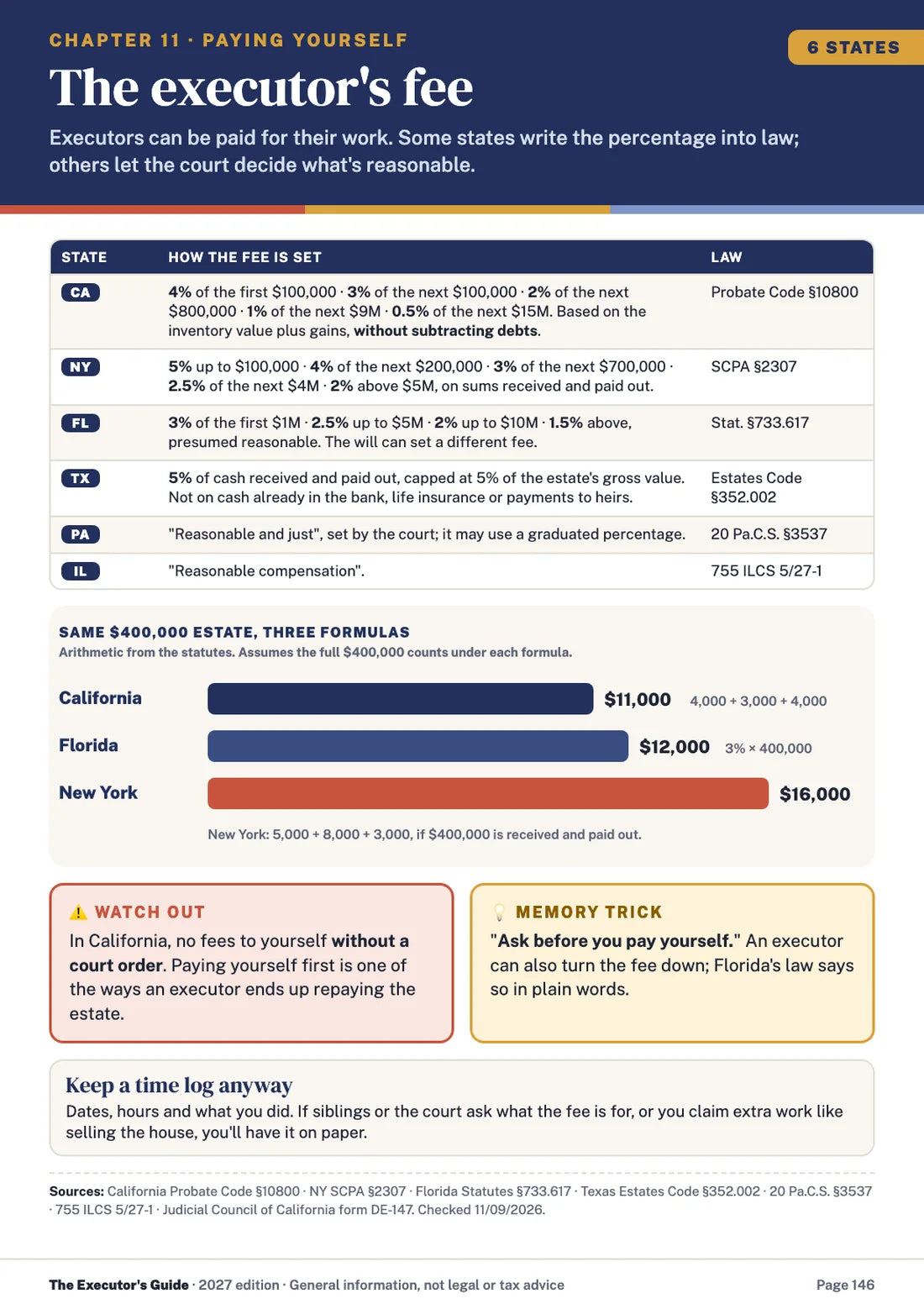
What the law says about the executor's fee.
Some states set a percentage, others leave it to the court. Same estate, three formulas, side by side.
- California §10800, New York §2307, Florida §733.617, Texas §352.002
- Pennsylvania and Illinois: "reasonable" compensation
- Why to ask before paying yourself, and why to keep a time log

The whole family looks at the same page.
Brothers and sisters can follow the same calendar, see why money can't be handed out yet, and bring the same questions to the attorney or the CPA.
- Built on statutes and IRS publications, cited on every page
- Reviewed every year, because the numbers change
- Questions to ask the probate attorney and the CPA at the end of each topic
The executor's whole job, in one guide.
Full table of contents
On screen, on paper, or both.
Color PDF, right after payment
Open it on a phone, tablet or computer and share it with the family. Print the checklists and worksheets as many times as you need.

208 color pages, spiral-bound
Lies flat next to the statements and the phone. Free U.S. shipping, about 5–8 business days. Want both? Printed + eBook for $79.99.
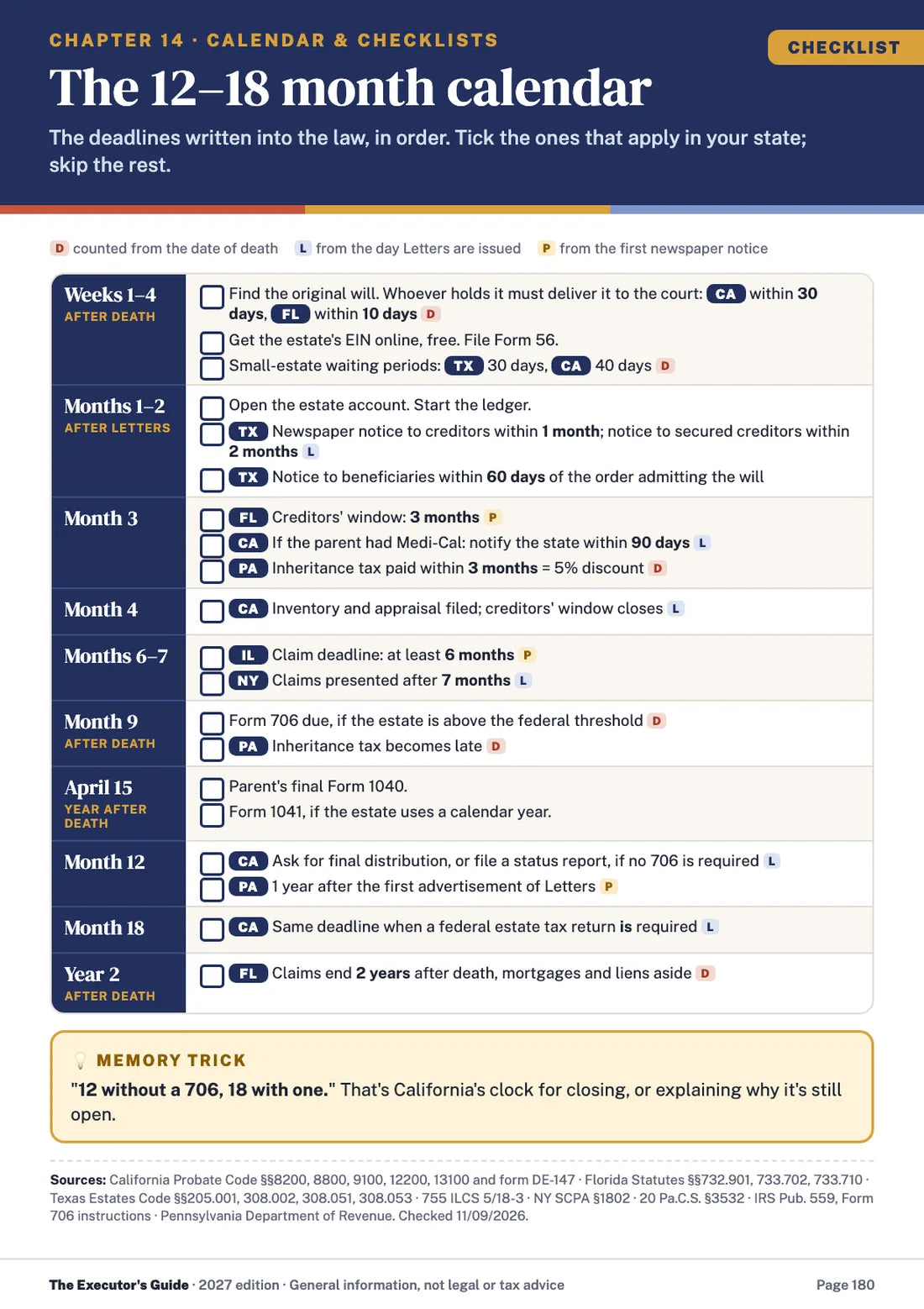
The calendar and the worksheets.
The deadlines from the law, from the first weeks to the second year, marked by state and by what they're counted from: the date of death, the Letters or the first notice.
- 12–18 month calendar with checkboxes
- Asset list, estate ledger, creditor log and call log
- With the eBook: print them again whenever you need
See 10 real pages, free.
The job on one page, the three piles, small-estate shortcuts, the EIN and the estate account, the creditors' clock, debts, the four tax returns, the step-up in basis, the executor's fee and the 12–18 month calendar. Read them and decide with the pages in front of you.
See the 10 pages ↓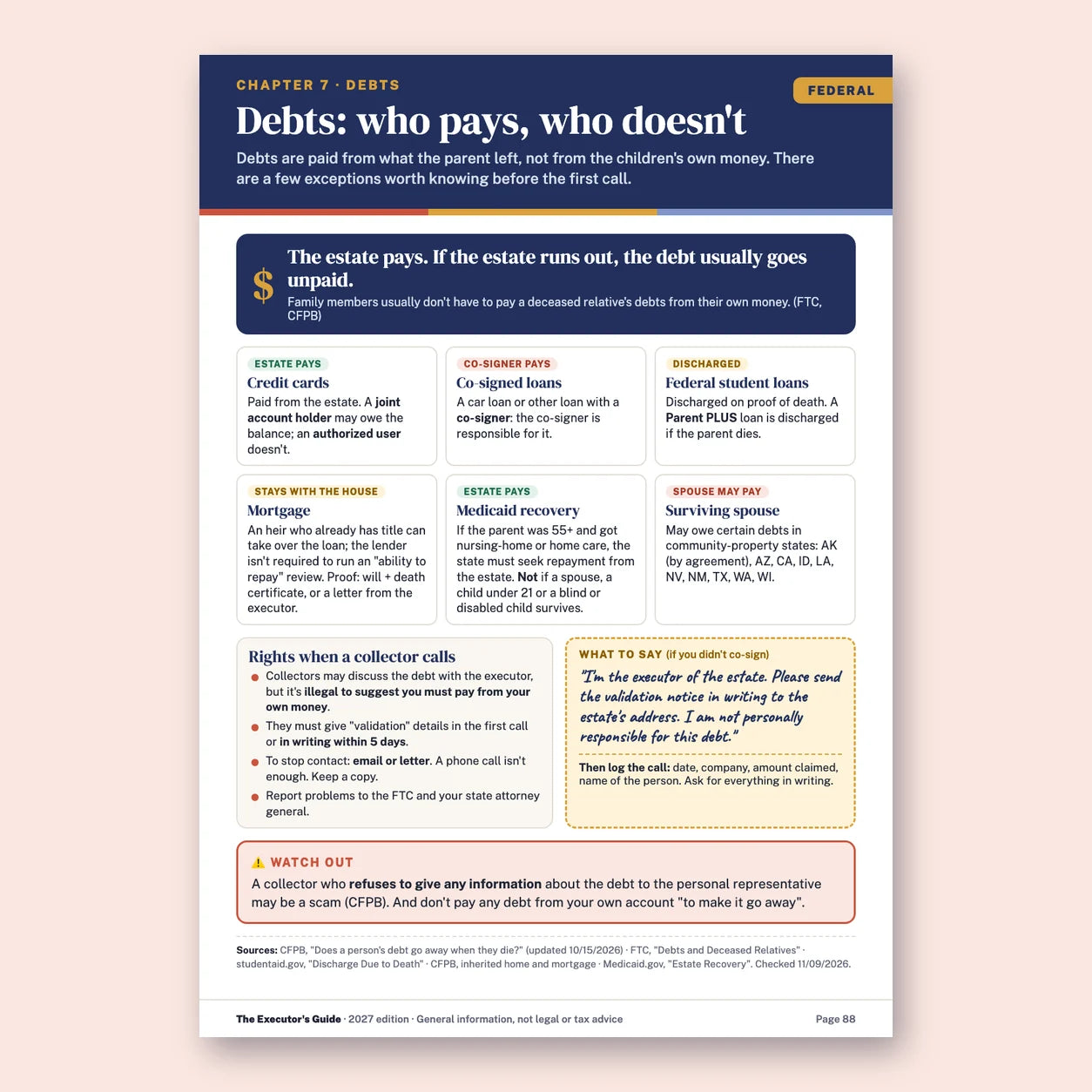
How is it different?
| What it has | This guide | Official websites | Books on Amazon | Probate attorney |
|---|---|---|---|---|
| The whole job, from probate to closing, in order | ✓ | Spread across many sites | Varies | ✓ |
| Charts, timelines and sorting diagrams | ✓ | Varies | Mostly text | — |
| Six states side by side, with the statute | ✓ | One state at a time | Varies | Your state |
| 2026–2027 numbers with the source on each page | ✓ | ✓ | Varies by edition | ✓ |
| Advice on your family's own situation | ✗ General information | ✗ | ✗ | ✓ |
| Price | From $39.99 | Free | About $11 to $25 | Fees vary |
You can start reading tonight.
You pay
Secure checkout, no account, no subscription. One payment.
You open the eBook
If you chose the eBook, the download link arrives by email. Open it on a phone, tablet or computer.
The book arrives
If you chose the printed book, it ships free to your U.S. address.
Settling a parent's estate, step by step, for the whole family.
- 208 illustrated color pages, 15 chapters
- Probate or not, small estates, Letters, the EIN and the estate account
- Creditors, debts, the four tax returns and the step-up in basis
- Six states side by side: CA, TX, FL, NY, PA, IL
- The executor's fee, distributing and closing
- 12–18 month calendar, checklists and worksheets
- Printed book: spiral-bound, lies flat
What executors ask before buying
Is this legal or tax advice?
No. This guide provides general information, not legal, tax or financial advice, and it is not a substitute for an attorney or a CPA. Probate rules are state law and they change. Talk to a probate attorney in your state, and a tax professional for the returns, before acting. Every topic ends with the questions to ask them.
Which states does it cover?
The federal rules (IRS returns, debt-collection rights, federal student loans, Medicaid estate recovery) apply everywhere. Six states are shown side by side with their statutes: California, Texas, Florida, New York, Pennsylvania and Illinois. For other states, the book explains what to look up and what to ask your local probate court or attorney.
What if there's no will?
The court may appoint an administrator, and the job is much the same: collect, pay, distribute. The book flags where the rules differ: for example, Texas's small-estate affidavit is only for estates with no will.
Do the children have to pay a parent's debts?
Usually not from their own money: debts are paid from the estate, and if it runs out they usually go unpaid. There are exceptions, like a co-signed loan, a joint credit card or some spouses in community-property states. The book has one page on who pays and who doesn't, based on CFPB and FTC guidance.
Does it explain the federal estate tax?
Yes. Form 706 is required only when the gross estate plus certain lifetime gifts is above $15,000,000 for deaths in 2026 and $15,480,000 for deaths in 2027. The book also covers the parent's final Form 1040, the estate's Form 1041 and, as an example of a state tax, Pennsylvania's inheritance tax.
Is it about the first days after a death?
No. It starts when someone has to settle the estate: probate, the estate account, creditors, taxes and closing. Funeral arrangements and the first phone calls are not the focus of this book.
Are you affiliated with the IRS or any court?
No. We are not affiliated with or endorsed by the IRS, any court or any government agency. Getting an EIN from the IRS is free: never pay a website for it.
Can you look at our situation and tell us what to do?
No. We can't advise on individual cases. The book is built so you can bring the right pages and questions to a probate attorney or a CPA.
Are the numbers up to date?
They were checked on November 9, 2026, against the IRS and the official legislature websites of each state, and each page shows its source. Thresholds and limits change, so the guide is reviewed every year.
Can I read it on my phone?
Yes. The eBook is a color PDF that opens on a phone, tablet or computer. You can print the checklists, the worksheets and any page you want.
When does the printed book arrive?
Shipping is free to U.S. addresses and takes about 5–8 business days. The eBook arrives by email right after payment.
What if it's not right for us?
You have a 30-day guarantee. Write to us within 30 days and we'll refund you. No questions, no forms.
Ready to see the whole job, in order?
208 illustrated pages, six states side by side, a 12–18 month calendar. 30-day guarantee.
From $39.99 · eBook or printed