Phoneme or grapheme? Blend or digraph?
The reading test, illustrated.
A study guide with a picture on every page for Foundations of Reading, the test used for teaching licenses in 19 states, plus a practice book with every answer explained and a four-part method for the two written answers. Made for adults who study after work: in a prep program, on an alternative route, or coming back for a retake.
Both books on the desk, the PDF on the phone for the commute · $89.99
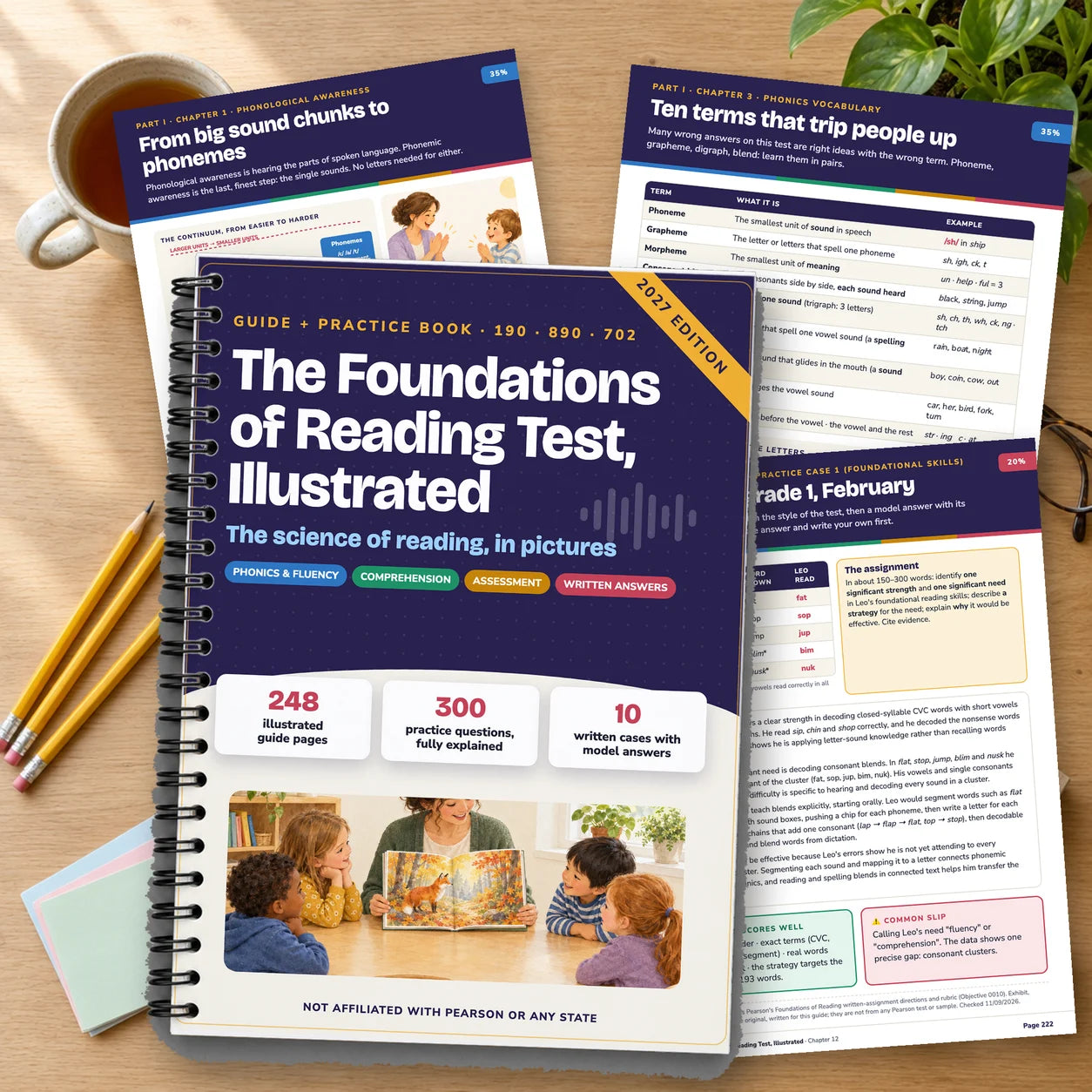
Not a wall of text. One idea per page.
Every page works the same way, so after a day of classes or work the book can be opened anywhere to pick up one term, one skill or one strategy in a few minutes.
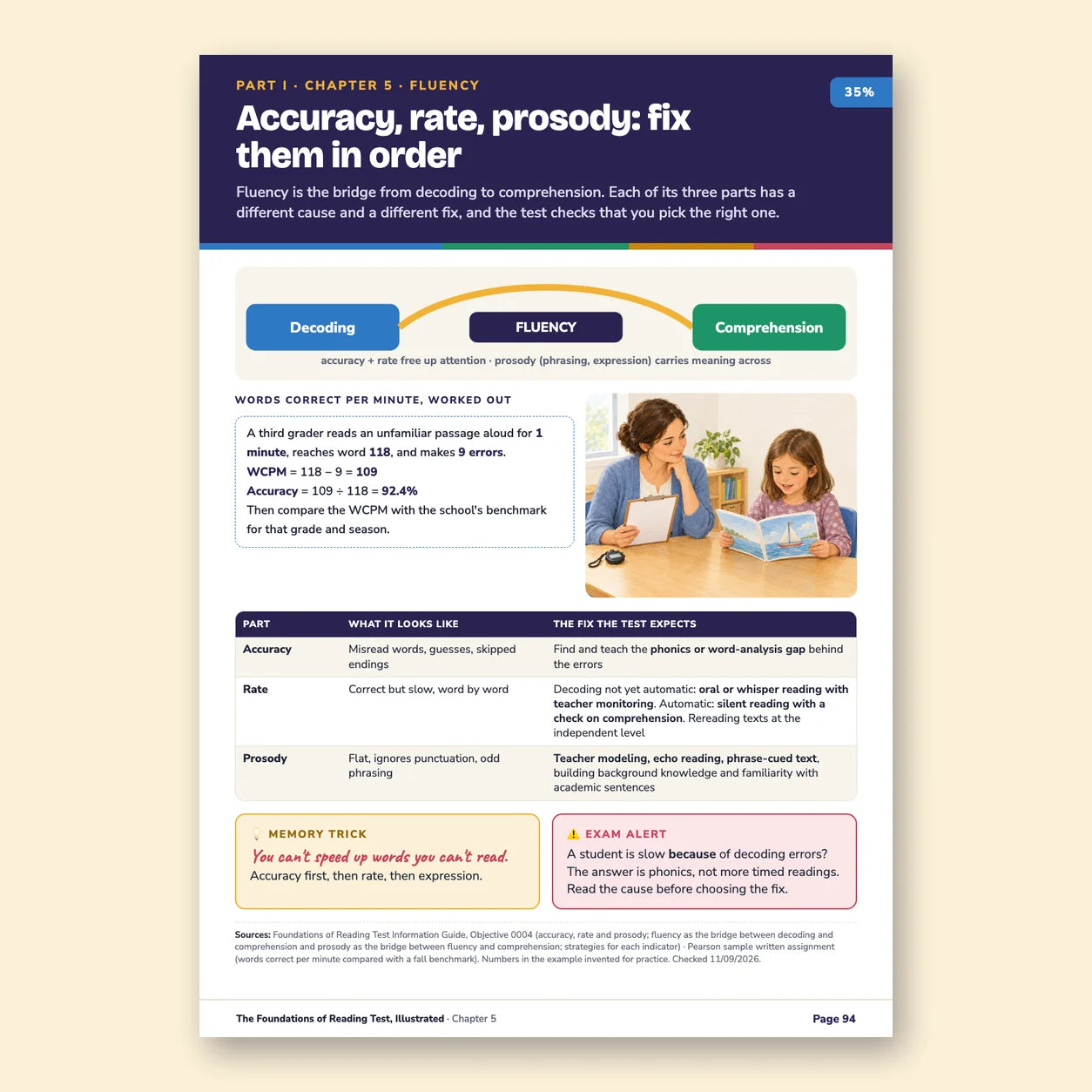
This is what the pages look like.
A question in the style of the test.
Original, written for the Practice Book. Pick an answer, then open the explanation.
A kindergarten teacher says a word aloud and asks the children to say it again without its first sound: "Say slip without /s/." Which skill is this activity building?
A. Phonics, because the children change one word into another.
B. Phonemic awareness: deleting a phoneme from a spoken word.
C. The alphabetic principle, because /s/ matches the letter s.
D. Onset-rime awareness, because the children keep the rime.
Show the answer and why the others are wrong
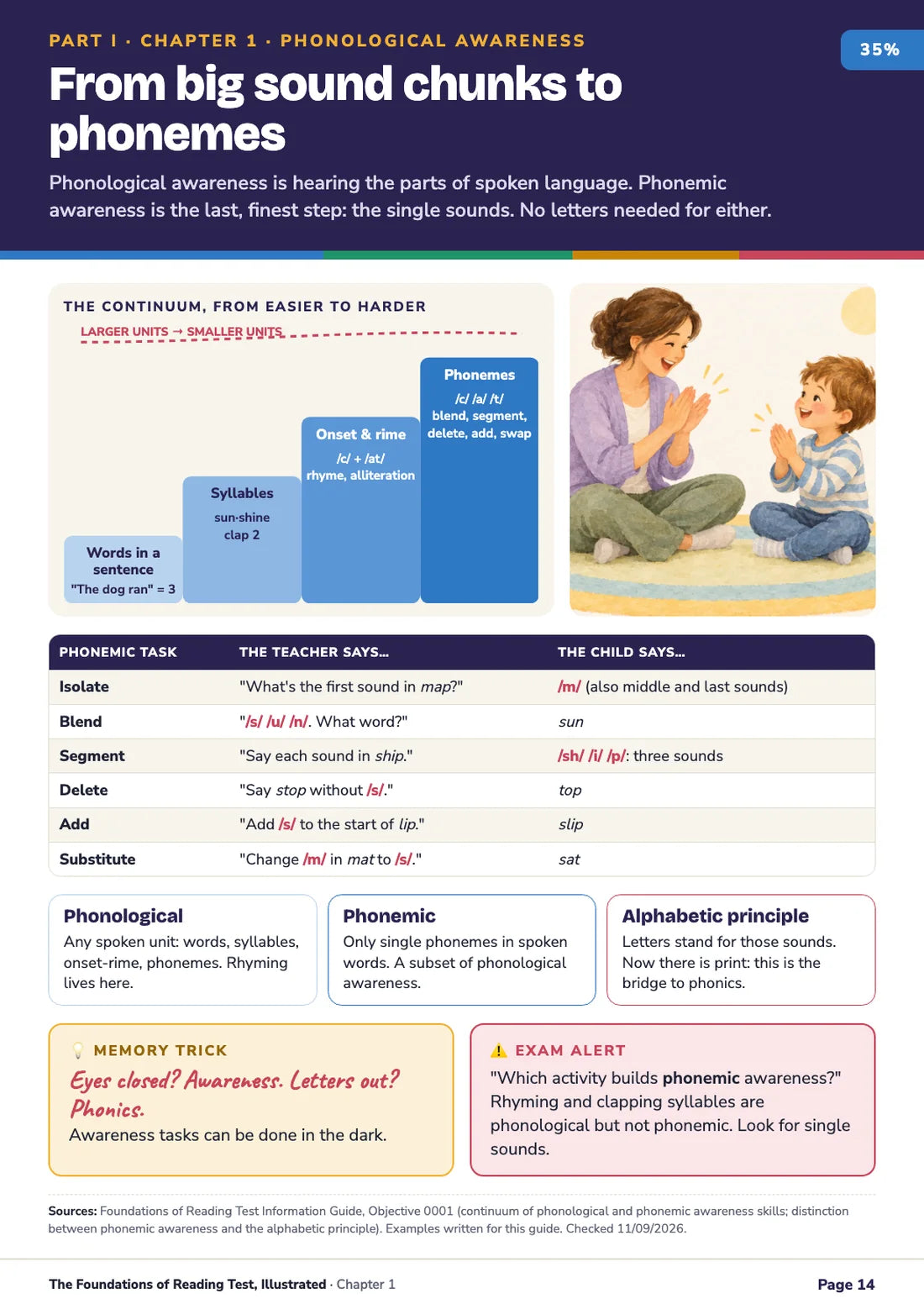
B. The children remove one sound from a spoken word, with no letters in sight: that is phoneme deletion, a phonemic awareness task. A and C both need print, letters matched to sounds, and there is none here. D is the trap: the onset of slip is sl, so taking away only /s/ splits the onset. Working with a single sound inside it is phonemic, not onset-rime. In the guide: page 14, "Eyes closed? Awareness. Letters out? Phonics."
For adults who study around a full day.
Next to the coursework
Elementary, early childhood and special education candidates. The chapters follow the 11 official objectives in order, so each class topic has its page.
Starting from the terms
Career changers and teachers adding a license or a reading endorsement. Each chapter starts from what a term means, with classroom examples, before any test question.
Aim at the weak spots
A retake is possible after 30 days, with no limit on attempts. The guide is organized by the test's four subareas, so the chapters to reread are easy to find.
The rules of the test itself.
They come from Pearson's test pages and policies. The guide's first chapter explains each one.
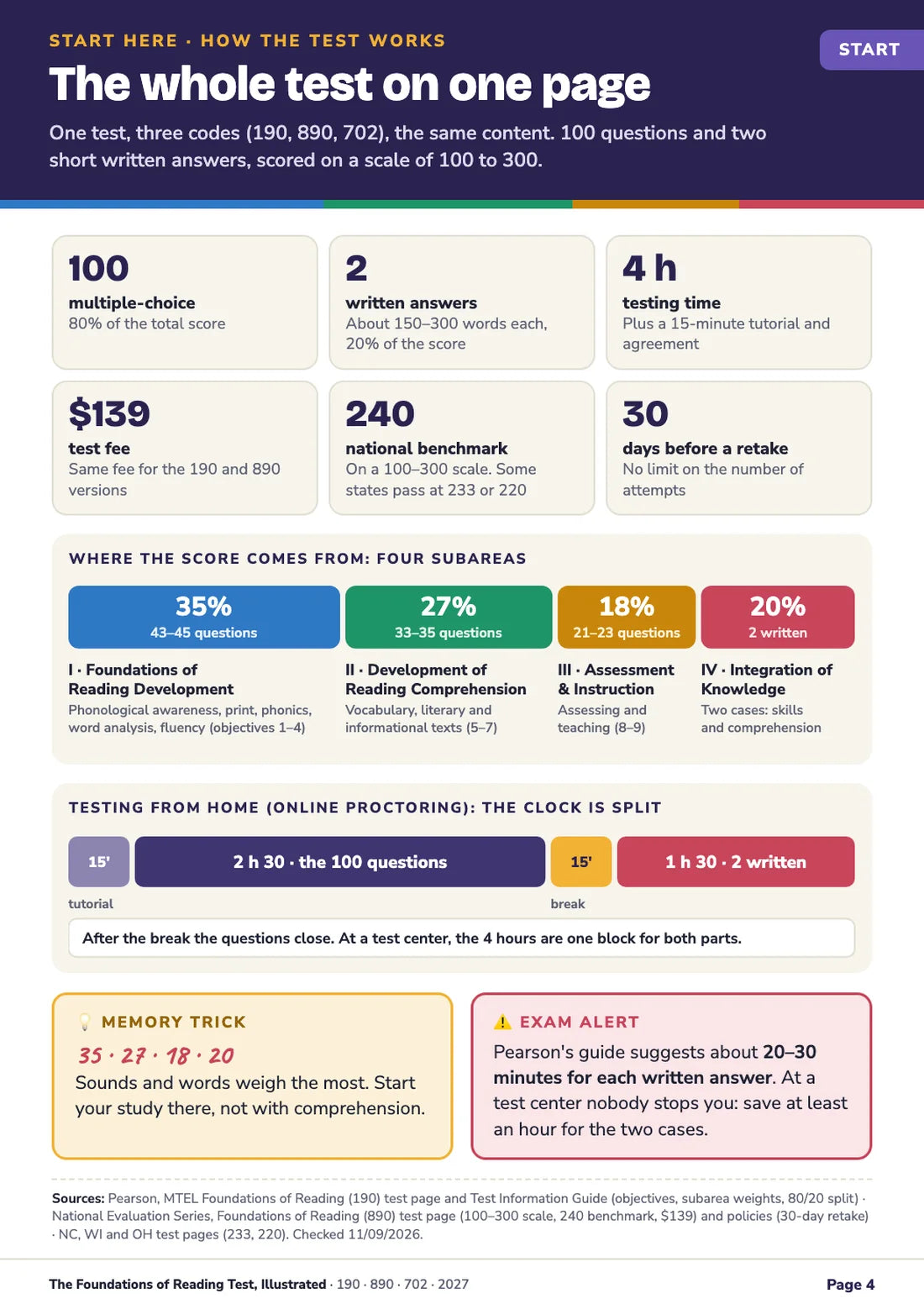
A 100–300 scale
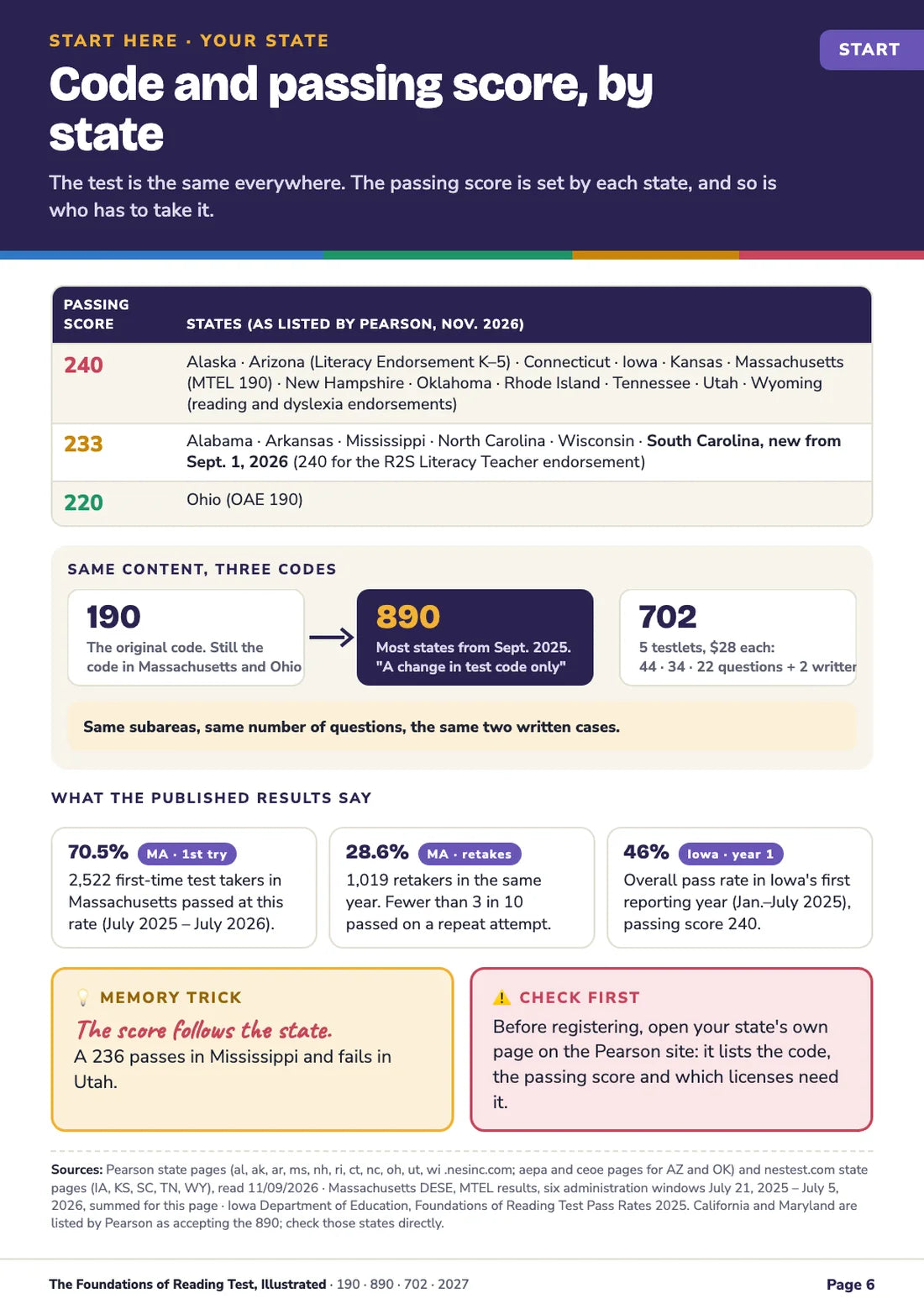
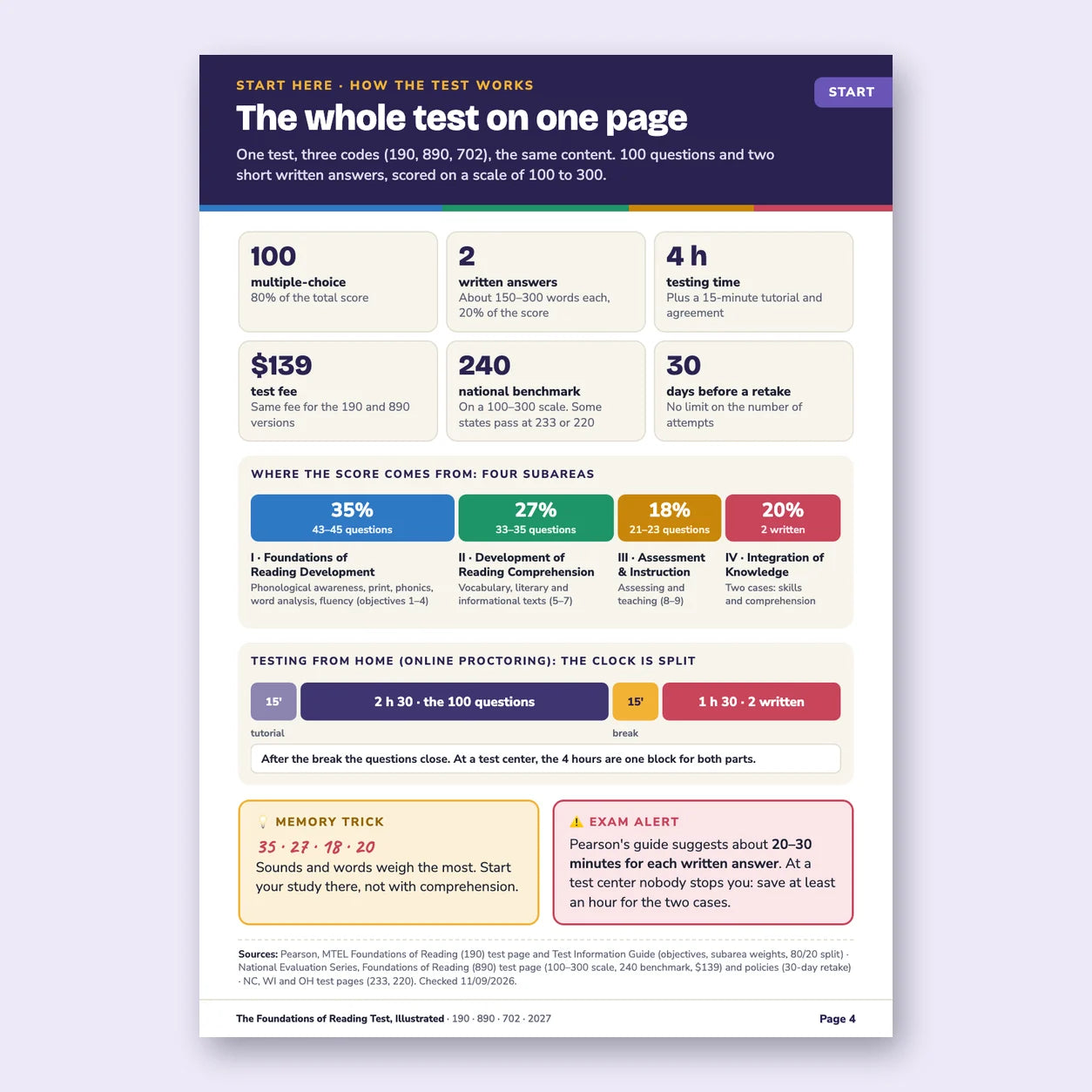
The national benchmark is 240, but each state sets its own cut: 240 in most states, 233 in Alabama, Arkansas, Mississippi, North Carolina, South Carolina and Wisconsin, 220 in Ohio.
2 cases, 20% of the score
About 150–300 words each, about one student's reading. Scored 4 to 1 on purpose, subject knowledge, support and rationale.
$139, then 30 days
The test costs $139 at a test center or from home with an online proctor. After a fail, the wait is 30 days before trying again.
Sounds, letters, words, fluency.
Oral language and phonological awareness, concepts of print and the alphabetic principle, phonics and high-frequency words, syllables and morphemes, and fluency. The biggest part of the test, and the biggest part of the book.
- The phonological continuum drawn as a staircase, with the six phonemic tasks
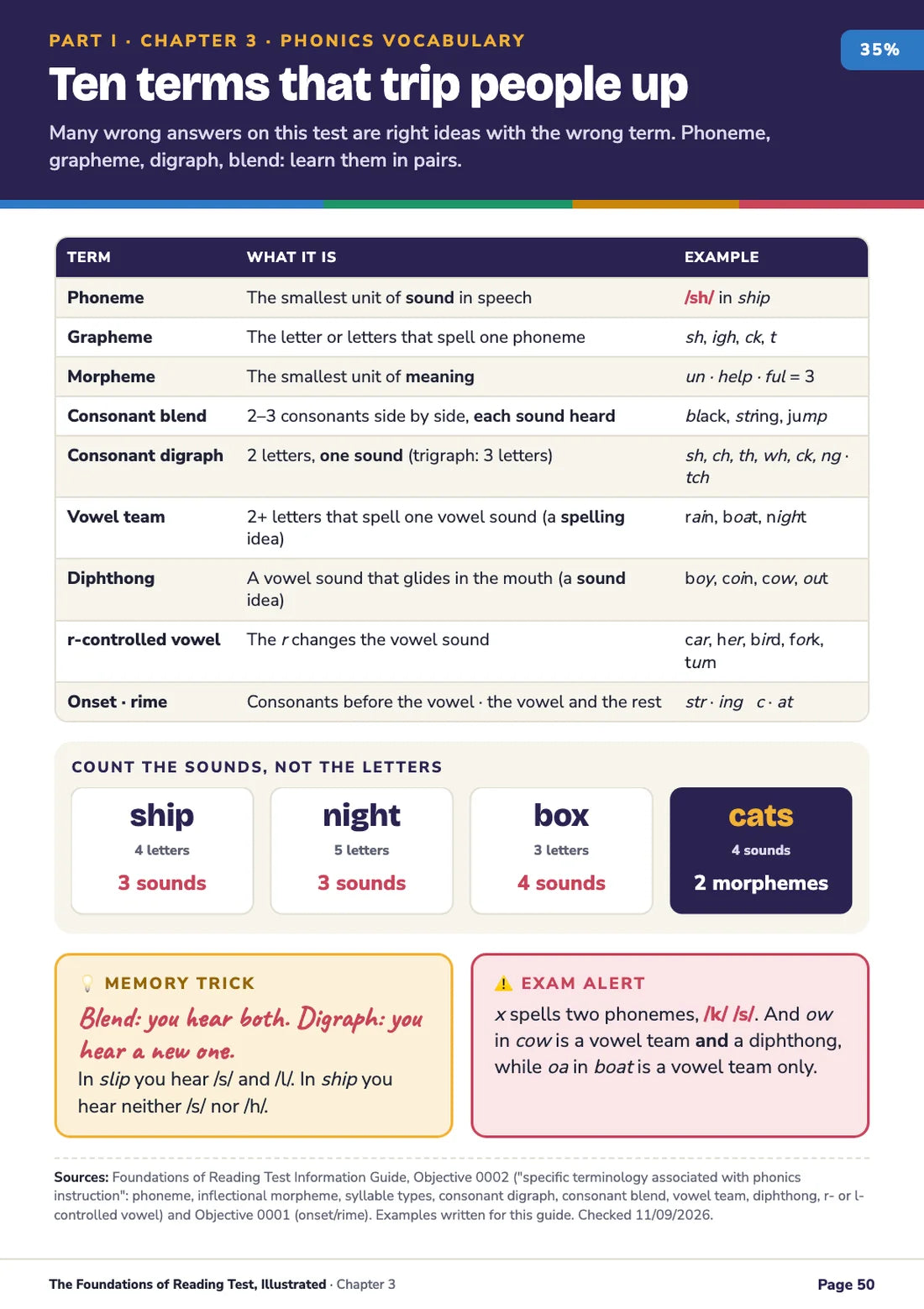
- Phoneme, grapheme, morpheme, blend, digraph, vowel team, diphthong: side by side
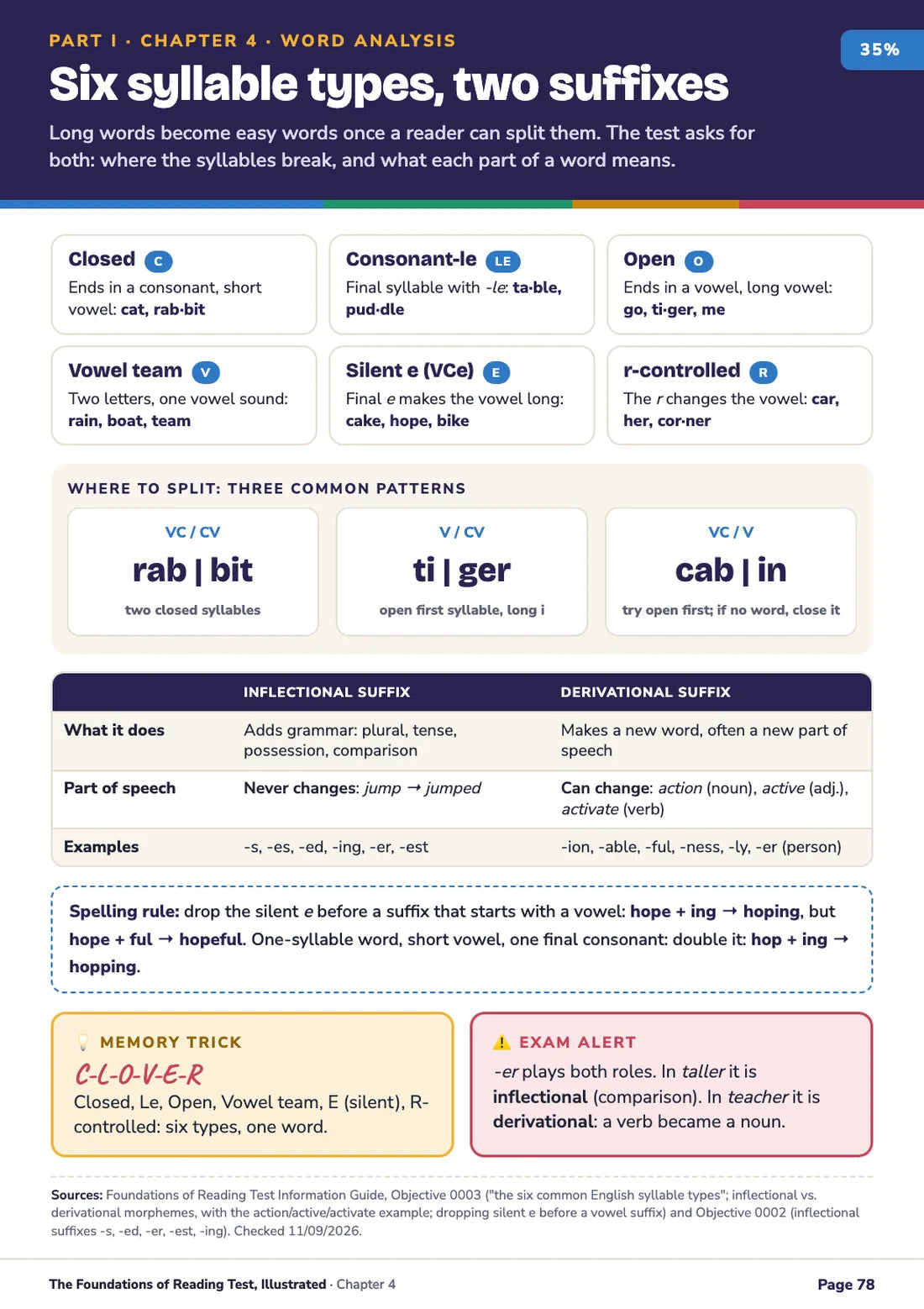
- The six syllable types and the common ways to split a word
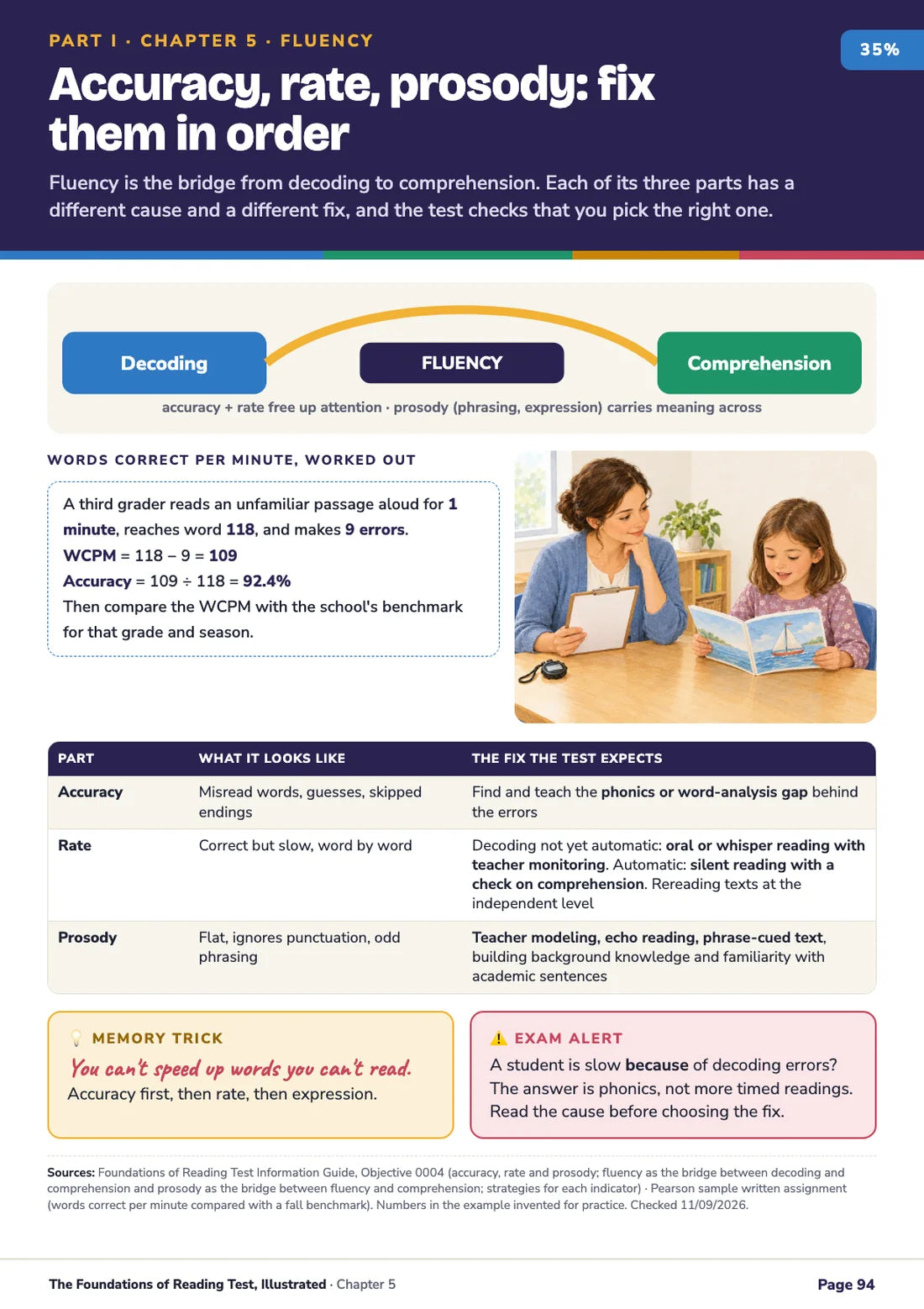
- Words correct per minute and accuracy, worked out step by step
Vocabulary and two kinds of text.
Academic language and vocabulary, then literary texts and informational texts: key ideas, craft and structure, comparing texts, comprehension strategies and close reading.
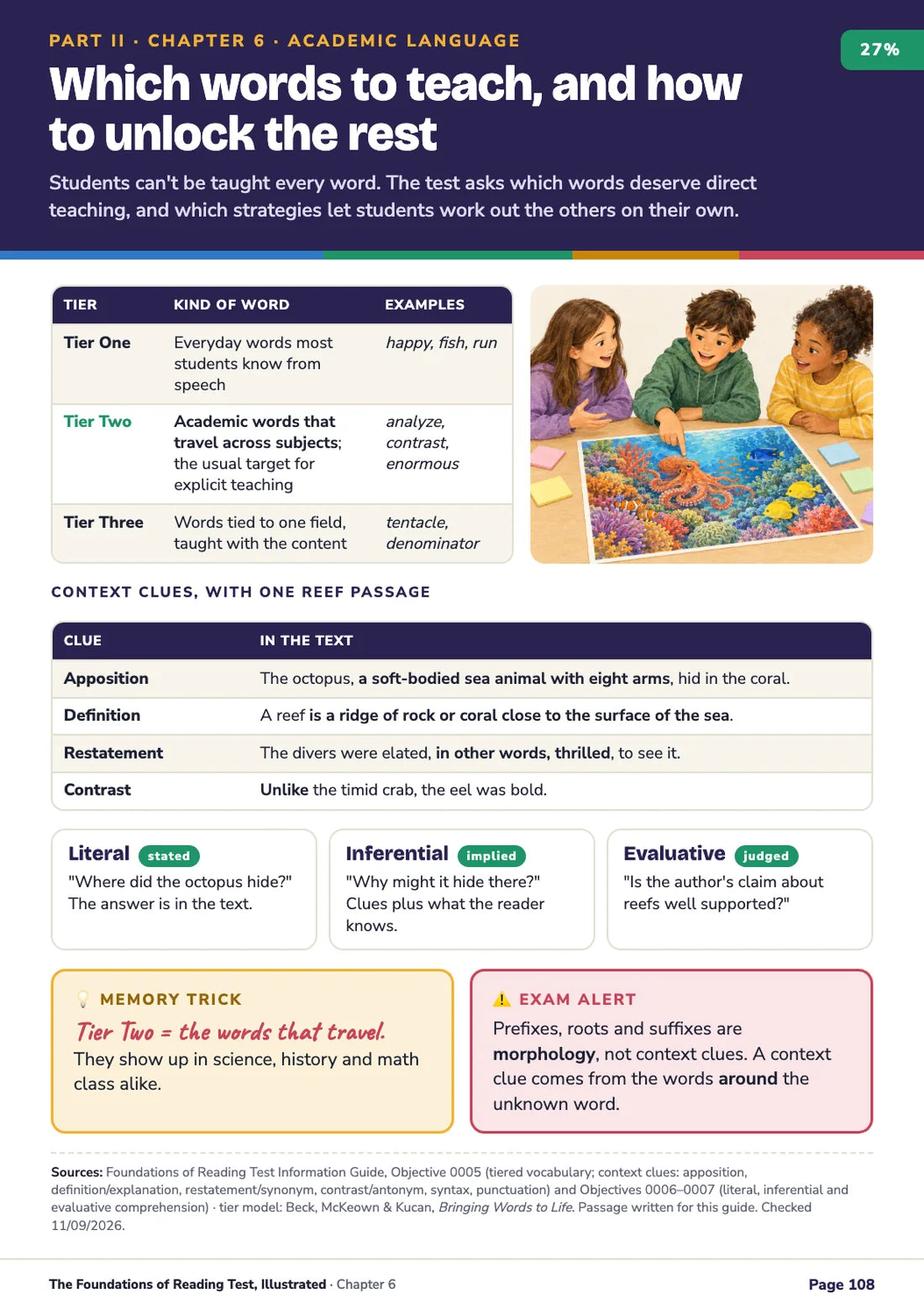
- Tier One, Two and Three words, and which ones to teach directly
- Six kinds of context clues, each with an example
- Literal, inferential and evaluative questions on the same passage
- Text structures and text features in one chart
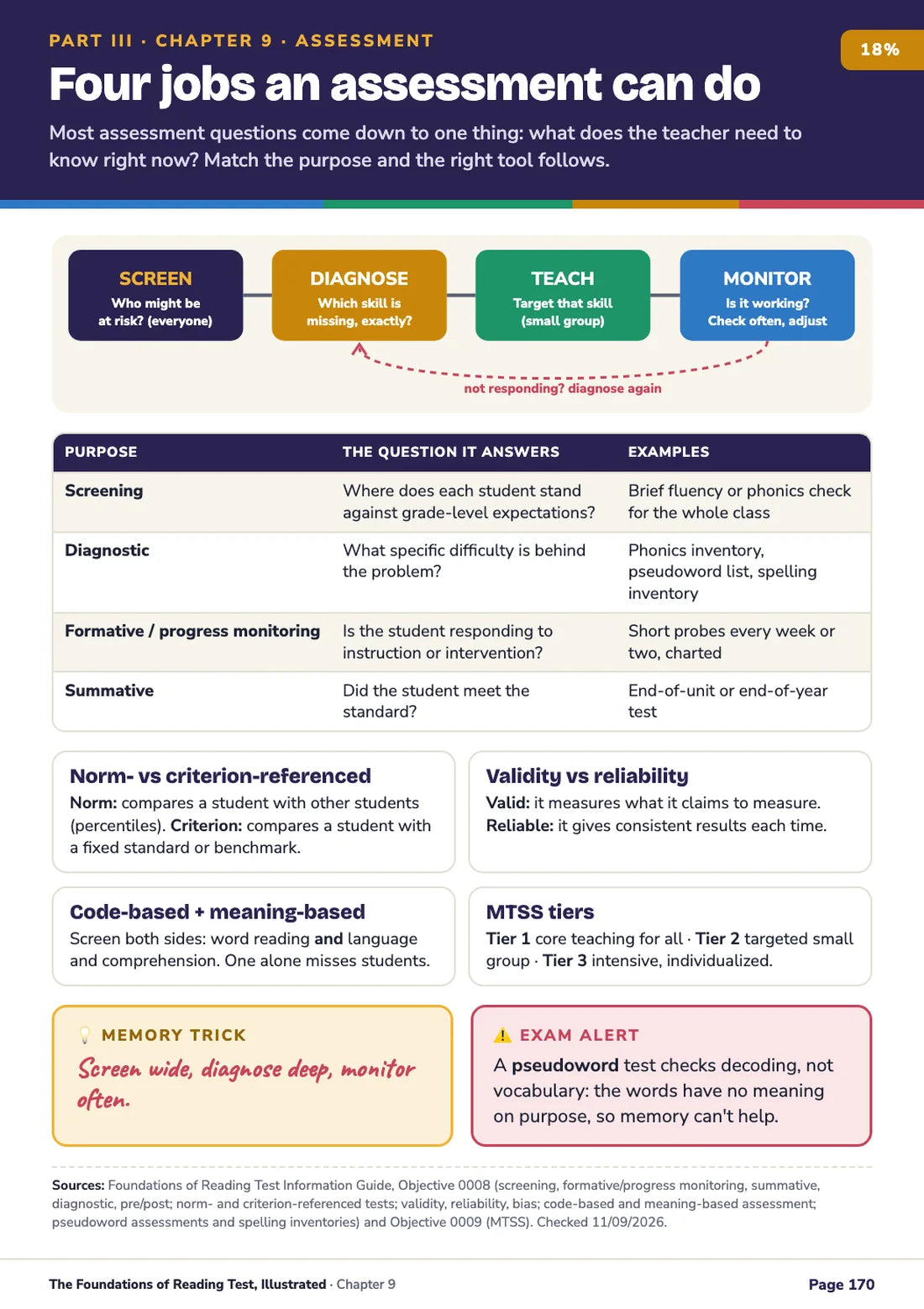
Pick the assessment by its purpose.
Screening, diagnostic, progress-monitoring and summative assessment, the tools behind each, then planning instruction: MTSS tiers, grouping, text complexity and supporting every reader.
- Screen, diagnose, teach, monitor: the cycle in one diagram
- Norm- vs criterion-referenced, validity vs reliability
- Pseudowords, spelling inventories, oral retells: what each one checks
- Supporting English learners and students with disabilities
Two written answers, one method.
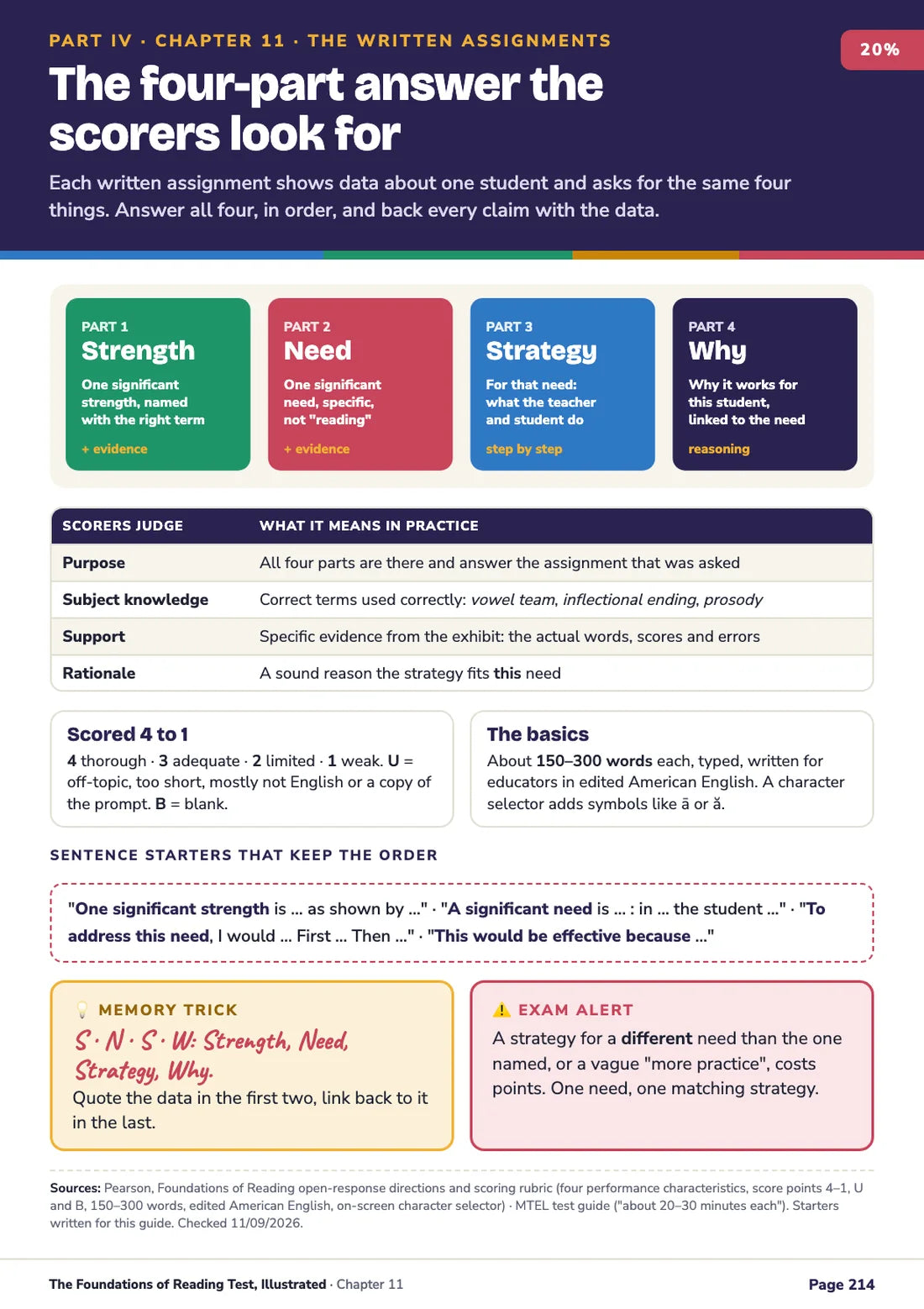
Both written assignments ask for the same four things about one student: a strength, a need, a strategy, and why it would work. The guide teaches the order, the terms and the evidence, then gives practice cases with model answers.
- The four scoring criteria explained in plain words
- Sentence starters that keep the answer in order
- 6 practice cases in the guide, 4 more in the practice tests
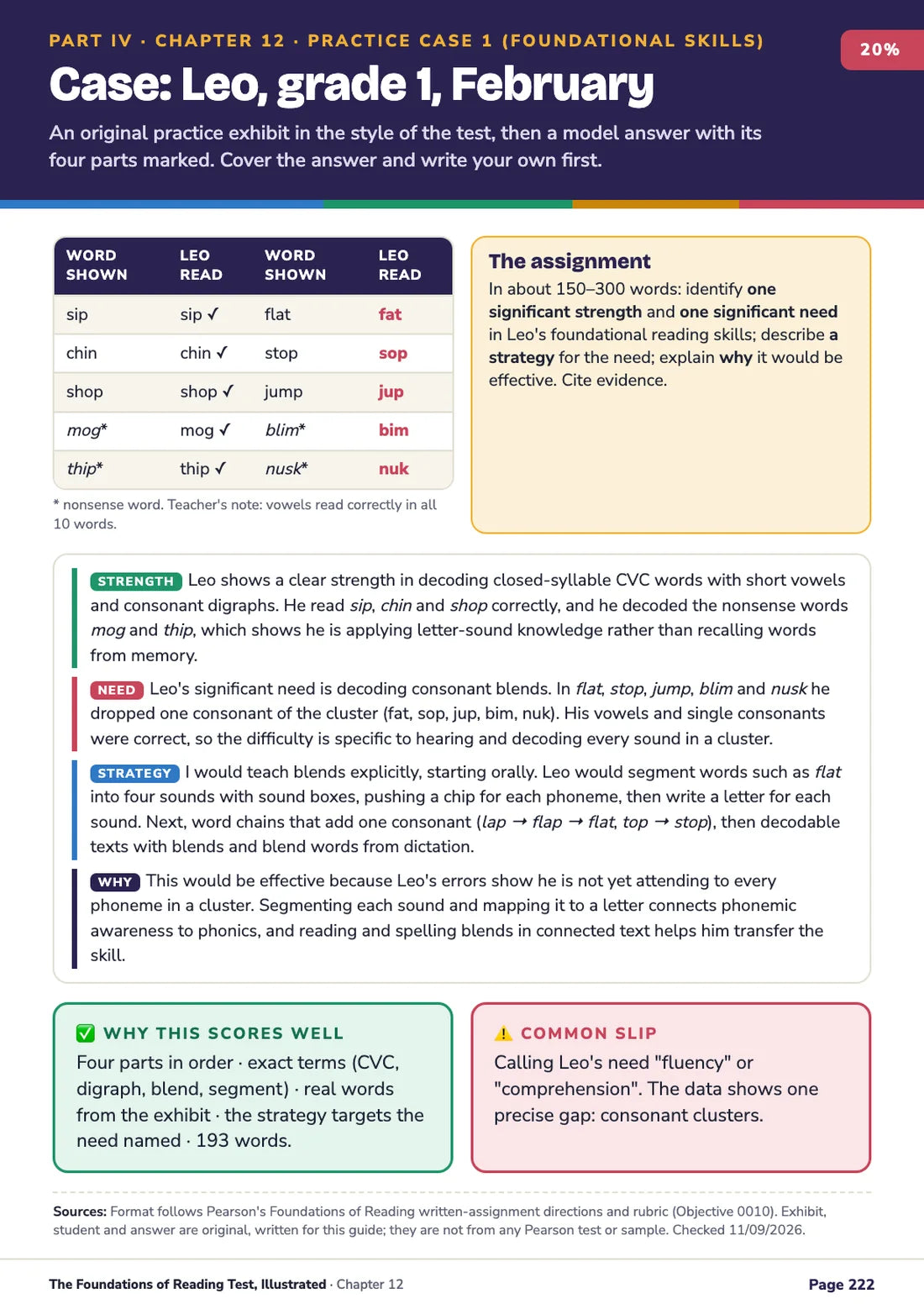
- Original exhibits: word lists, fluency records, retells
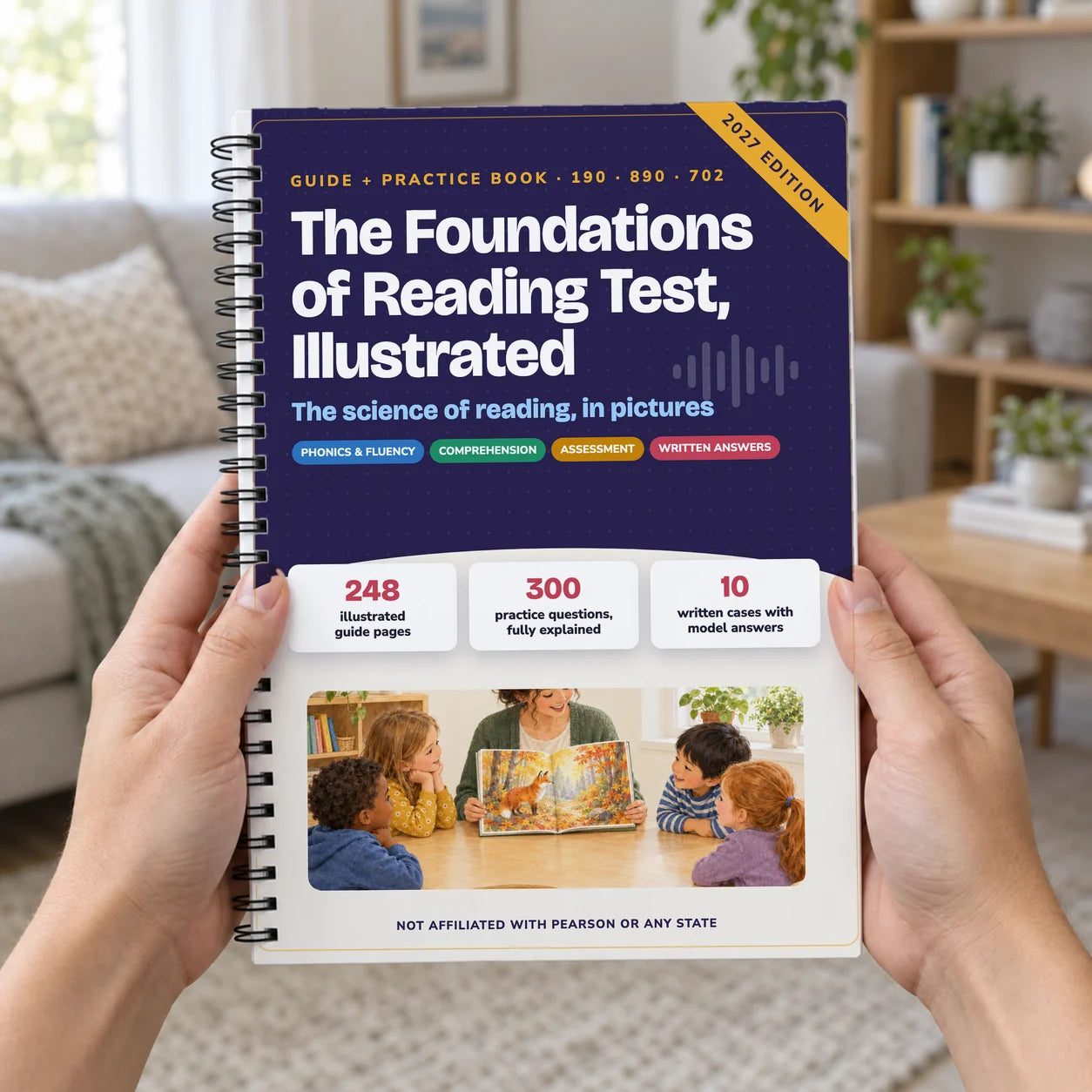
300 questions. Every answer explained.
Two full practice tests of 100 questions each, split across the subareas like the real test, each with two written assignments. Then 100 drills on the terms that cause the most mistakes.
- Why the right answer is right, and why each wrong one is wrong
- The guide page to reread after every question
- A score sheet by subarea and objective
- Original questions written for this book, not copied from any test

Built for studying in short evenings.
One page, one idea, one picture. It's possible to stop after any page and know exactly where things stand, which matters when the studying happens after classes or work. It works on its own or next to a prep course.
- Chapters follow the four subareas and 11 objectives, in order
- Each page names the objective it comes from
- Cram sheets and a terms card for the last week
The guide and the practice book, for all four subareas.
The Guide · full table of contents
The Practice Book · 152 pages
On screen, on paper, or both.
Color PDF, right after payment
The guide and the practice book on a phone, tablet or computer. Good for a few questions on a lunch break.
Two spiral-bound books
The 248-page guide and the 152-page practice book, lying flat on the desk. Free US shipping, about 5–8 business days. Want both? Printed + eBook for $89.99.
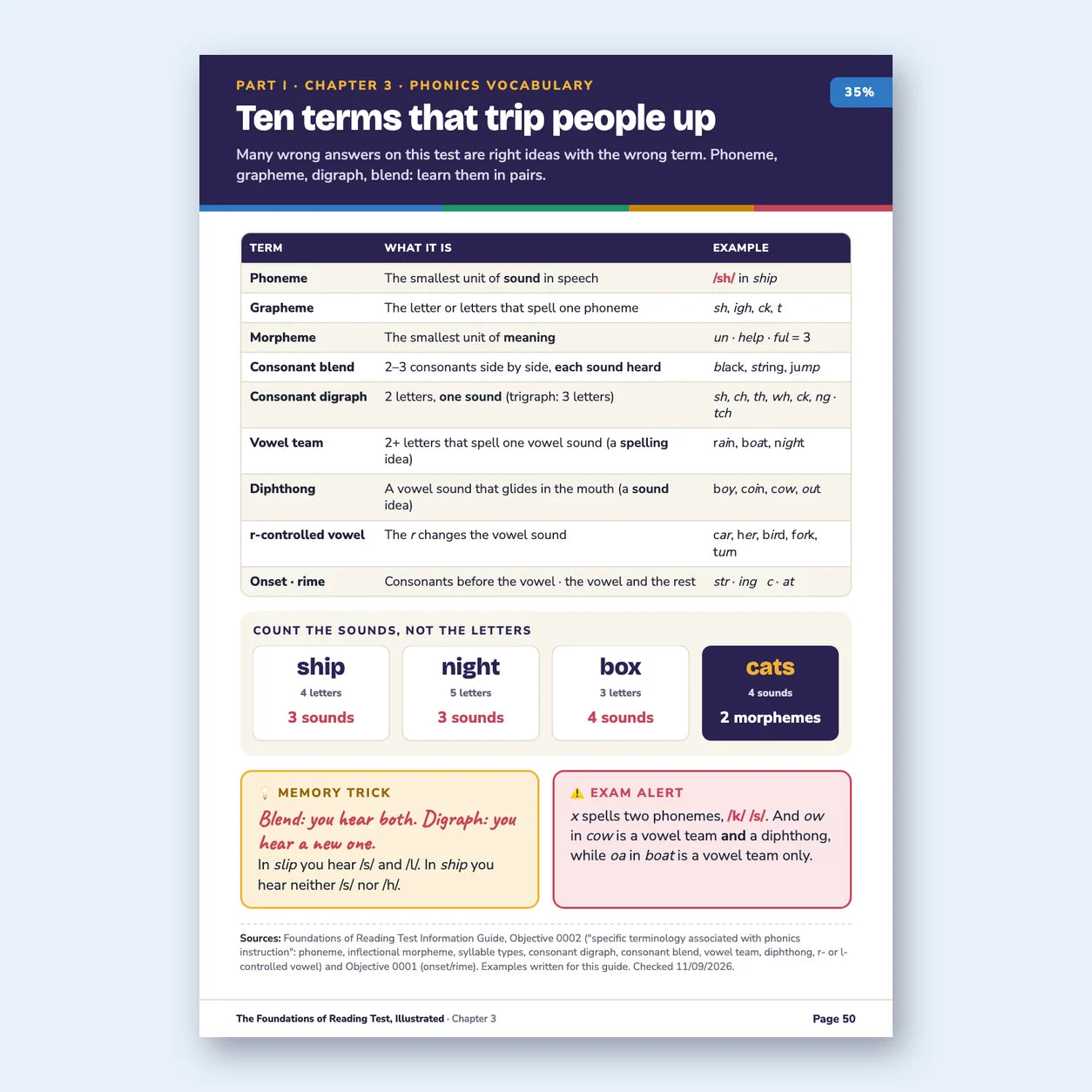
A terms card for the last week.
The terms the test likes to mix up, on one card, and short review sheets for each subarea, to read the night before.
- Every term with one example word
- The memory tricks from every chapter, in one place
- A score sheet to see which subarea needs another pass
See 10 real pages, free.
The test on one page, codes and passing scores by state, phonological awareness, the terms that trip people up, syllable types, fluency, vocabulary, assessment, the written-answer method and a full practice case. Read them and decide with the pages in front of you.
See the 10 pages ↓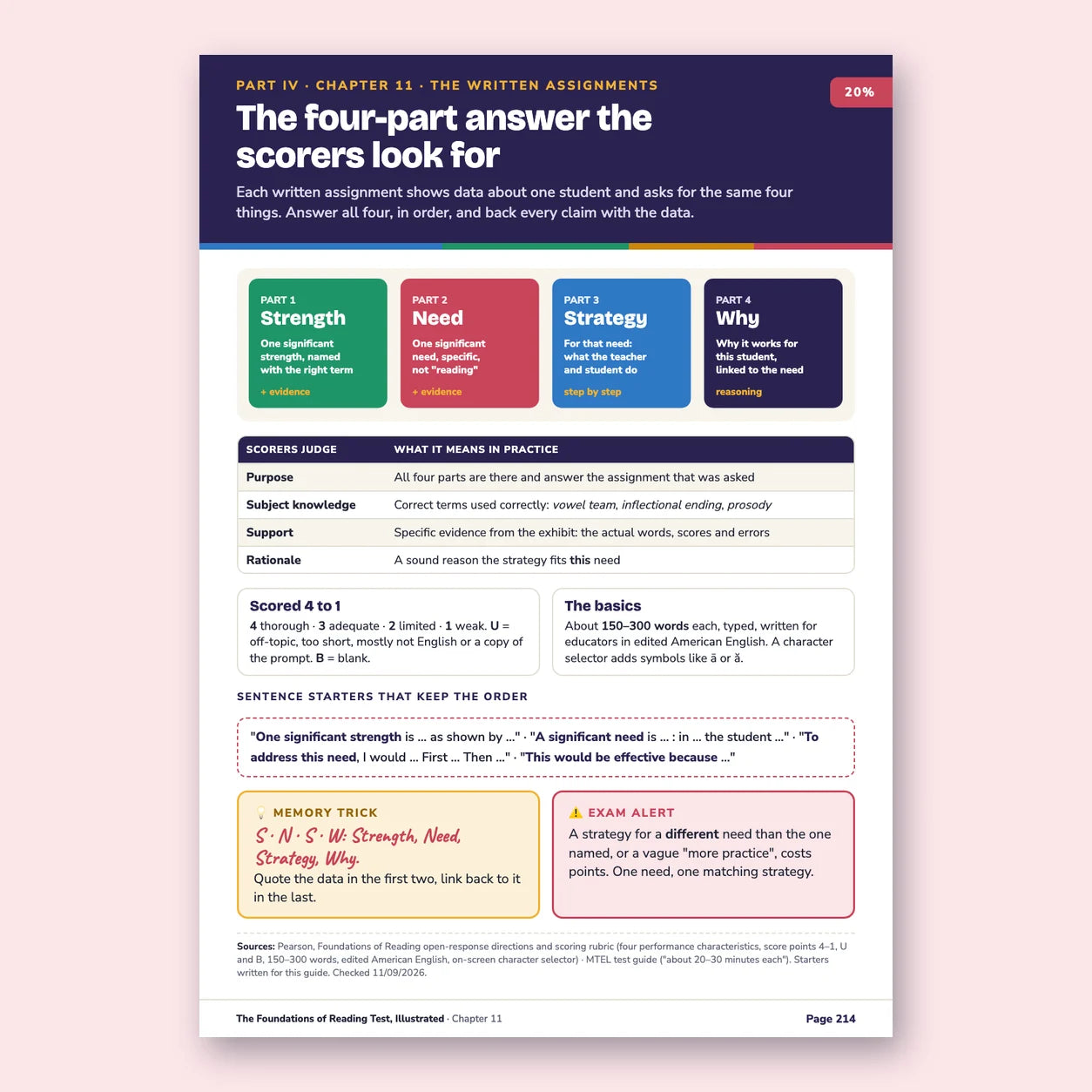
How is it different?
| What it has | This guide | Online prep courses | Text study guides | Free official materials |
|---|---|---|---|---|
| A diagram or chart on every page | ✓ | Varies | Mostly text | — |
| A method for the 2 written answers | ✓ 10 cases with model answers | Varies | Varies | ✓ One sample and the rubric |
| Practice questions with explanations | ✓ 300 | ✓ | Varies | ✓ A practice test, by state |
| Interactive lessons | ✗ | ✓ | ✗ | ✗ |
| The source named on each page | ✓ | Varies | Varies | ✓ The objectives themselves |
| Price | From $39.99 | Often a 30- or 90-day subscription | About $10–$50 per book | Free |
Studying can start tonight.
Pay once
Secure checkout, no account, no subscription. One payment.
Open the eBook
With the eBook, the download link arrives by email. It opens on a phone, tablet or computer.
The books arrive
With the printed books, they ship free to a US address.
All four subareas of the reading test, explained with pictures.
- 248-page illustrated guide, 15 chapters
- Phonological awareness, phonics, fluency, vocabulary, comprehension, assessment
- Every term with an example; every page with its official objective
- A four-part method and 10 practice cases for the written answers
- 152-page Practice Book: 300 questions, every answer explained
- Printed books: spiral-bound, lie flat
What candidates ask before buying
Is this affiliated with Pearson or with my state?
No. This guide is not affiliated with or endorsed by Pearson, its Evaluation Systems group, the National Evaluation Series or any state department of education. The test is registered for and paid separately ($139). Test names are used only to say which test the guide covers.
190, 890 or 702: which one is mine?
Same content, different codes. Most states moved from 190 to 890 in 2025, which Pearson calls "a change in test code only"; Massachusetts (MTEL) and Ohio (OAE) still list 190. The 702 version splits the same test into five testlets, in Connecticut and Maryland. Page 6 of the guide lists the states; the state's own Pearson page is the final word.
What score do I need?
It depends on the state, on a 100–300 scale: 240 in most states, 233 in Alabama, Arkansas, Mississippi, North Carolina, South Carolina (initial and add-on certification, from Sept. 1, 2026) and Wisconsin, and 220 in Ohio.
How are the two written answers scored?
Each one is scored 4, 3, 2 or 1 on four characteristics: purpose, subject knowledge, support and rationale. The assignment asks for a strength, a need, a strategy and why it would work, citing the data about one student, in about 150–300 words. Chapters 11 to 13 teach the method with practice cases.
Can the test be taken from home?
Pearson offers it at test centers and with online proctoring. From home, the time is split: 2 hours 30 minutes for the questions, an optional 15-minute break, then 1 hour 30 minutes for the written answers.
Will this book make me pass?
No book can promise that. The guide explains every objective in the official framework, teaches a method for the written answers and gives 300 practice questions with explanations. How much and how someone studies is what decides it.
Are these real test questions?
No. Every question, exhibit and model answer was written for this book. Ours follow the official objectives and the format Pearson describes.
Do I also need a course?
It depends on how someone studies. Courses add interactive lessons; this guide adds diagrams, worked examples and short explanations. Many people use a course and a book together.
Is the guide useful in the classroom too?
The test covers what a reading teacher does every day, so the pages on phonemic awareness, phonics, fluency and assessment are written with classroom examples. It is a study guide, not a curriculum.
Can I read it on my phone?
Yes. The eBook is a color PDF that opens on a phone, tablet or computer.
When do the printed books arrive?
Shipping to US addresses is free and takes about 5–8 business days. The eBook arrives by email right after payment.
What if it's not right for me?
There's a 30-day guarantee. Write to us within 30 days for a refund. No questions, no forms.
Ready to study the reading test with pictures?
248 illustrated pages, 300 questions with every answer explained, a method for the two written answers. 30-day guarantee.
From $39.99 · eBook or printed