Family members can be paid to give care at home in many states.
Here's how it works, page by page.
An illustrated guide for adult children and spouses in the U.S.: the Medicaid programs that can pay a family caregiver, the VA caregiver stipend, care agreements and the 5-year look-back, and the taxes. 184 pages with 2026 numbers and sources. eBook or printed book.
The book at home, the PDF for the sibling who lives far away · $79.99
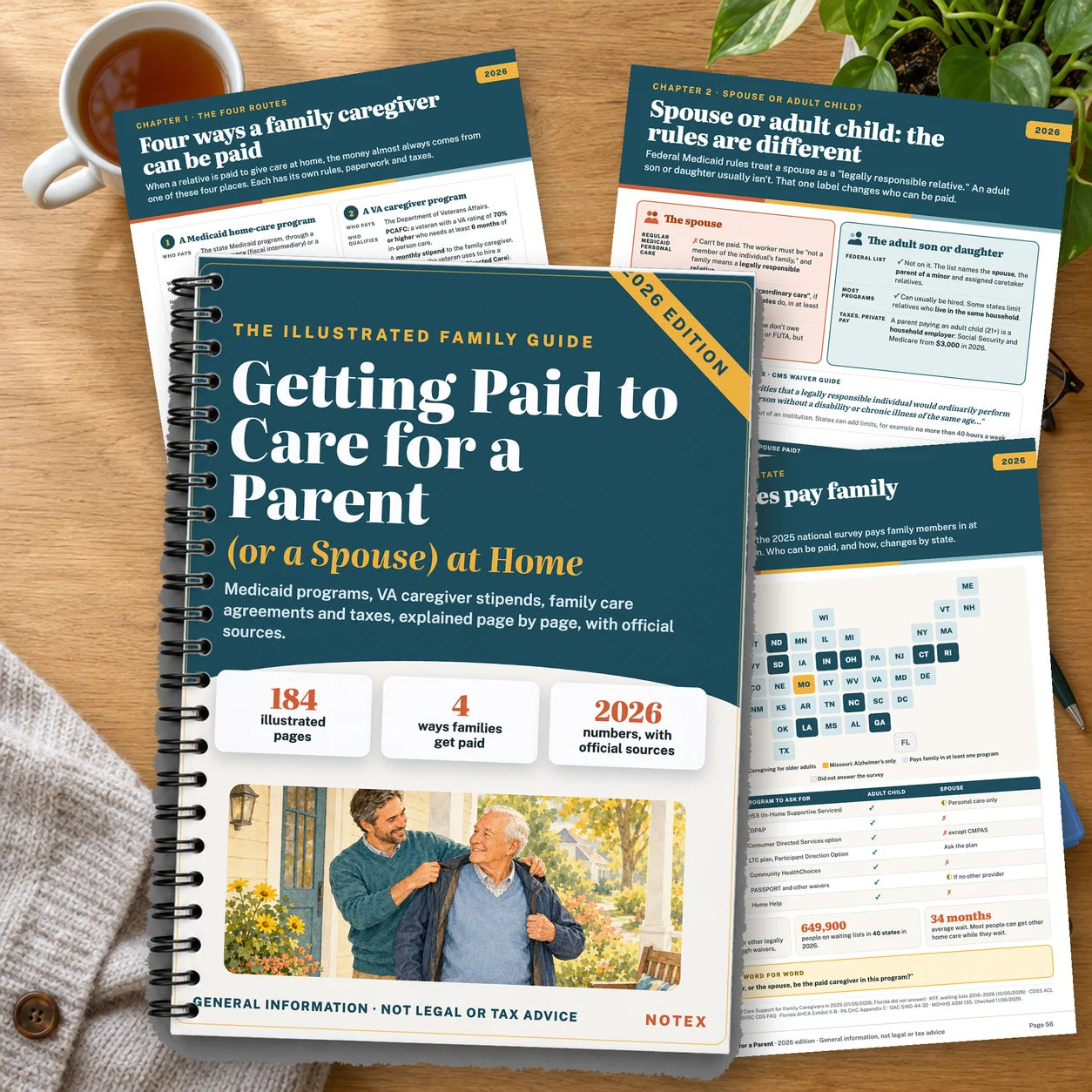
Not a wall of rules. One topic per page.
Every page works the same way, so a caregiver with ten spare minutes can find the answer at the kitchen table.
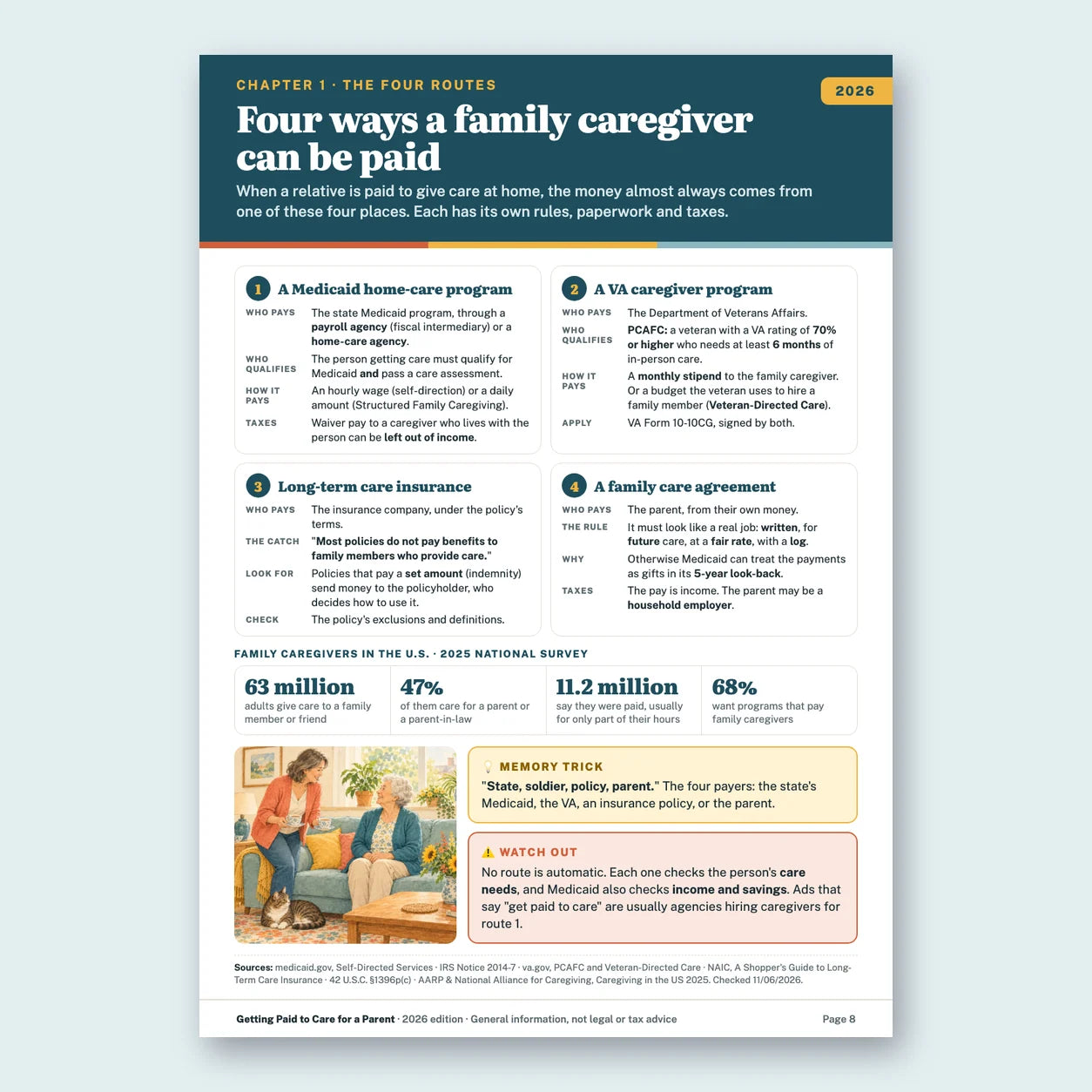
This is what the pages look like.
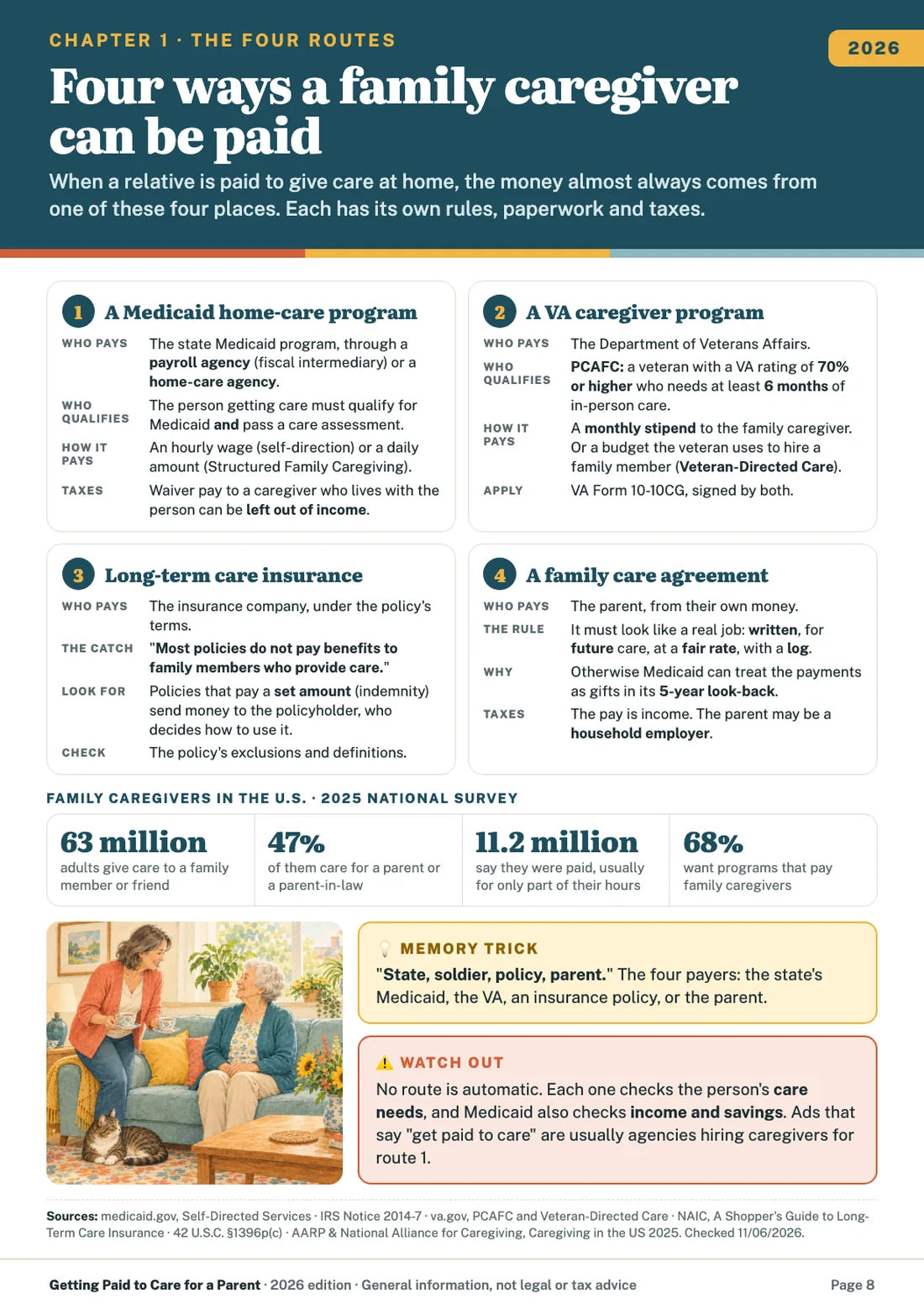
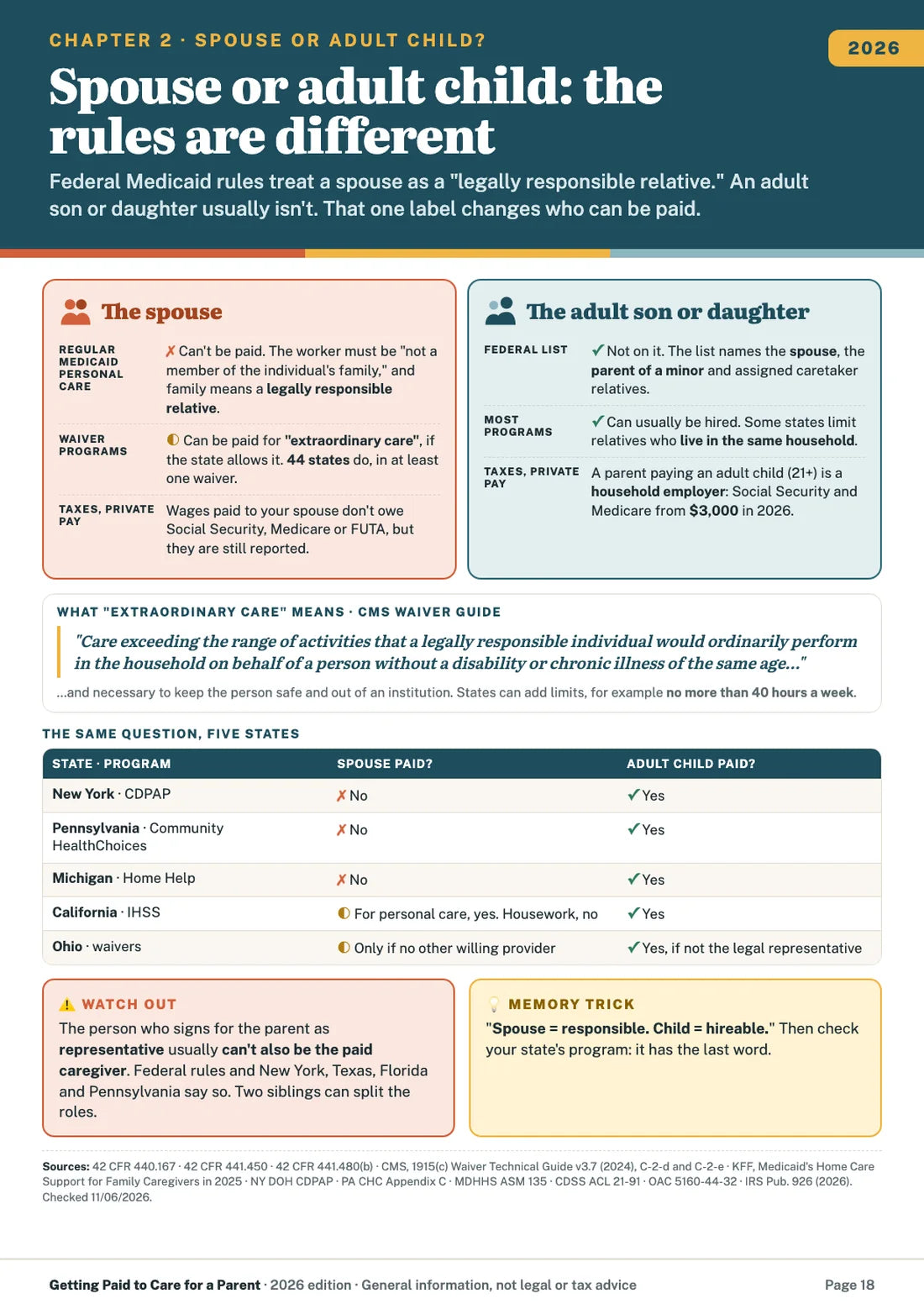
For the son, daughter or spouse who is already giving the care.
Find out if a program can pay
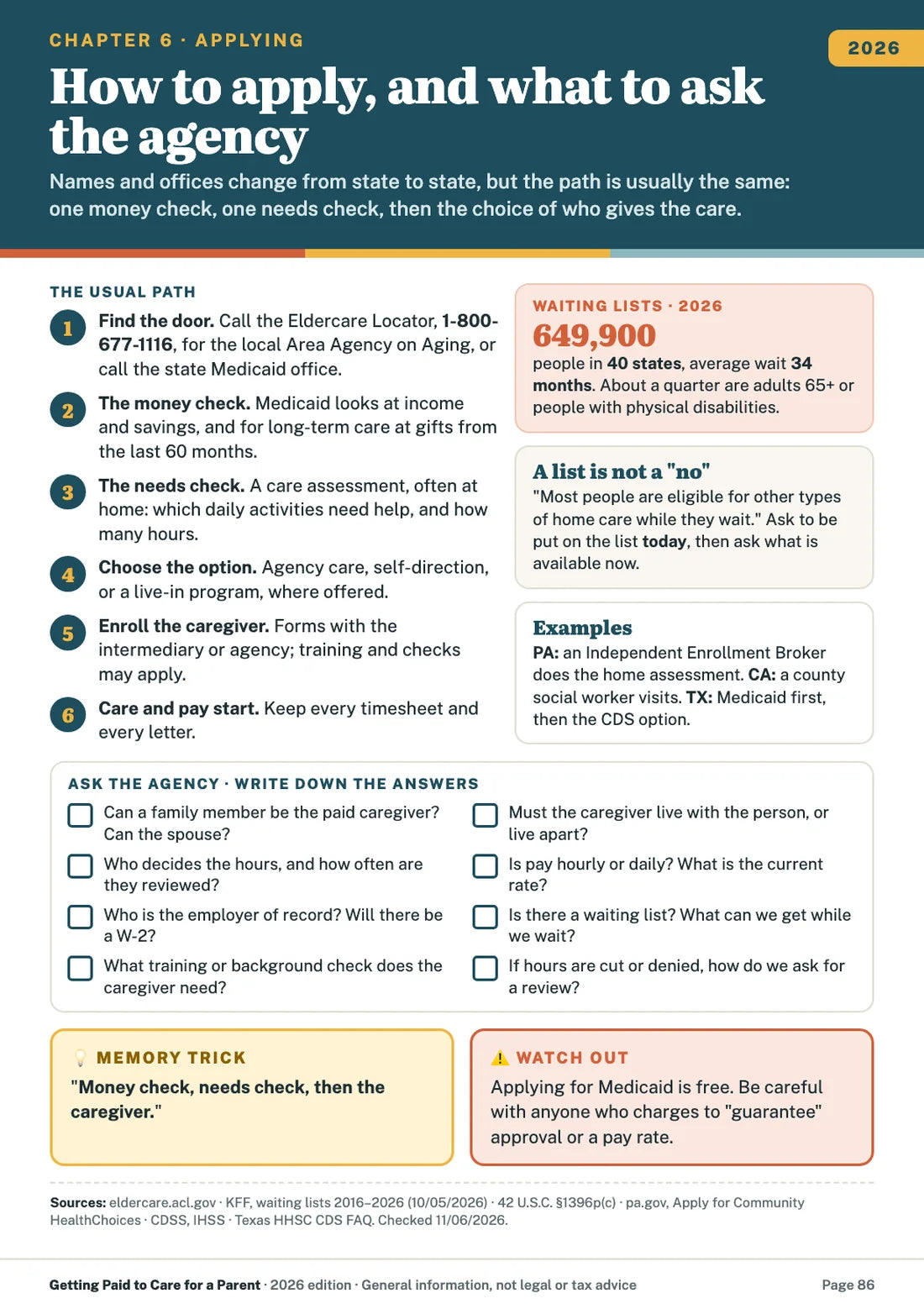
Which Medicaid programs in each state can pay a family member, what the care assessment looks at, and the exact question to ask, word for word.
See the whole picture first
Waiting lists, hourly and daily pay, who is the employer, and what the taxes look like, before anyone changes a job.
The VA has its own programs
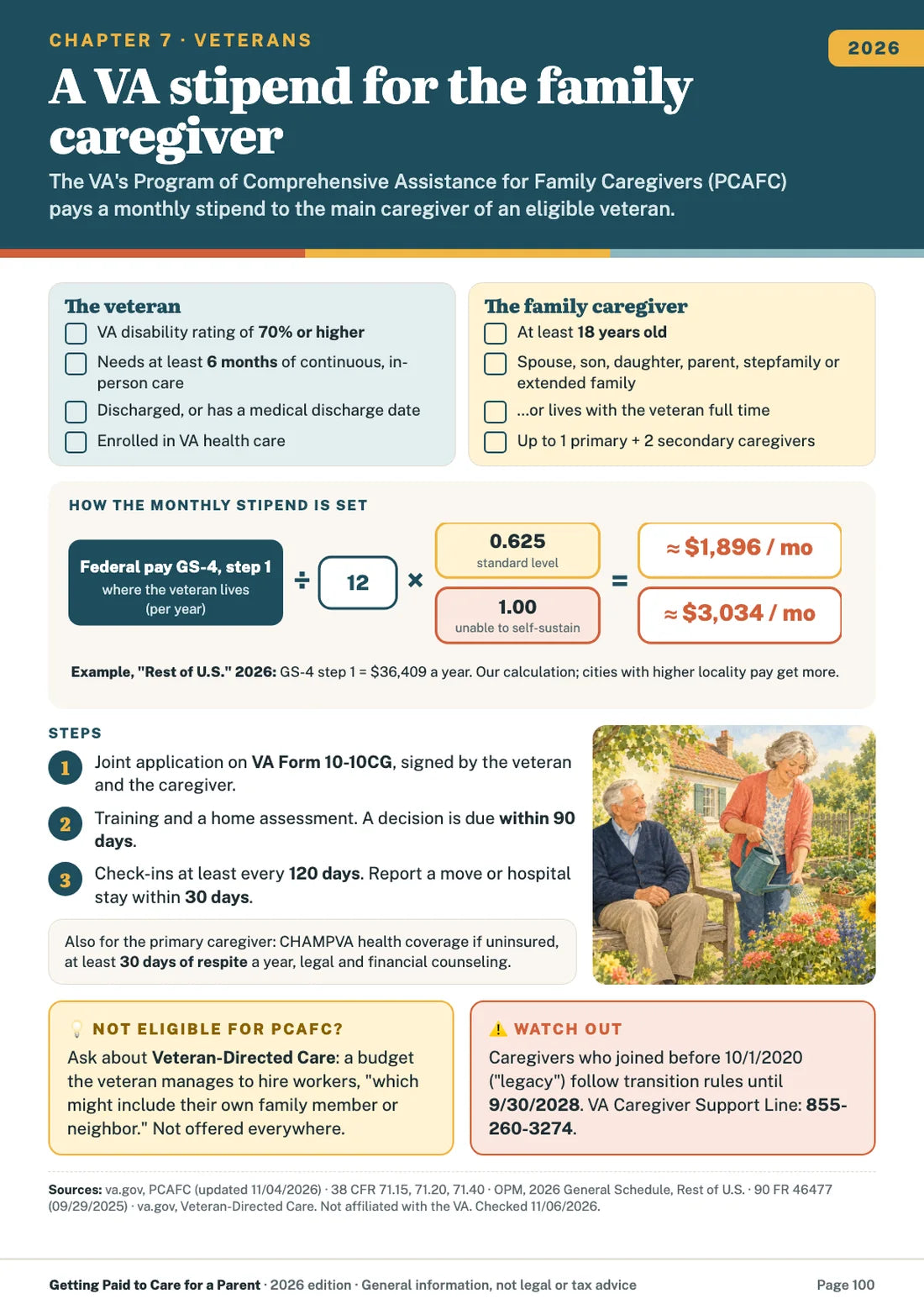
The PCAFC monthly stipend, Veteran-Directed Care, and how the stipend is calculated from federal pay tables.
What's worth knowing before the first application.
These rules are written down in federal regulations and state manuals. The book explains each one with a diagram, the 2026 numbers and the source.
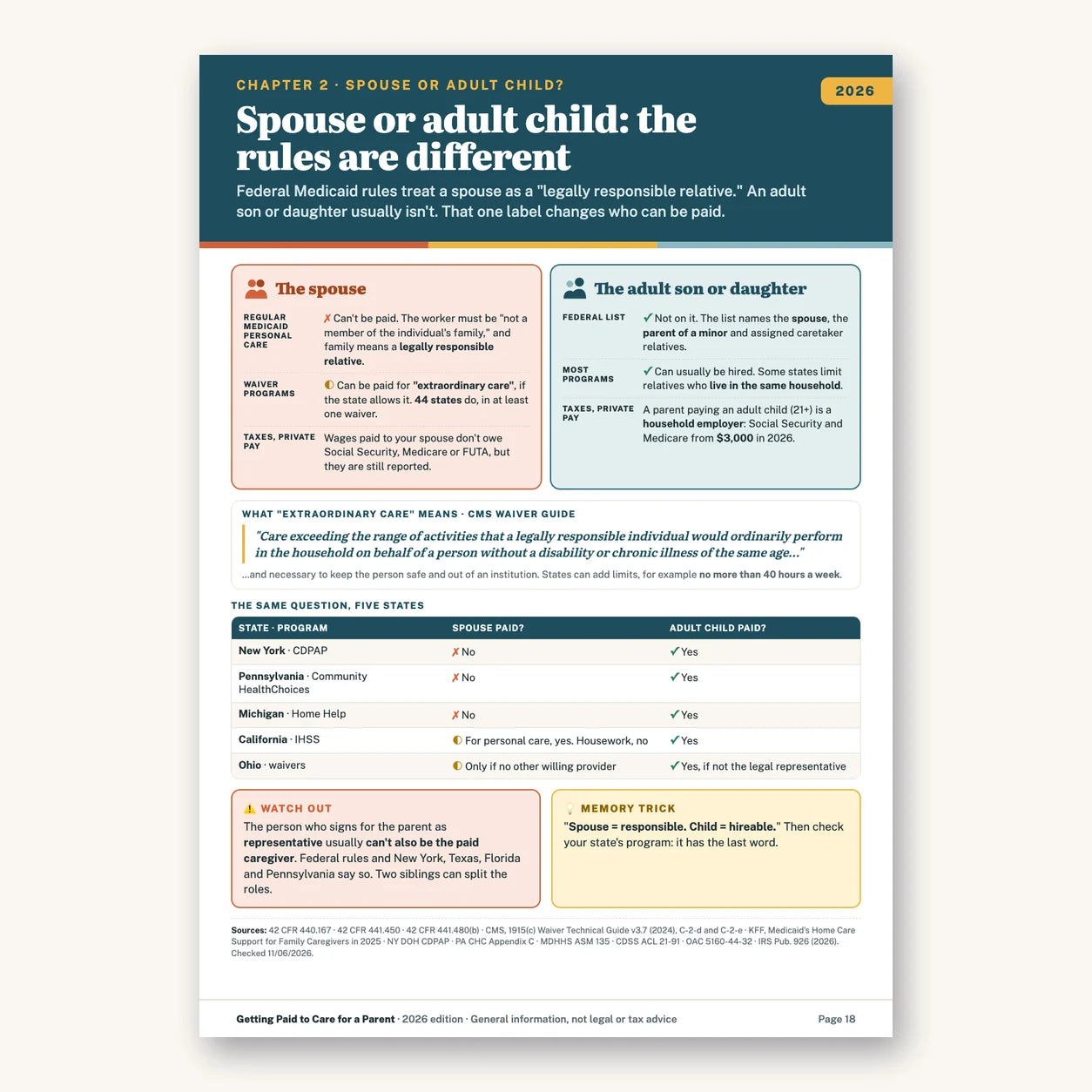
The label "legally responsible"
Regular Medicaid personal care can't pay a legally responsible relative, such as a spouse. Waiver programs can pay a spouse for "extraordinary care" in states that allow it: 44 states do.
One person can't do both
The person who manages the program for the parent usually can't also be the paid caregiver. Federal rules and several states say so. Siblings can split the roles.
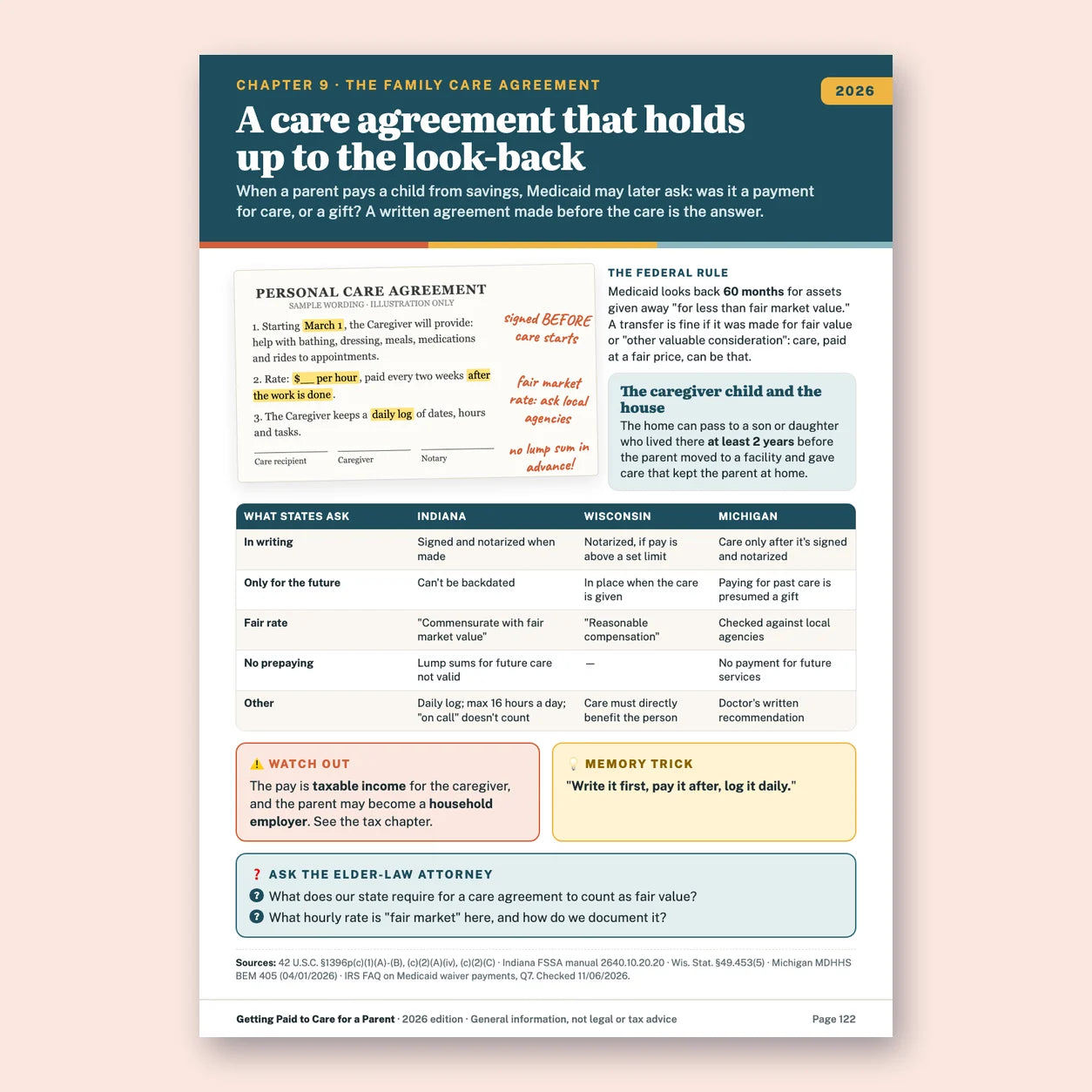
The 5-year look-back
Money a parent pays a child without a written agreement can later look like a gift to Medicaid. States ask for an agreement in writing, made first, at a fair rate, with a log.
Why a spouse and a child get different answers.
The federal definitions, the "extraordinary care" rule, and how five big states apply them.
- Who counts as a "legally responsible relative" in federal rules
- The CMS definition of "extraordinary care," quoted
- New York, Pennsylvania, Michigan, California and Ohio compared
- Why the representative and the paid caregiver should be two different people
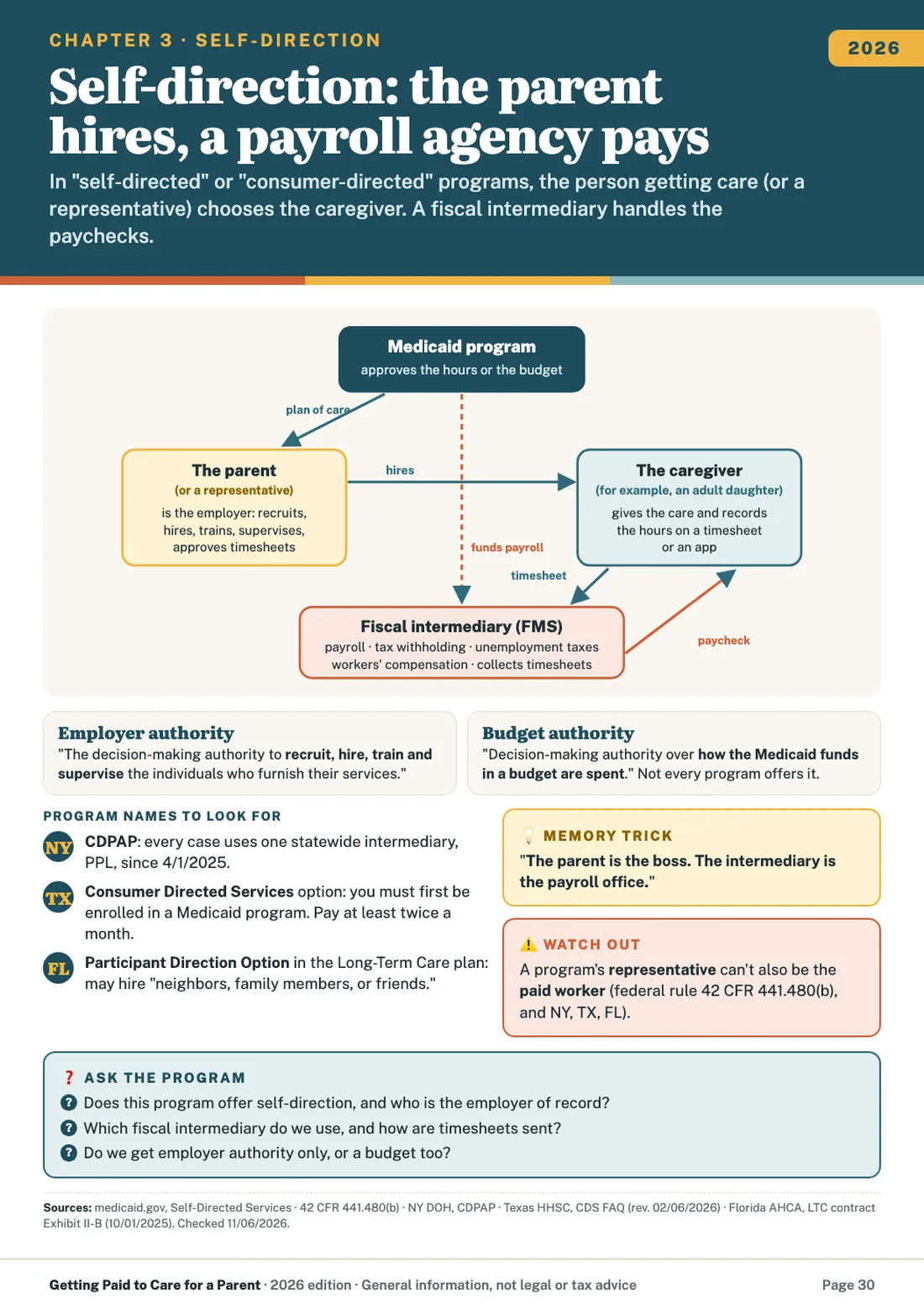
The parent hires. A payroll agency pays.
How self-directed and consumer-directed programs work, drawn as one flowchart.
- Employer authority and budget authority, in plain words
- What the fiscal intermediary does: payroll, withholding, workers' comp
- New York's single intermediary since 4/1/2025, Texas CDS, Florida's Participant Direction Option
- Timesheets: what to record, every day
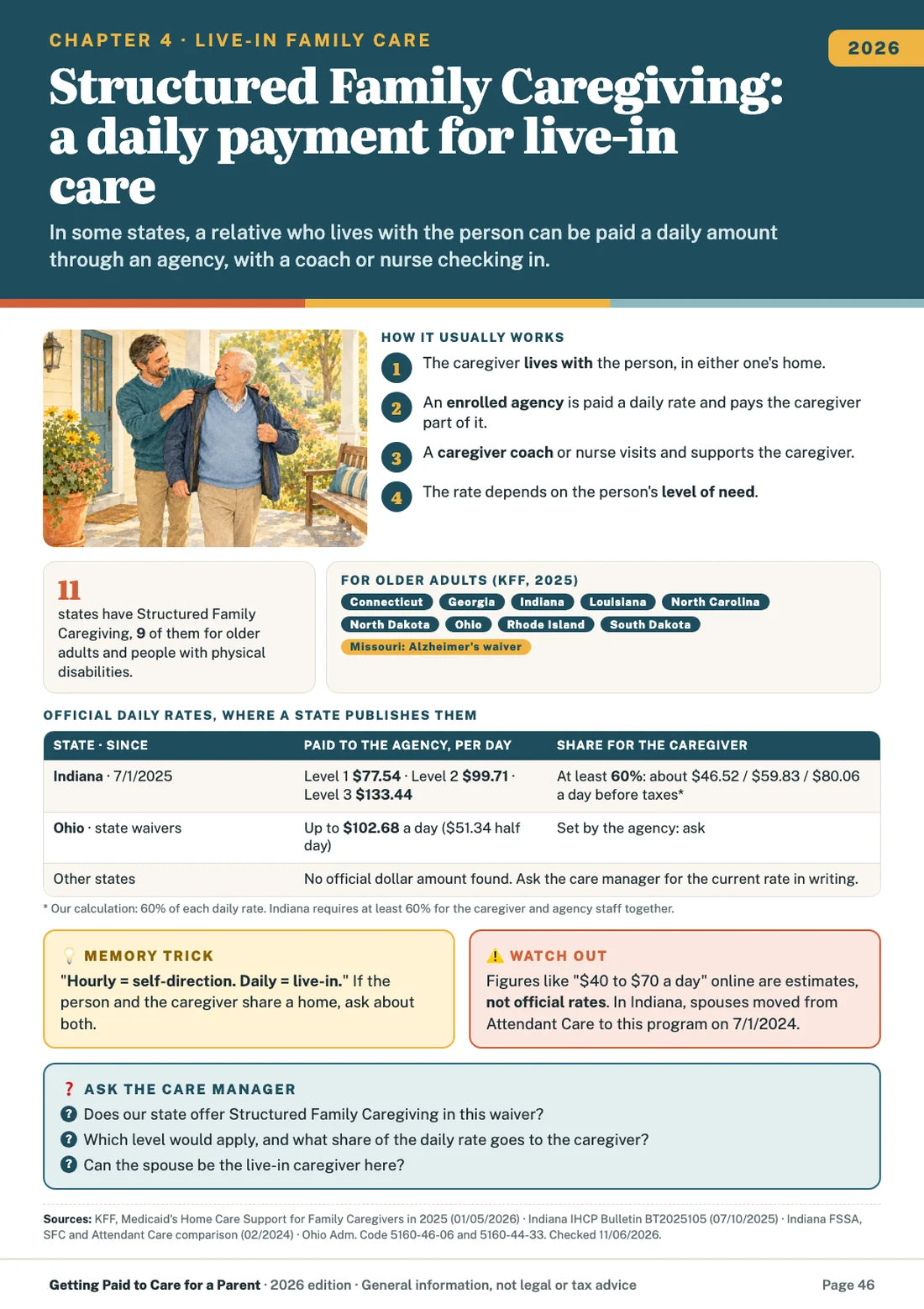
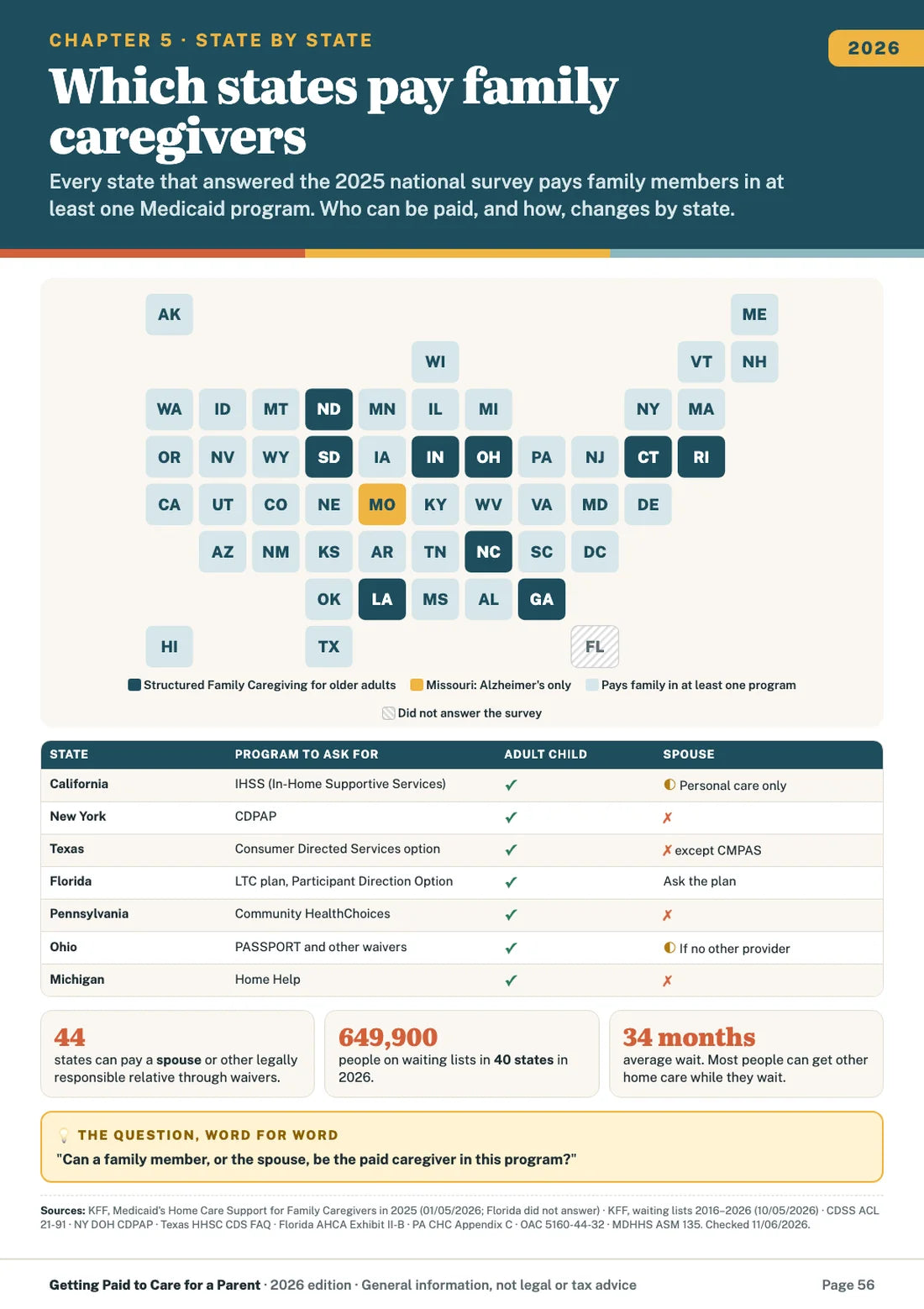
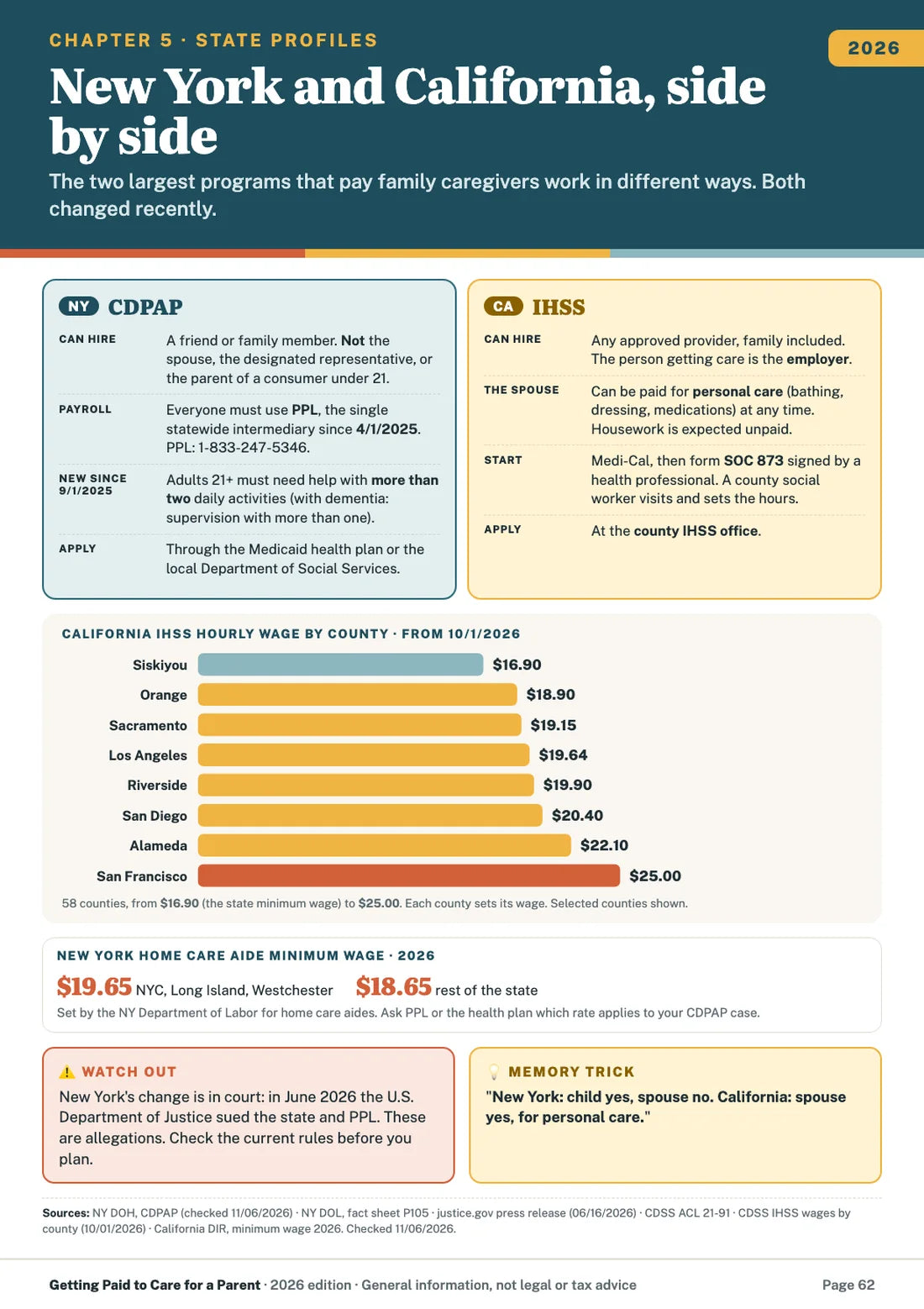
The map, then a profile for 12 states.
Which states have Structured Family Caregiving, which program to ask for, and who can be paid.
- 11 states with Structured Family Caregiving, 9 of them for older adults
- California IHSS wages by county: $16.90 to $25.00 an hour from 10/1/2026
- Indiana's official daily rates: $77.54, $99.71 and $133.44 to the agency
- Waiting lists: 649,900 people in 40 states, and what to do meanwhile
The VA stipend for a veteran's family caregiver.
The Program of Comprehensive Assistance for Family Caregivers, step by step, with the formula behind the monthly amount.
- Who qualifies: a VA rating of 70% or higher and 6+ months of in-person care
- The stipend: federal GS-4 step 1 pay ÷ 12 × 0.625 or 1.00, with a 2026 example
- VA Form 10-10CG, the 90-day decision and the 120-day check-ins
- Veteran-Directed Care: a budget that can hire a family member
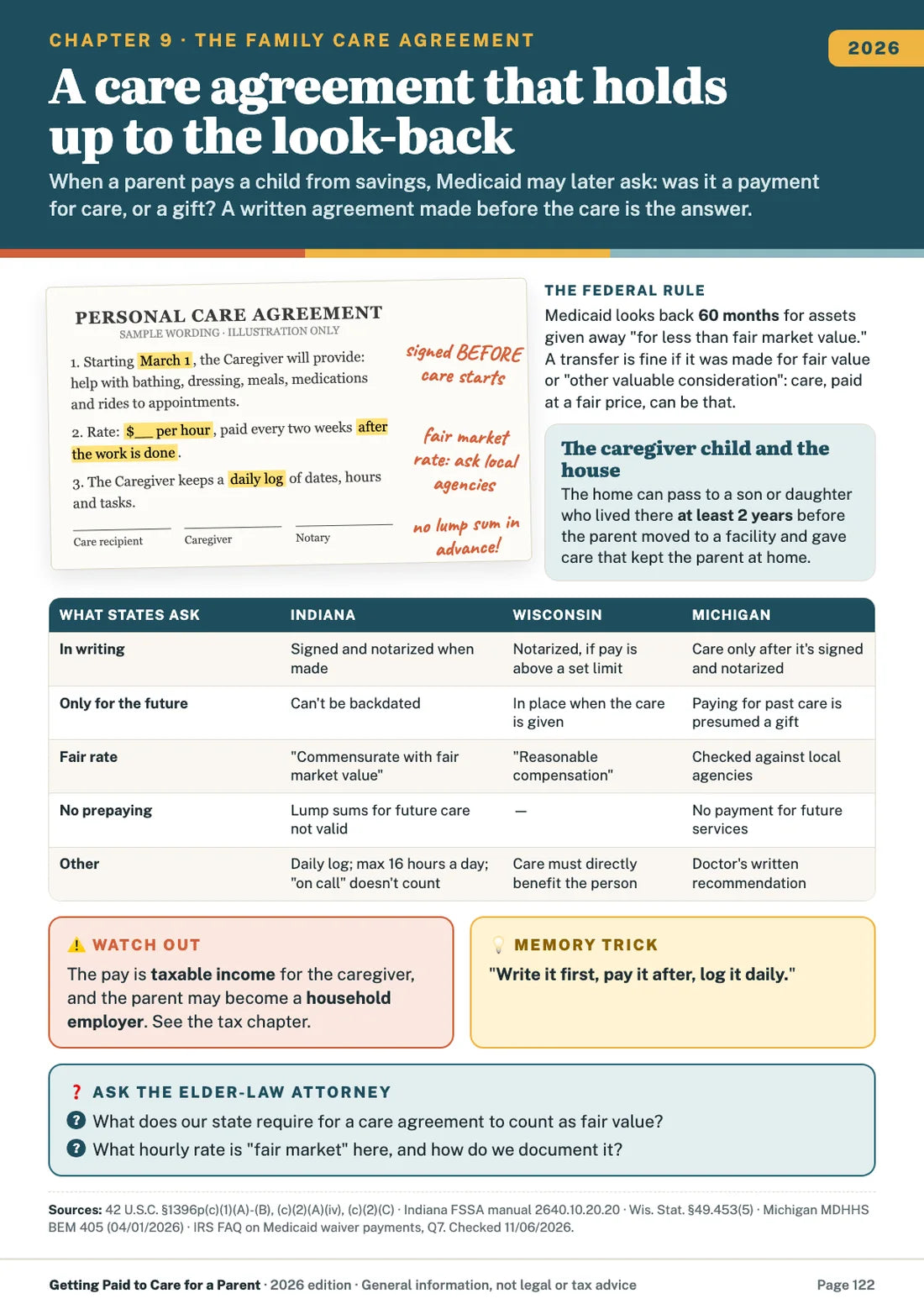
Paying a child from savings, the careful way.
An annotated sample agreement and what Indiana, Wisconsin and Michigan ask for, to bring to an elder-law attorney.
- In writing, signed before care starts, notarized where required
- A fair market rate, and how families document it
- No lump sums paid in advance; a daily log of hours and tasks
- The home and the caregiver child: the 2-year rule in federal law
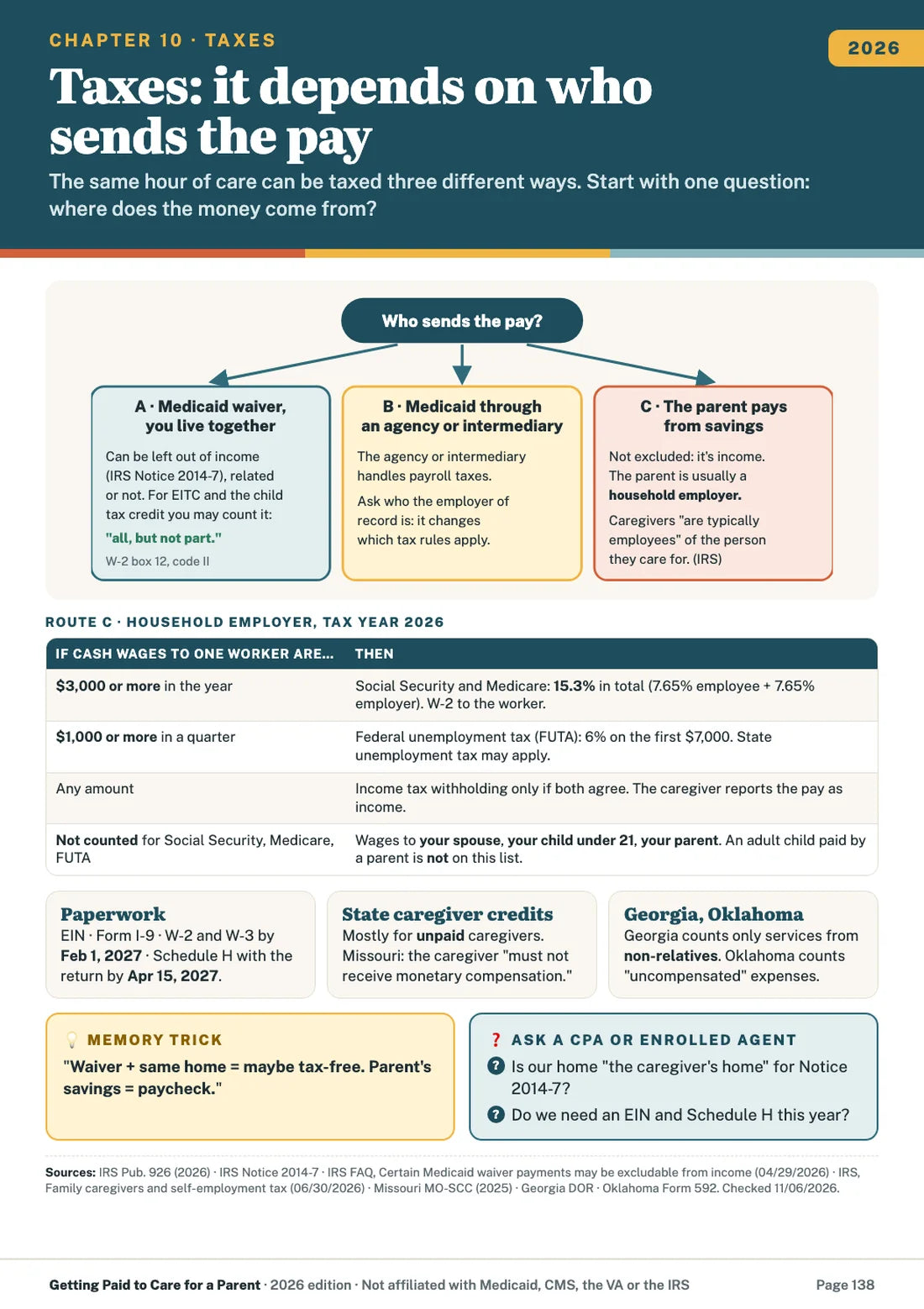
Three ways the pay arrives, three tax answers.
Medicaid waiver pay for live-in care, pay through an agency, and pay from a parent's savings, side by side.
- IRS Notice 2014-7: when Medicaid waiver pay can be left out of income
- Household employer basics for 2026: the $3,000 and $1,000 thresholds, W-2, Schedule H
- Who is exempt: a spouse, a child under 21, a parent
- Why most state caregiver tax credits are for unpaid caregivers

The whole family looks at the same page.
The parent, the caregiver and the siblings can read the same chart and call the agency with the same questions. Decisions get clearer, and the roles are written down.
- Built on regulations, agency manuals and official pages, cited on every page
- Reviewed every year: rates and thresholds change each year
- We are not a home-care agency and we don't enroll caregivers
Every route to paid family care, in one guide.
Full table of contents
On screen, on paper, or both.
Color PDF, right after payment
Open it on a phone, tablet or computer, and share it with the family. Print the timesheets and logs as many times as you need.
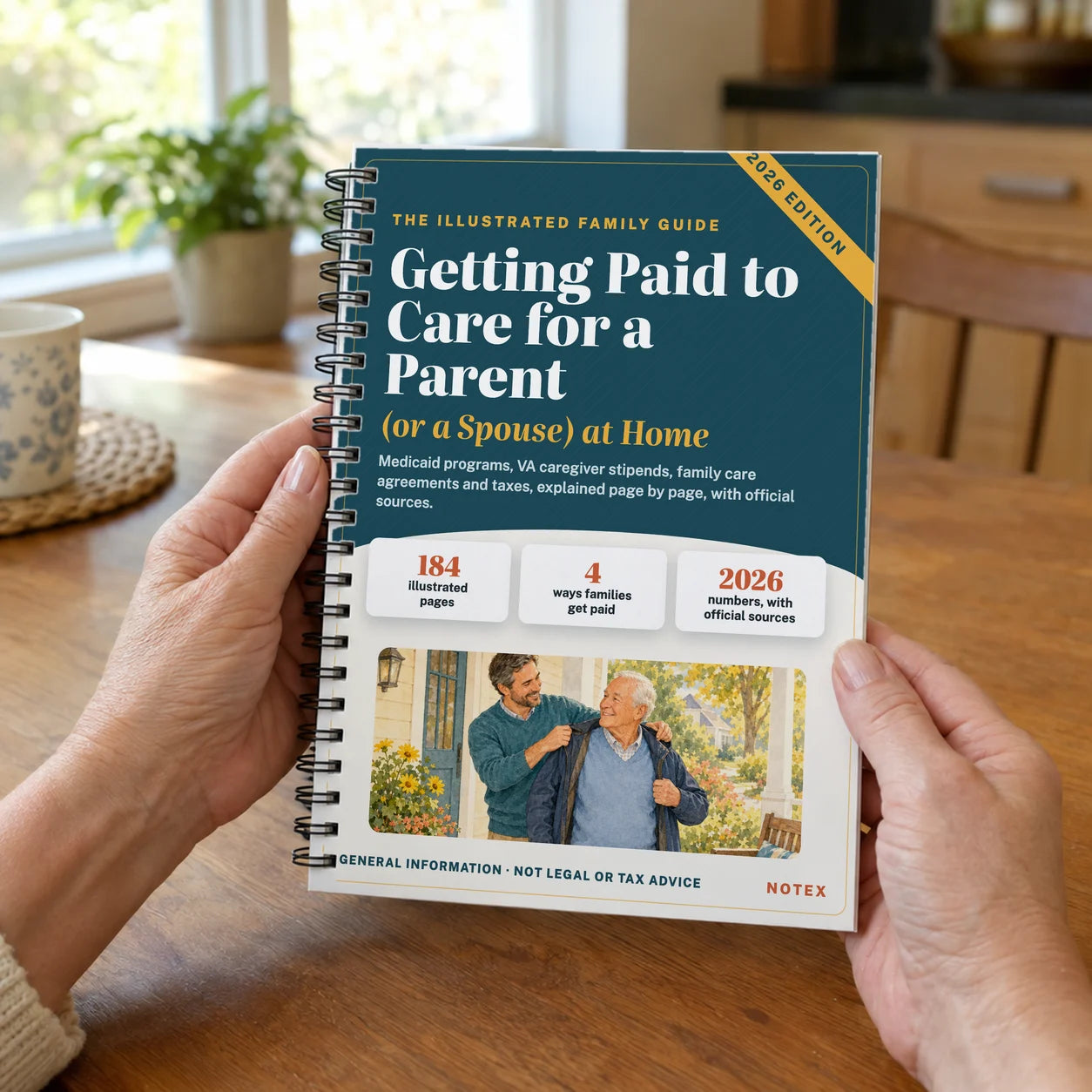
184 color pages, spiral-bound
Lies flat next to the phone and the paperwork. Free shipping to US addresses, about 5–8 business days. Want both? Printed + eBook for $79.99.
The logs, the timesheet and the checklists.
Programs and agreements both depend on records. The worksheets help the family keep them the same way every day.
- Daily care log and timesheet
- Call log for the Medicaid office, the VA and the agency
- Care agreement checklist to bring to the attorney
- With the eBook: print them again whenever you need
See 10 real pages, free.
The four routes, spouse or child, self-direction, Structured Family Caregiving, the state map, New York and California, how to apply, the VA stipend, the care agreement and the taxes. Read them and decide with the pages in front of you.
See the 10 pages ↓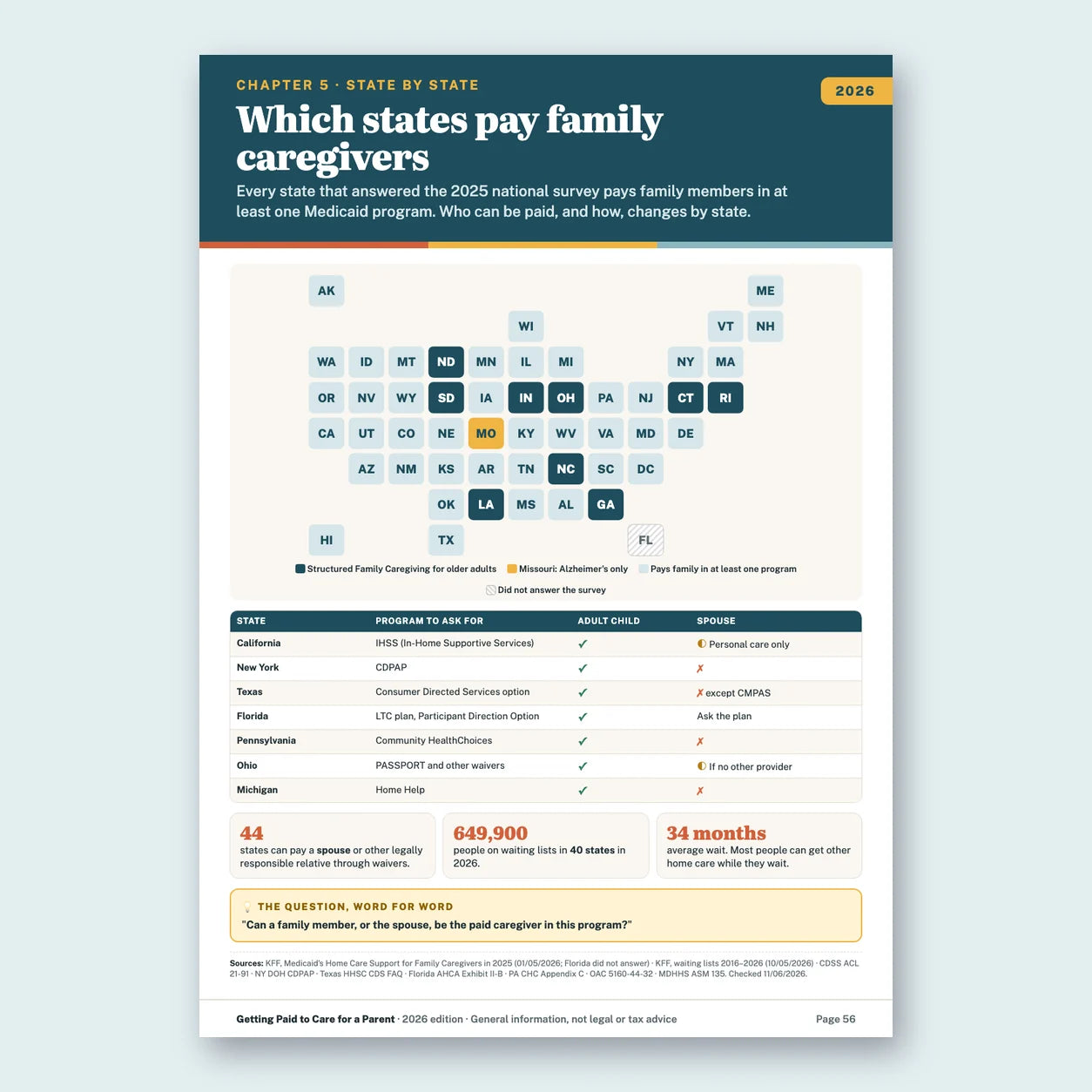
How is it different?
| What it has | This guide | Official websites | Home-care agency ads | Attorney or CPA |
|---|---|---|---|---|
| Medicaid, VA, insurance, agreements and taxes in one place | ✓ | Spread across many sites | Usually one program | Varies |
| Spouse and adult-child rules, state by state | ✓ | One state at a time | Their own states | Your state |
| Flowcharts, maps and decision trees | ✓ | Varies | — | — |
| 2026 numbers with the source on each page | ✓ | ✓ | Varies | ✓ |
| Advice on your family's own situation | ✗ General information | ✗ | ✗ | ✓ |
| Price | From $39.99 | Free | Varies | Fees vary |
You can start reading tonight.
You pay
Secure checkout, no account, no subscription. One payment.
You open the eBook
If you chose the eBook, the download link arrives by email. Open it on a phone, tablet or computer.
The book arrives
If you chose the printed book, it ships free to your US address.
Every route to paid family care, explained for the whole family.
- 184 illustrated color pages, 15 chapters
- Medicaid programs, spouse and child rules, applying and waiting lists
- The state map and 12 state profiles
- VA caregiver programs, long-term care insurance, care agreements and taxes
- 2026 numbers, each with its official source
- Care log, timesheet, call log and checklists to print
- Printed book: spiral-bound, lies flat, free US shipping
What families ask before buying
Is this legal or tax advice?
No. This guide provides general information, not legal, tax, or financial advice. It is not a substitute for an attorney, a CPA or the agency that runs each program. Rules change and vary by state: every topic in the book ends with the questions to ask.
Will this get us approved, or tell us how much we'll be paid?
No book can do that. Approval depends on each program's rules, the care assessment and, for Medicaid, income and savings. Pay depends on the state, the program and the hours. The book shows the official rates where states publish them, for example California's IHSS county wages of $16.90 to $25.00 an hour from October 2026, and tells you what to ask.
Can a spouse be paid, or only a son or daughter?
It depends on the program. Federal rules treat a spouse as a "legally responsible relative," which regular Medicaid personal care can't pay. Many waiver programs can pay a spouse for "extraordinary care." Chapter 2 explains the difference and compares real state programs.
Which states does it cover?
All of them, at the level of the federal rules and the state map. Chapter 5 profiles 12 states in detail, including California, New York, Texas, Florida, Pennsylvania, Ohio, Michigan and Indiana, and shows what to ask your own state's Medicaid office.
Are you a home-care agency, or affiliated with Medicaid or the VA?
No. We sell the guide only. We are not a home-care agency, we don't enroll caregivers and we don't receive referral fees. We are not affiliated with or endorsed by Medicaid, CMS, the VA, the IRS or any government agency.
Does it cover veterans?
Yes. A full chapter on the VA's Program of Comprehensive Assistance for Family Caregivers (PCAFC), how the monthly stipend is calculated, the application on VA Form 10-10CG, and Veteran-Directed Care.
Is the sample care agreement a ready-to-sign contract?
No. It is sample wording, annotated, to show what states look for. Bring it to an elder-law attorney in your state, who can write an agreement that fits your family.
Does it explain the taxes?
Yes, for the three ways the pay can arrive: Medicaid waiver pay for live-in care (IRS Notice 2014-7), pay through an agency, and pay from a parent's savings, with the 2026 household employer thresholds from IRS Publication 926. For your own return, talk to a CPA or an enrolled agent.
Are the numbers up to date?
The 2026 figures were checked on November 6, 2026 against official sources such as medicaid.gov, ecfr.gov, state Medicaid agencies, va.gov, opm.gov and irs.gov, and each page shows its source. We review the guide every year.
Can I read it on my phone?
Yes. The eBook is a color PDF that opens on a phone, tablet or computer. You can print the worksheets and any page you want.
When does the printed book arrive?
Shipping is free to US addresses and takes about 5–8 business days. The eBook arrives by email right after payment.
What if it's not right for us?
You have a 30-day guarantee. Write to us within 30 days and we'll refund you. No questions, no forms.
Ready to see which routes could pay your family's caregiver?
184 illustrated pages, 2026 numbers with sources, the state map and the questions to ask. 30-day guarantee.
From $39.99 · eBook or printed