The papers to sign while a parent still can.
And what happens if it's too late.
An illustrated guide for adult children in the U.S.: the financial power of attorney, the health care proxy, the living will and the HIPAA release, how banks, doctors, Social Security and the VA treat them, and what the court does when nothing was signed. 120 pages, six states side by side, the law behind every rule. eBook or printed book.
The book at home, the PDF for the brother or sister who lives far away · $59.99
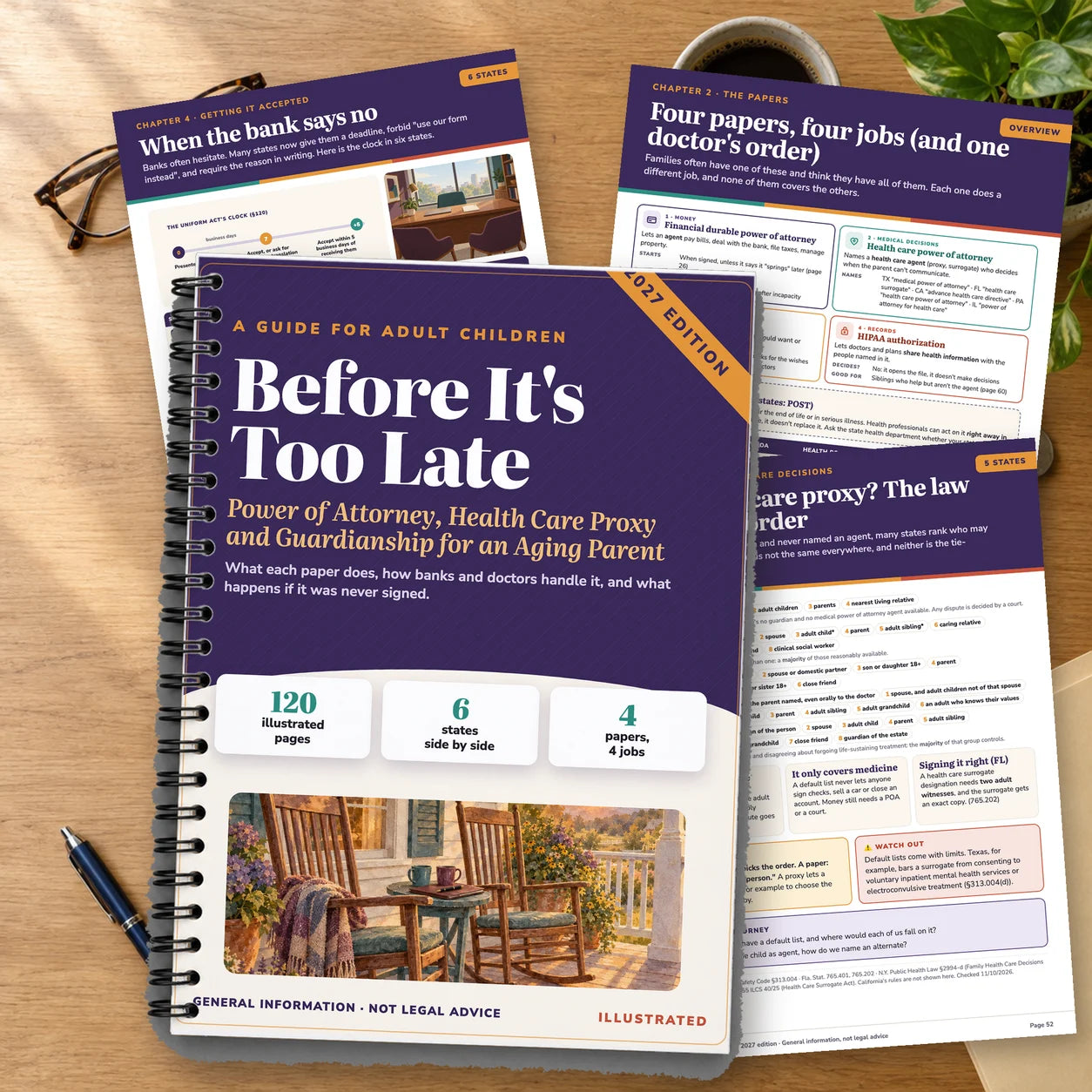
Not a wall of legal text. One question per page.
Every page works the same way, so a family can find the rule, the deadline and the next step before the meeting with the attorney or the call with the bank.
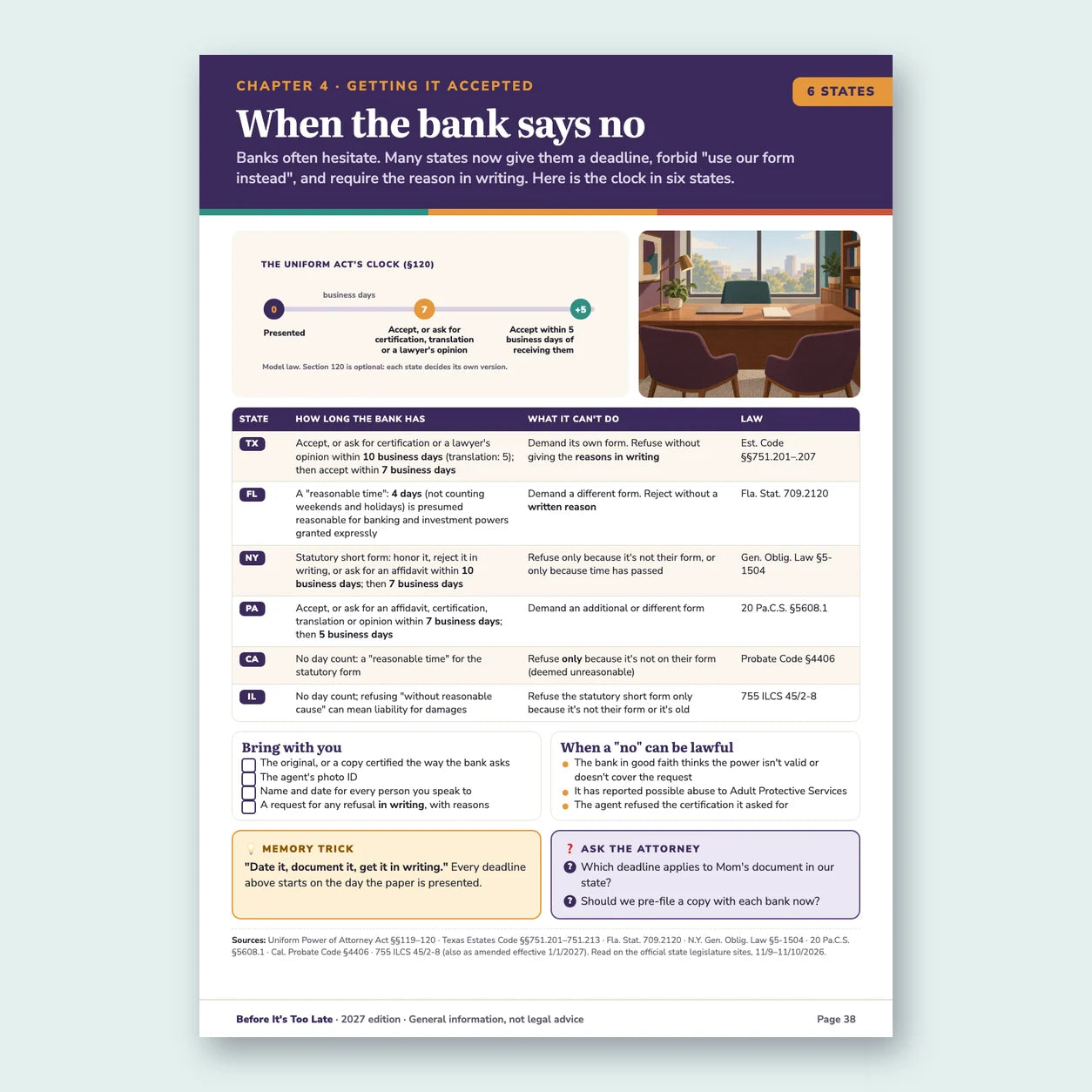
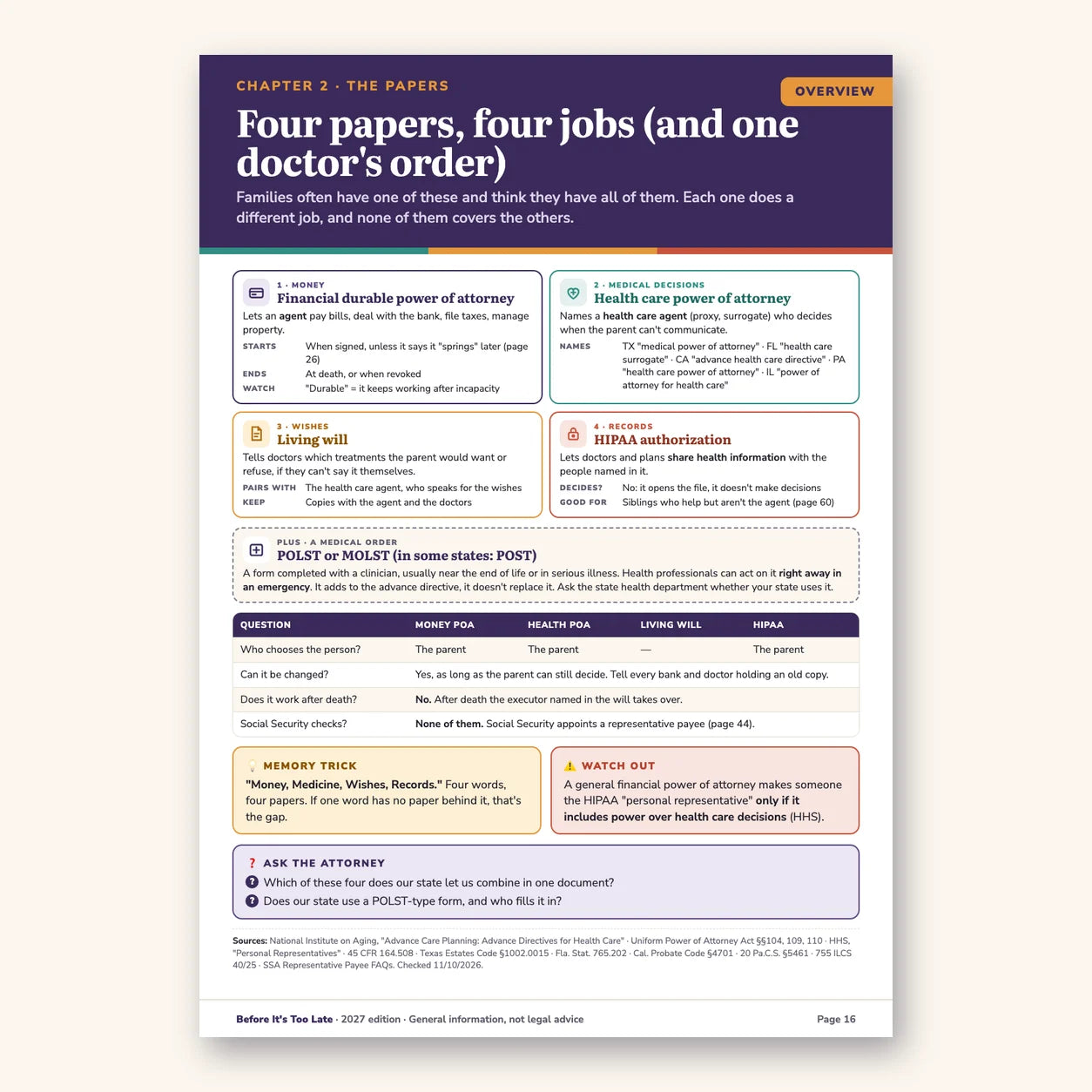
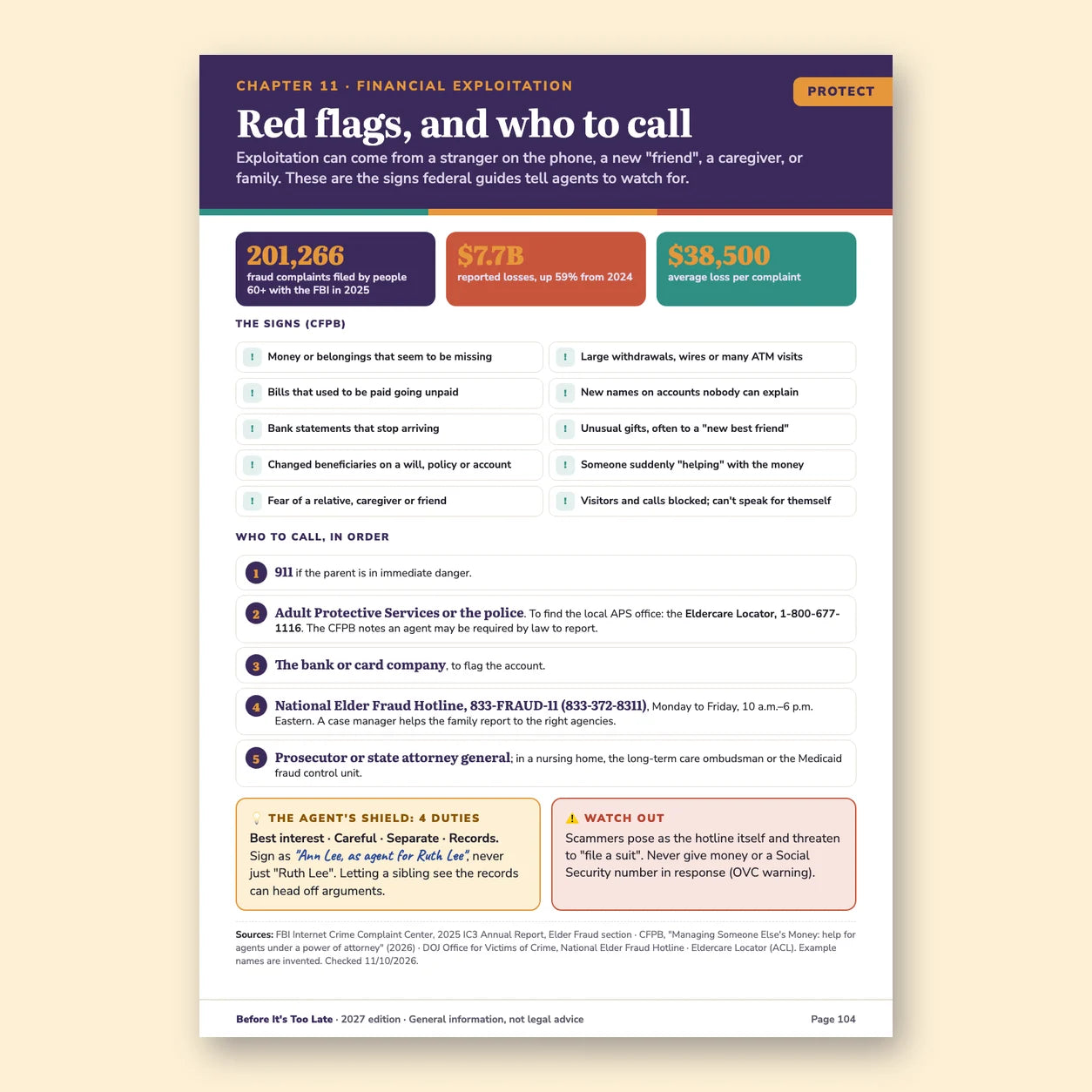
This is what the pages look like.
For the adult child who will be the one to step in.
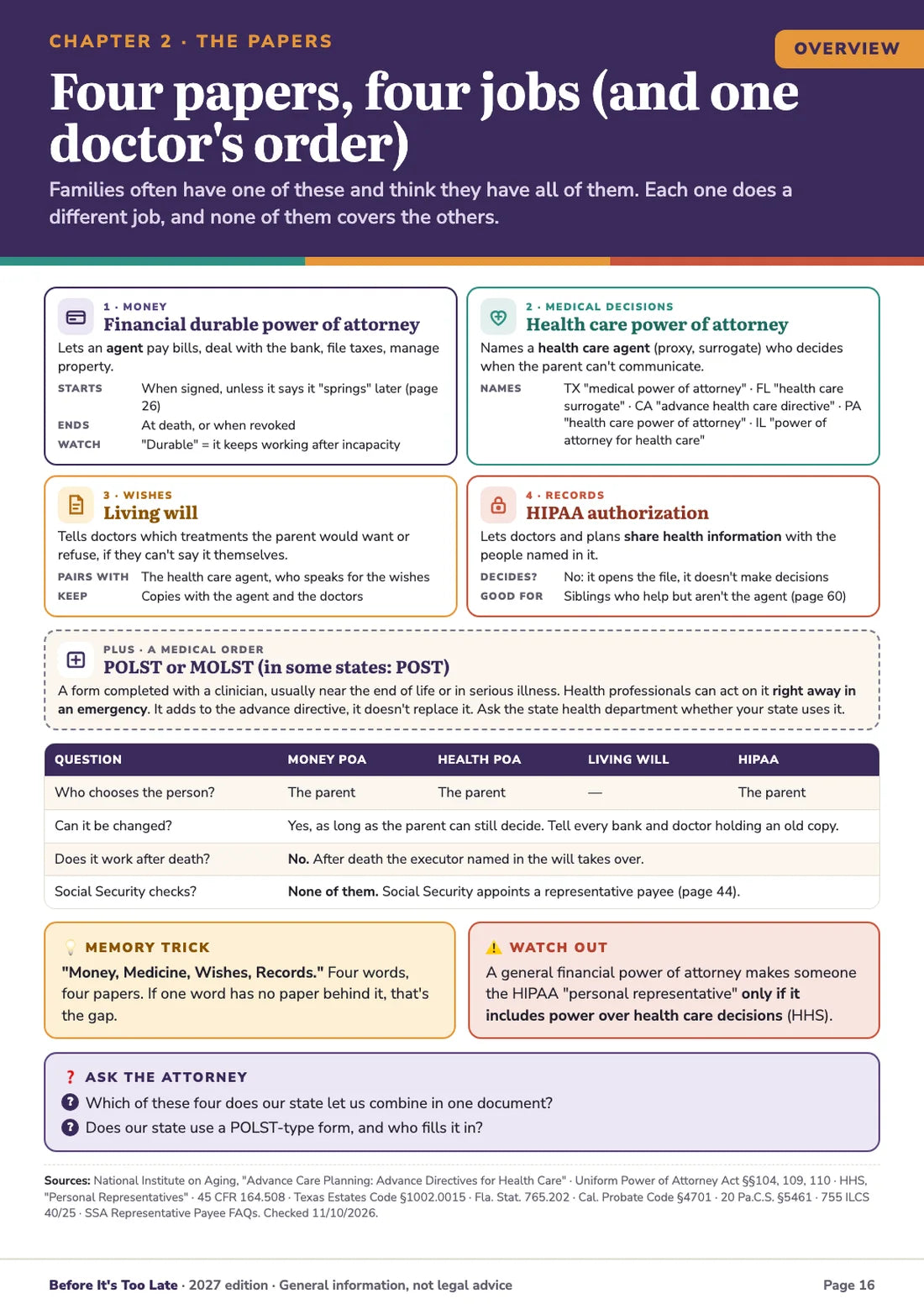
Before anything happens
Which four papers to have, what each one can and can't do, immediate or springing, and what to ask at the first meeting with an attorney.
Good days and bad days
Why the timing matters, what the attorney checks, and how banks, doctors, Social Security and the VA will treat the papers once they're signed.
When it's already too late
Who decides on medical care if nothing was signed, how guardianship works, and the less restrictive options judges must look at first.
Signing the papers is half the job.
These rules are written down in state law and federal guidance. The book explains each one with a diagram and the source.
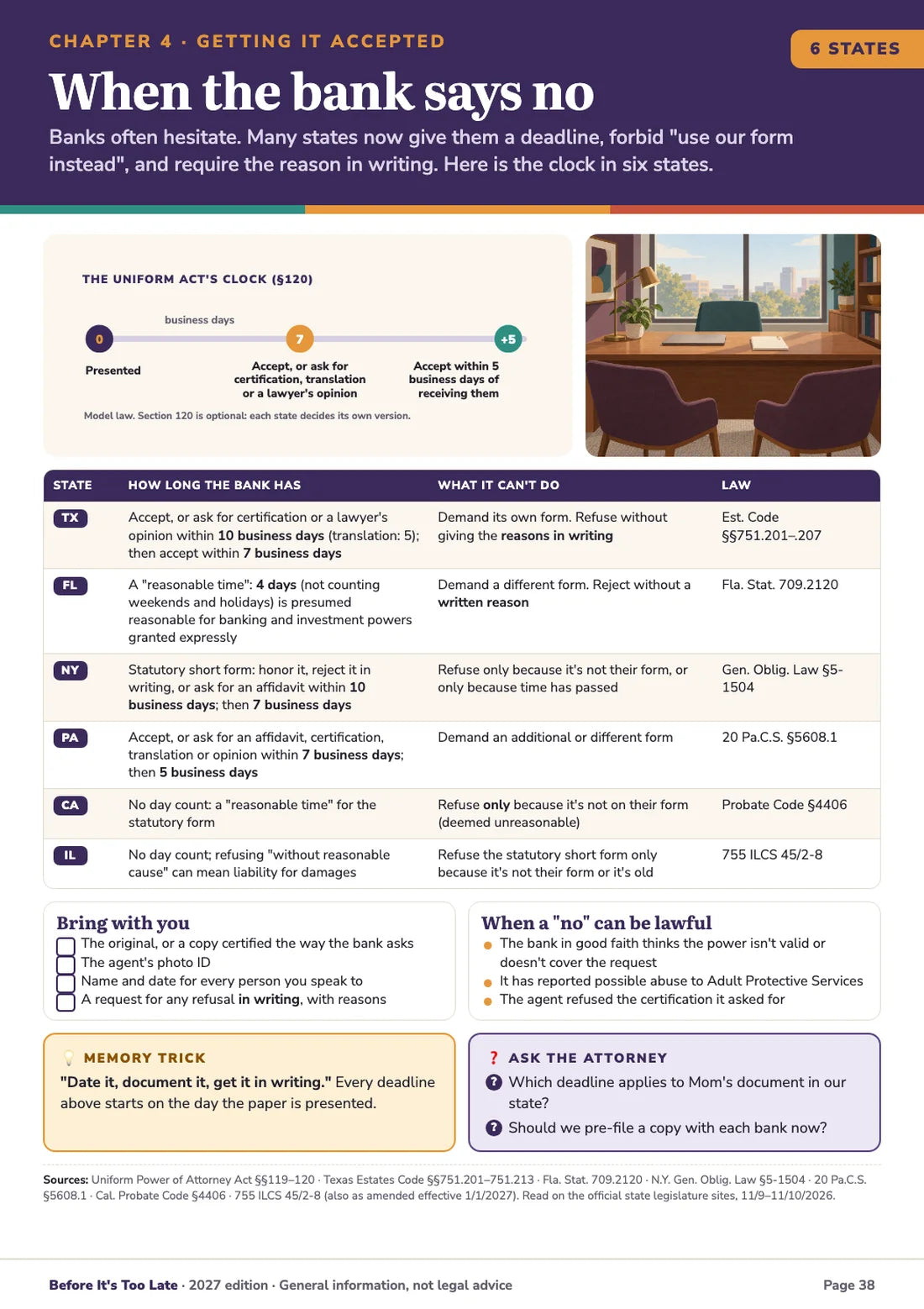
Many states set a deadline
7 business days under the uniform act and in Pennsylvania, 10 in Texas and New York, 4 days presumed reasonable in Florida. And "use our form instead" is not allowed in several of them.
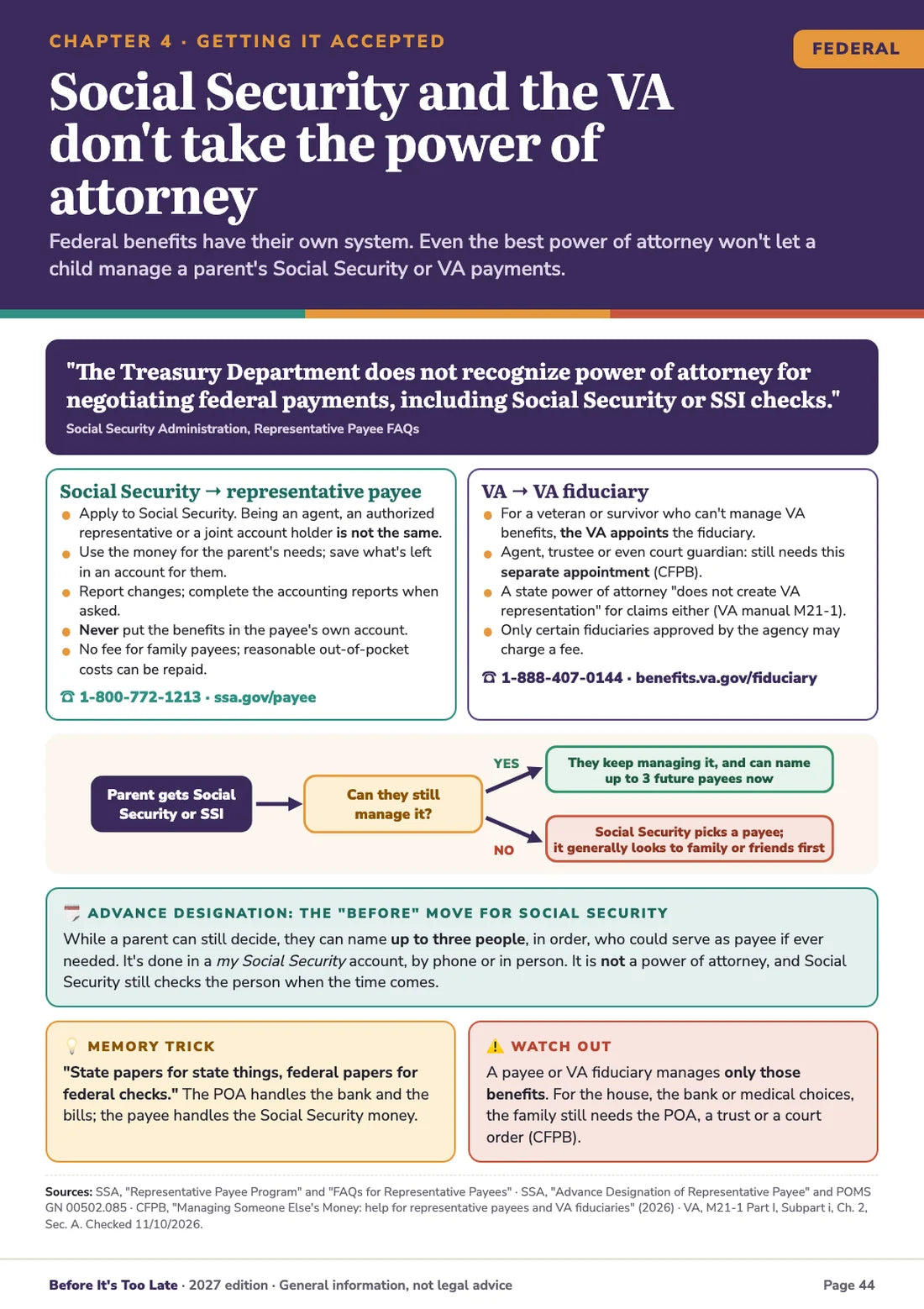
The POA stops at Social Security
Social Security and the VA need their own appointment: a representative payee or a VA fiduciary. A parent can name up to three future payees in advance.
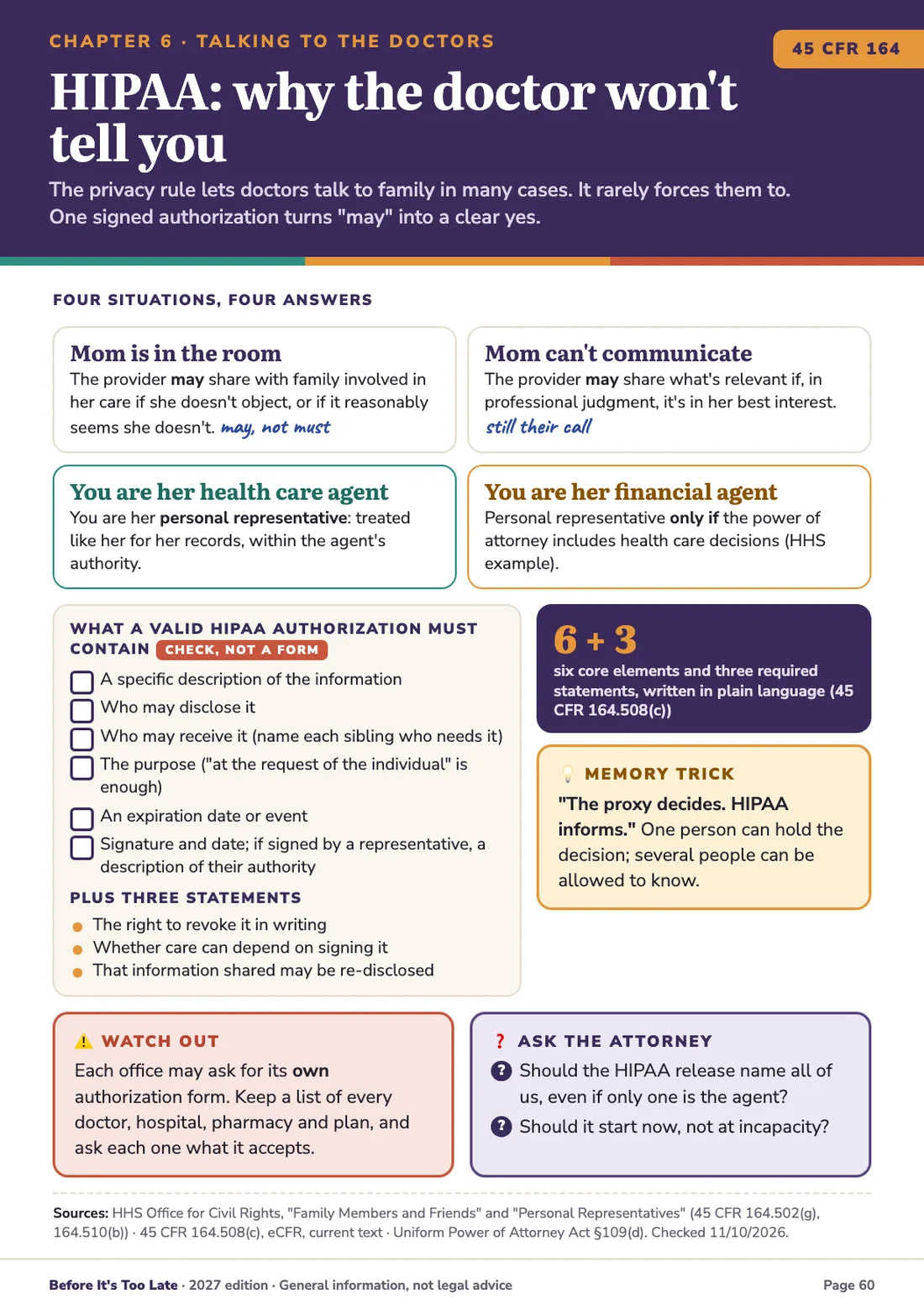
HIPAA says "may", not "must"
Doctors may talk to family involved in care, but they aren't required to. A signed authorization or a health care agent turns "may" into a clear answer.
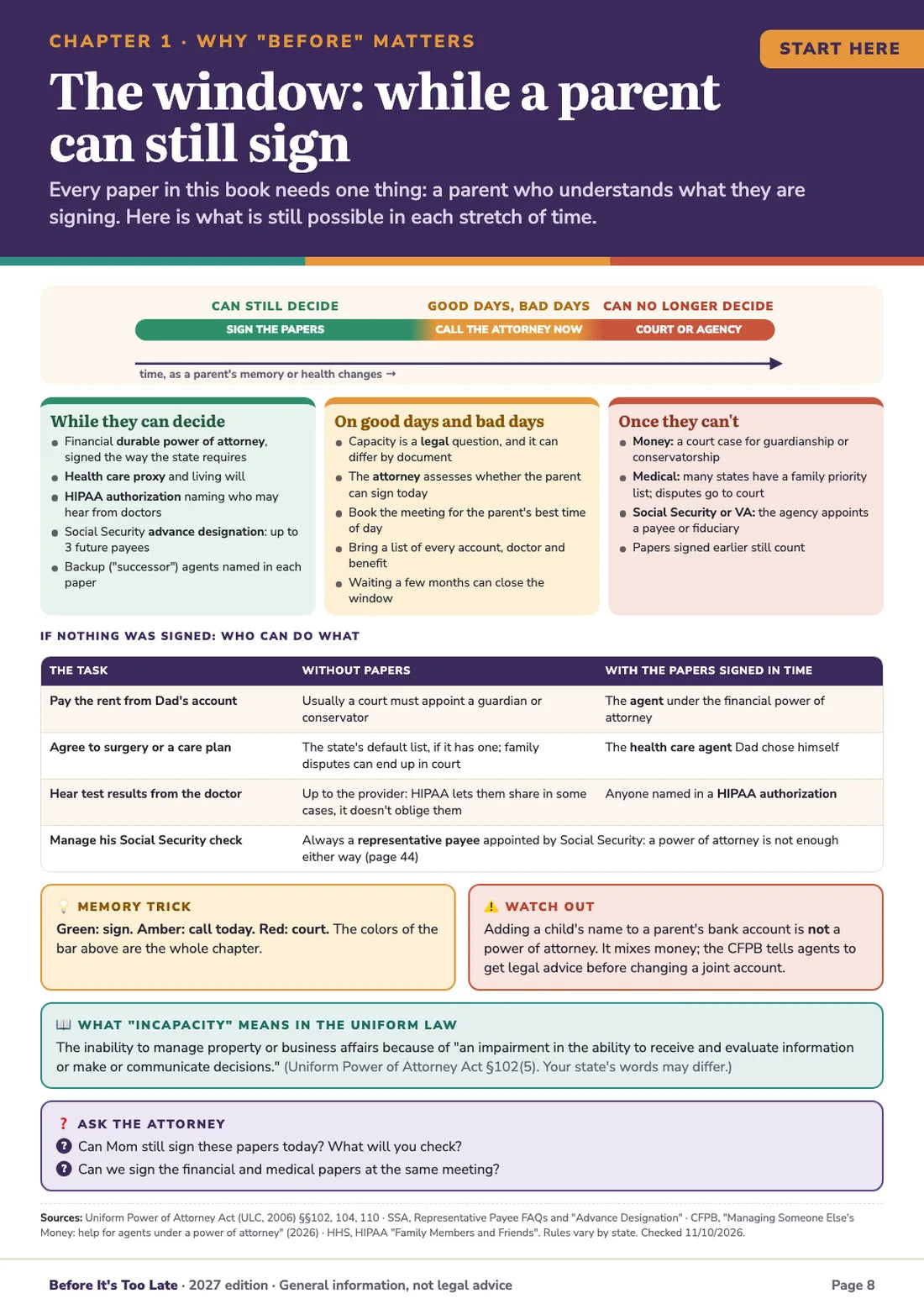
The window, on one line.
Every paper needs a parent who understands what they're signing. The book shows what's still possible at each stage.
- What to sign while a parent can still decide
- Good days and bad days: why the attorney decides on capacity
- If nothing was signed: who can pay the rent, agree to surgery, hear test results
- Why a joint bank account is not a plan
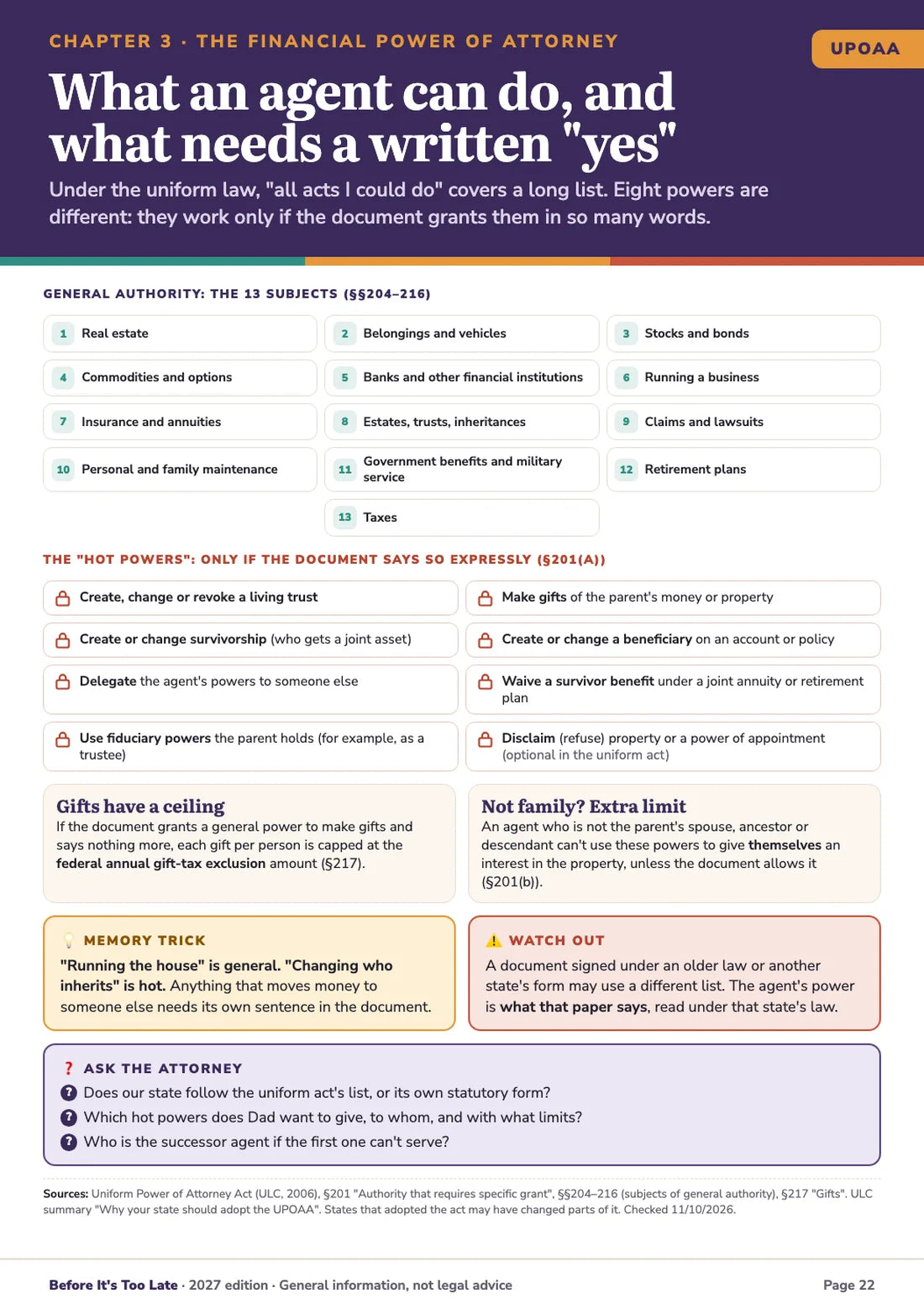
What the agent can do, and what needs a written "yes".
Under the uniform act, general authority covers 13 subjects. Eight "hot powers" work only if the document grants them expressly.
- Gifts, trusts, beneficiaries, survivorship: the powers that need their own sentence
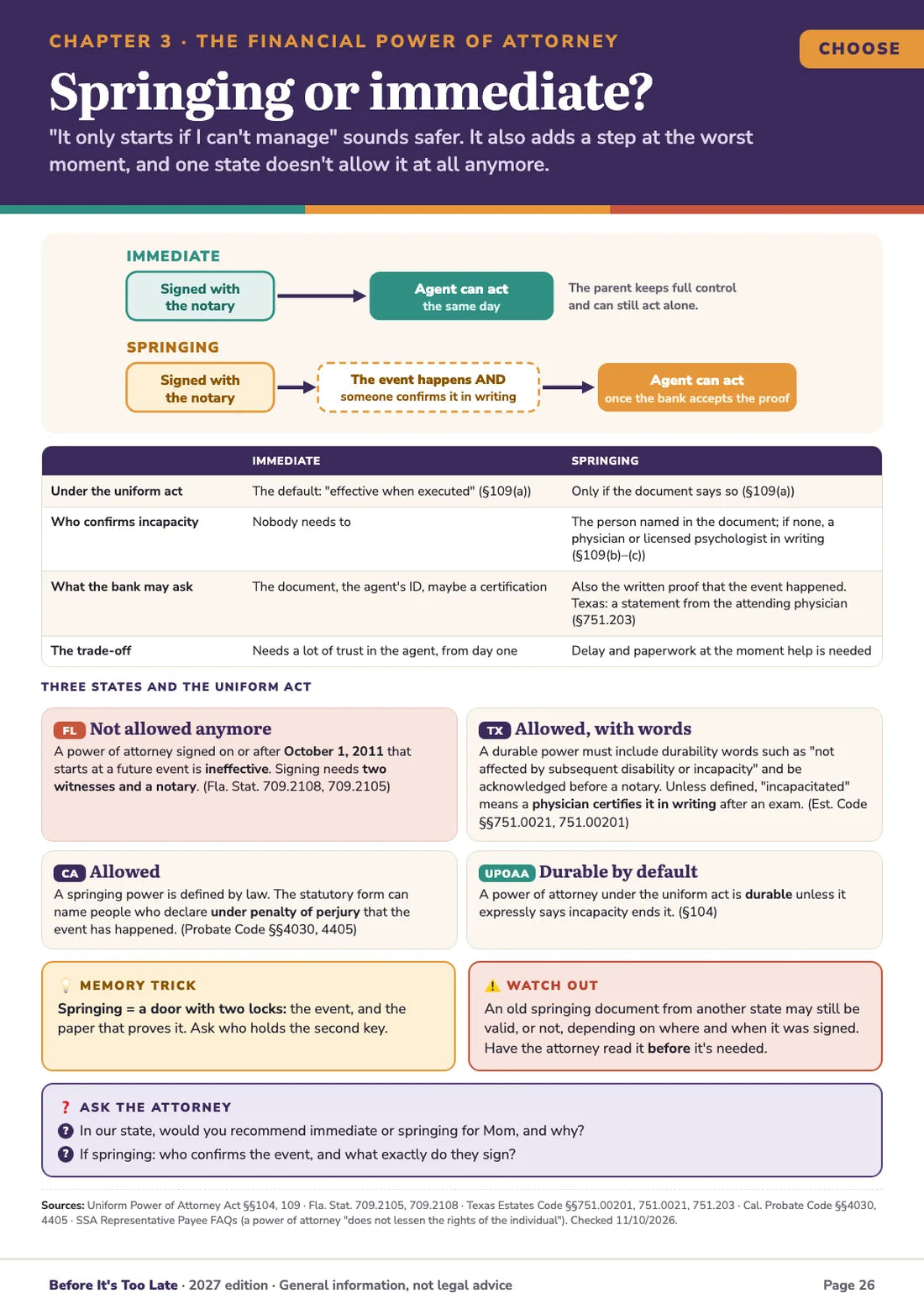
- Springing or immediate, and why Florida no longer allows springing
- The agent's duties: best interest, care, separate money, records
- How to sign as agent, and why never just the parent's name
When the bank says no.
Many states now give banks a deadline and require the reason for a refusal in writing. The book puts six states on one page.
- Texas 10 + 7 business days, New York 10 + 7, Pennsylvania 7 + 5
- Florida: 4 days presumed reasonable for banking powers
- When a refusal can be lawful
- Social Security payee, VA fiduciary and the advance designation
The proxy, the living will, HIPAA and POLST.
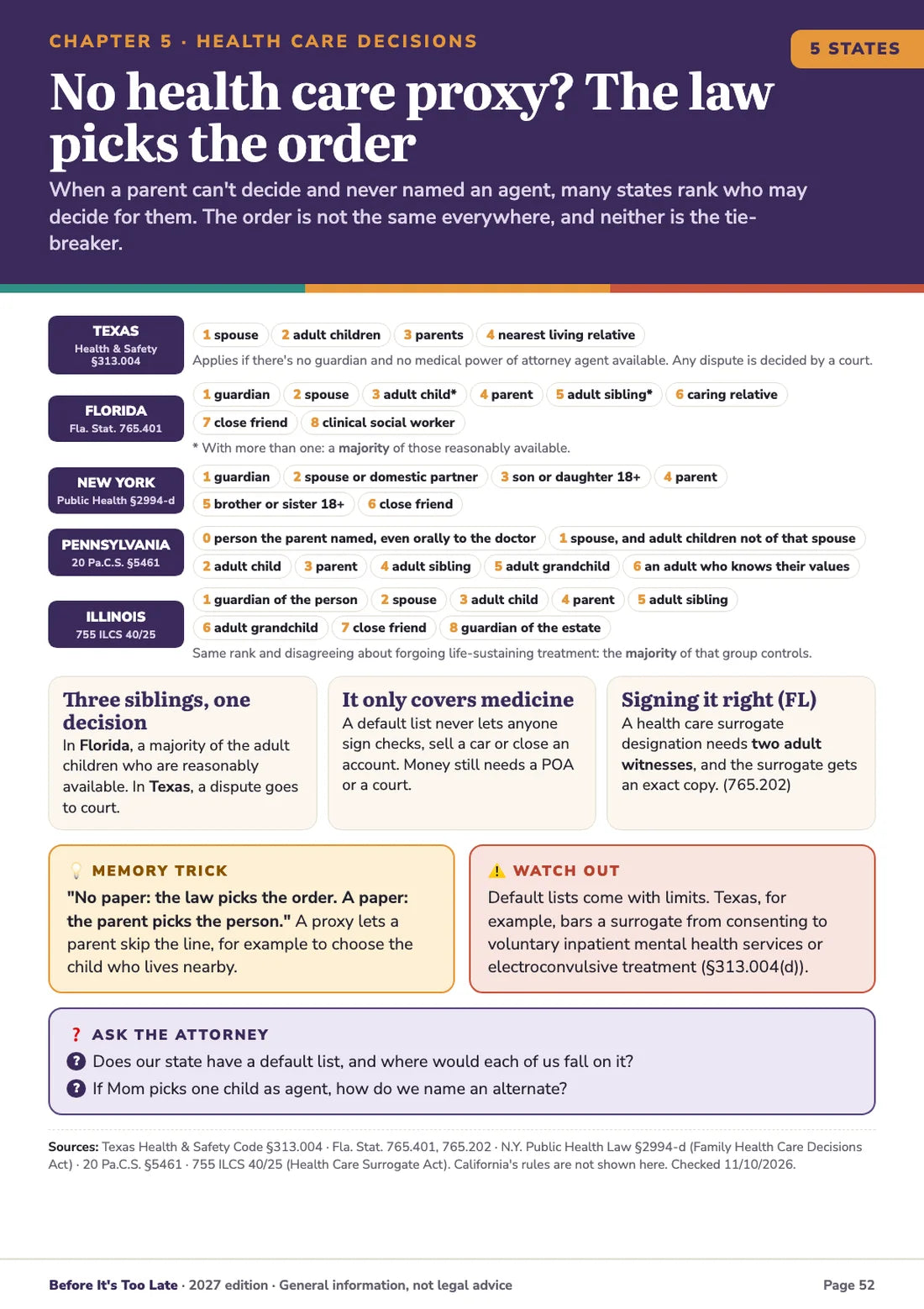
Who speaks for a parent at the hospital, and who the law picks when nobody was named.
- Five states' default order: spouse, children, parents, siblings…
- Three siblings, one decision: majority rule or court
- The six elements a HIPAA authorization must contain
- POLST or MOLST, and Medicare's advance care planning visit
Guardianship, and the doors to try first.
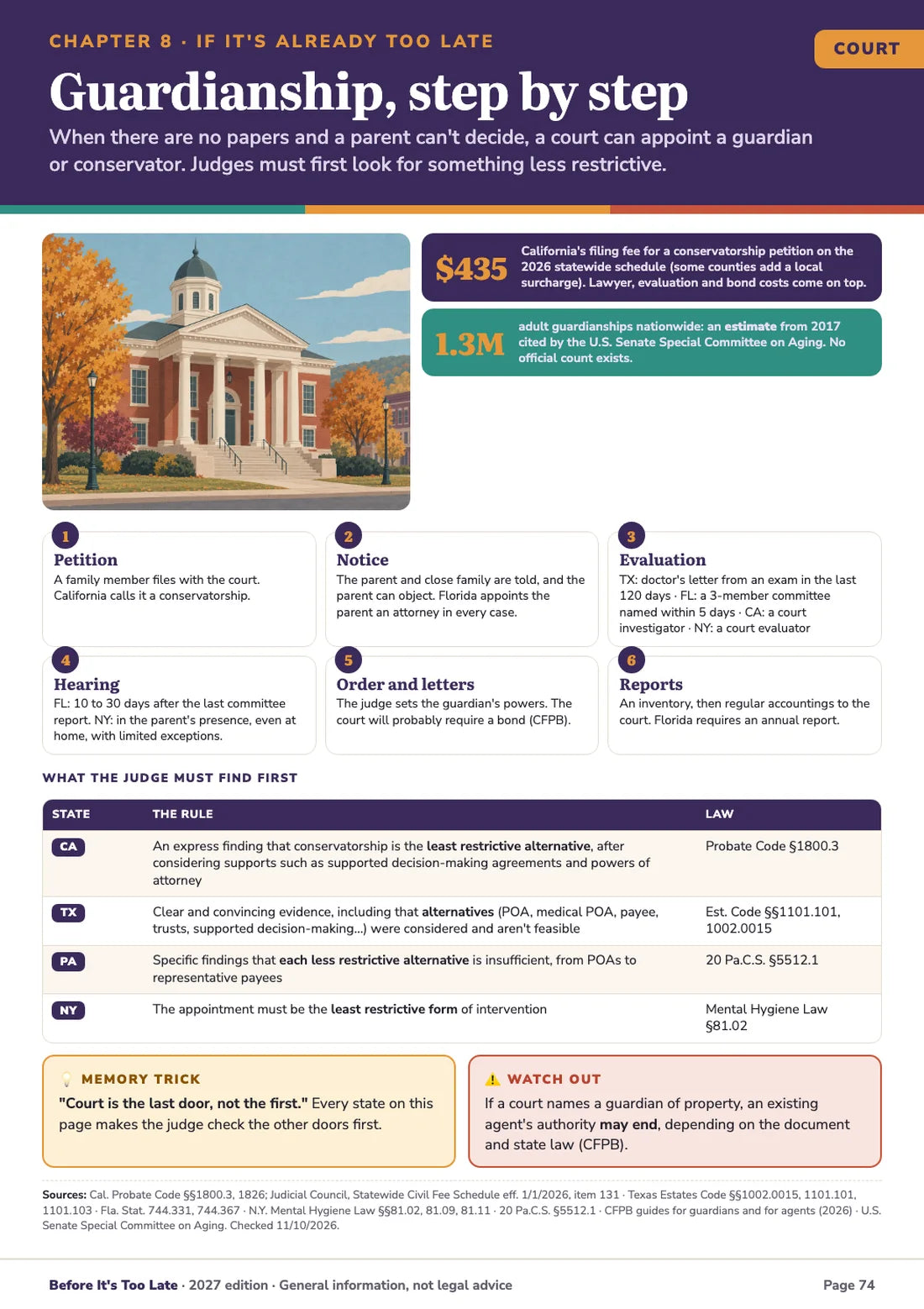
When nothing was signed, a court may appoint a guardian or conservator. Judges must first look at less restrictive options.
- The six steps, from petition to yearly reports
- Texas: a doctor's letter from an exam in the last 120 days
- Florida: a three-member examining committee named within 5 days
- Supported decision-making, payees and other alternatives
Brothers and sisters, records and red flags.
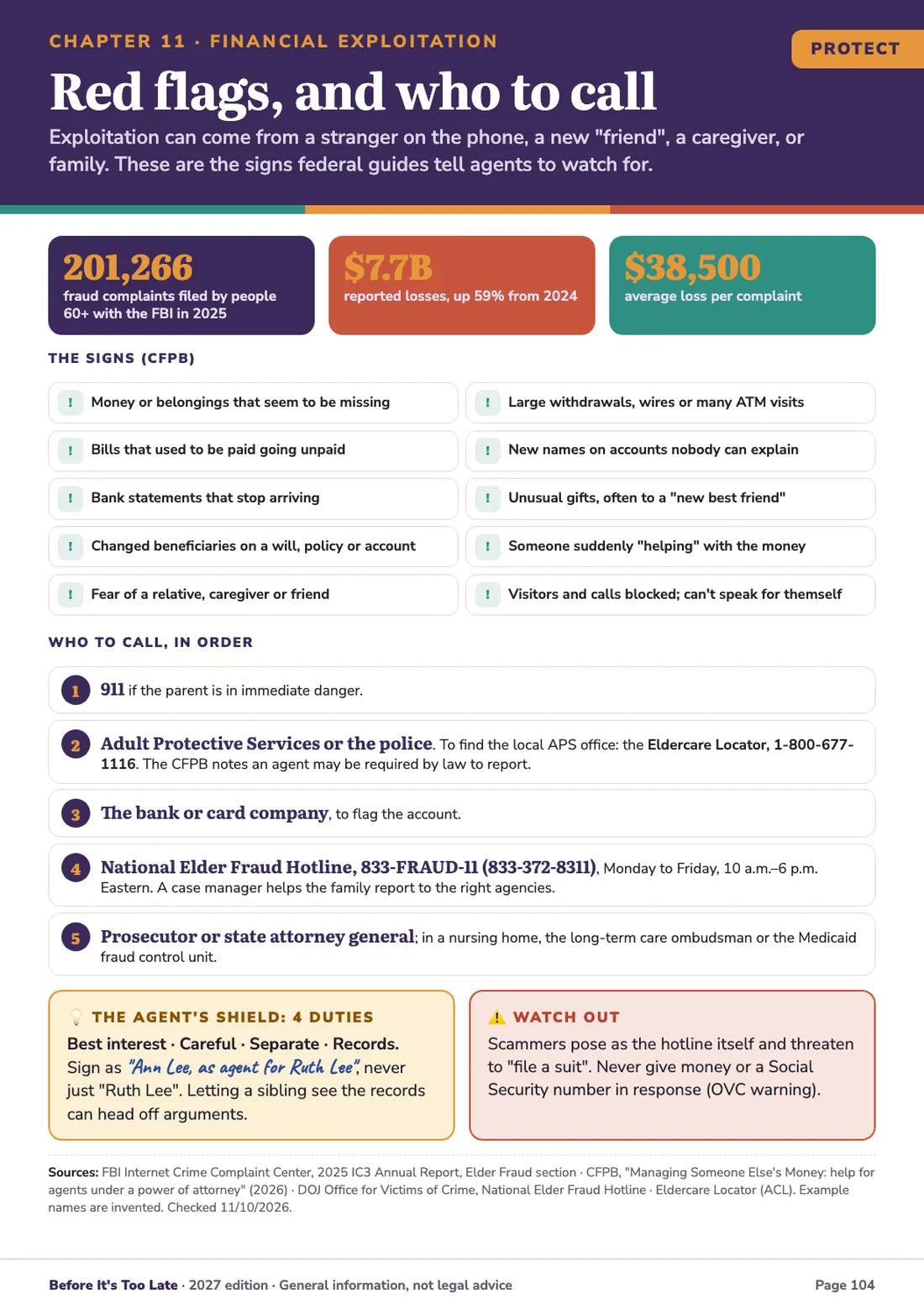
People 60 and older reported $7.7 billion in fraud losses to the FBI in 2025. The book lists the signs and who to call.
- The ten warning signs federal guides point to
- Who to call, in order: from Adult Protective Services to the National Elder Fraud Hotline
- Keeping records that siblings can see
- When siblings disagree: roles, records, questions for the attorney

An easier conversation at the kitchen table.
One page at a time, a parent and their children can see what each paper does and decide together, while the parent is the one deciding.
- Built on statutes and federal guidance, cited on every page
- Reviewed every year, because the rules change
- Questions for the attorney at the end of each topic
Every paper, every office, in one guide.
Full table of contents
On screen, on paper, or both.
Color PDF, right after payment
Open it on a phone, tablet or computer and share it with the family. Print the checklists as many times as you need.

120 color pages, spiral-bound
Lies flat on the table during the meeting with the attorney. Free U.S. shipping, about 5–8 business days. Want both? Printed + eBook for $59.99.
The checklists and the phone numbers.
Where each paper is kept, which banks and doctors have a copy, the agent's ledger and the numbers to call, ready to print and share with the family.
- Document locator and list of banks, doctors and benefits
- Agent's ledger, with an example
- With the eBook: print them again whenever you need
See 10 real pages, free.
The window, the four papers, the agent's powers, springing or immediate, the bank's deadline, Social Security and the VA, who decides without a proxy, HIPAA, guardianship and the red flags. Read them and decide with the pages in front of you.
See the 10 pages ↓
How is it different?
| What it has | This guide | Official websites | Books on Amazon | Elder-law attorney |
|---|---|---|---|---|
| All four papers, banks, benefits and court, in one place | ✓ | Spread across many sites | Varies | ✓ |
| Charts, ladders and side-by-side diagrams | ✓ | Varies | Mostly text | — |
| Six states side by side, with the statute | ✓ | One state at a time | Varies | Your state |
| Documents drafted and signed for your family | ✗ No forms to sign | Some state forms | Some sell forms | ✓ |
| Advice on your family's own situation | ✗ General information | ✗ | ✗ | ✓ |
| Price | From $29.99 | Free | About $10 to $32 | Fees vary |
You can start reading tonight.
You pay
Secure checkout, no account, no subscription. One payment.
You open the eBook
If you chose the eBook, the download link arrives by email. Open it on a phone, tablet or computer.
The book arrives
If you chose the printed book, it ships free to your U.S. address.
The papers, the offices and the court, explained for the whole family.
- 120 illustrated color pages, 13 chapters
- Financial power of attorney: powers, hot powers, springing or immediate
- Banks, Social Security and the VA: what each one accepts
- Health care proxy, living will, HIPAA and POLST
- Guardianship and the less restrictive options
- Six states side by side: CA, TX, FL, NY, PA, IL
- Printed book: spiral-bound, lies flat
What families ask before buying
Is this legal advice?
No. This guide provides general information, not legal or financial advice, and it is not a substitute for an attorney. Powers of attorney, health care decisions and guardianship are governed by state law, and the rules change. Talk to an elder-law or estate-planning attorney in your state before signing anything. Every topic ends with the questions to ask.
Does it include forms to fill in and sign?
No, on purpose. A power of attorney or health care directive has to meet your state's rules, and the wrong form can cause exactly the problems this book describes. Instead, the book shows what each paper does, what to check, and what to ask. The documents themselves come from your attorney or your state's official forms.
Which states does it cover?
The federal rules (Social Security, the VA, HIPAA, Medicare's planning visit) apply everywhere. Six states are shown side by side with their statutes: California, Texas, Florida, New York, Pennsylvania and Illinois. For other states, the book explains what to look up and what to ask.
What if a parent already has memory problems?
Whether a parent can still sign is a legal question for the attorney, and it can differ by document. The book explains what can still be done on good days, and, if it's too late, how guardianship works and which less restrictive options judges must consider first.
Does the bank have to accept a power of attorney?
It depends on the state. Several states set a deadline and require a written reason for a refusal: Texas, Florida, New York and Pennsylvania, for example. California and Illinois make some refusals unreasonable. The book has one page with the rules of six states and the cases where a refusal can be lawful.
Can the agent manage a parent's Social Security?
Not with the power of attorney. Social Security appoints a representative payee and the VA appoints a fiduciary. A parent who can still decide can name up to three possible payees in advance.
What if brothers and sisters disagree?
The book shows how some states break ties on medical decisions (a majority of the adult children in Florida, for example, while in Texas disputes go to court), why records shared with the family help, and what to ask the attorney about naming a backup agent.
Does it cover paying for care or Medicaid?
No. This book is about who can decide and sign for a parent. It doesn't cover care costs, Medicaid planning or what happens after a death.
Are you affiliated with any government agency?
No. We are not affiliated with or endorsed by Social Security, the VA, HHS, any court, any state or the Uniform Law Commission.
Are the rules up to date?
They were checked on November 10, 2026, against the official legislature websites of each state and federal agency pages, and each page shows its source. Laws change, so the guide is reviewed every year.
Can I read it on my phone?
Yes. The eBook is a color PDF that opens on a phone, tablet or computer. You can print the checklists and any page you want.
When does the printed book arrive?
Shipping is free to U.S. addresses and takes about 5–8 business days. The eBook arrives by email right after payment.
What if it's not right for us?
You have a 30-day guarantee. Write to us within 30 days and we'll refund you. No questions, no forms.
Ready to talk about the papers while a parent can still decide?
120 illustrated pages, six states side by side, questions for the attorney. 30-day guarantee.
From $29.99 · eBook or printed