How families pay for college,
page by page.
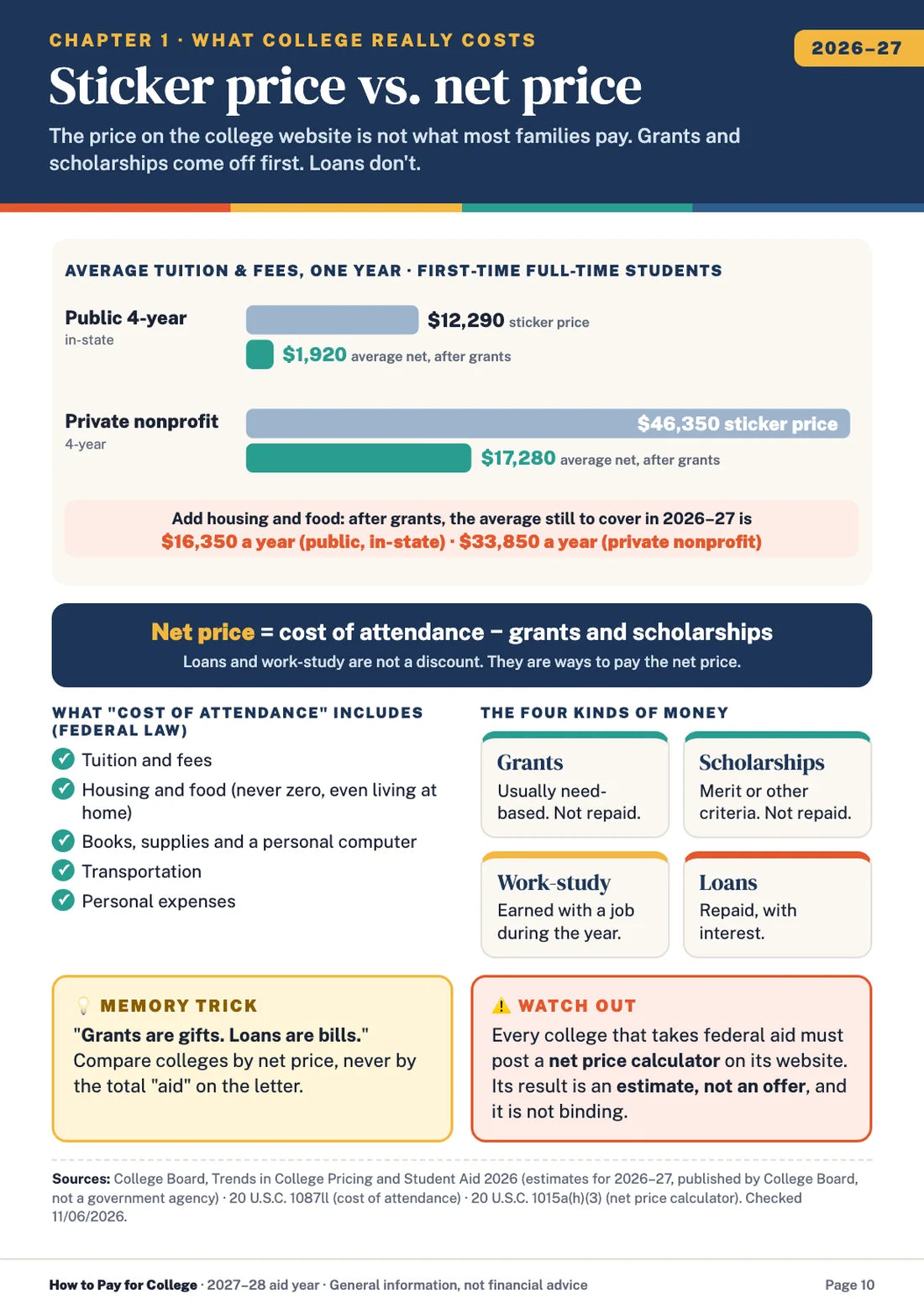
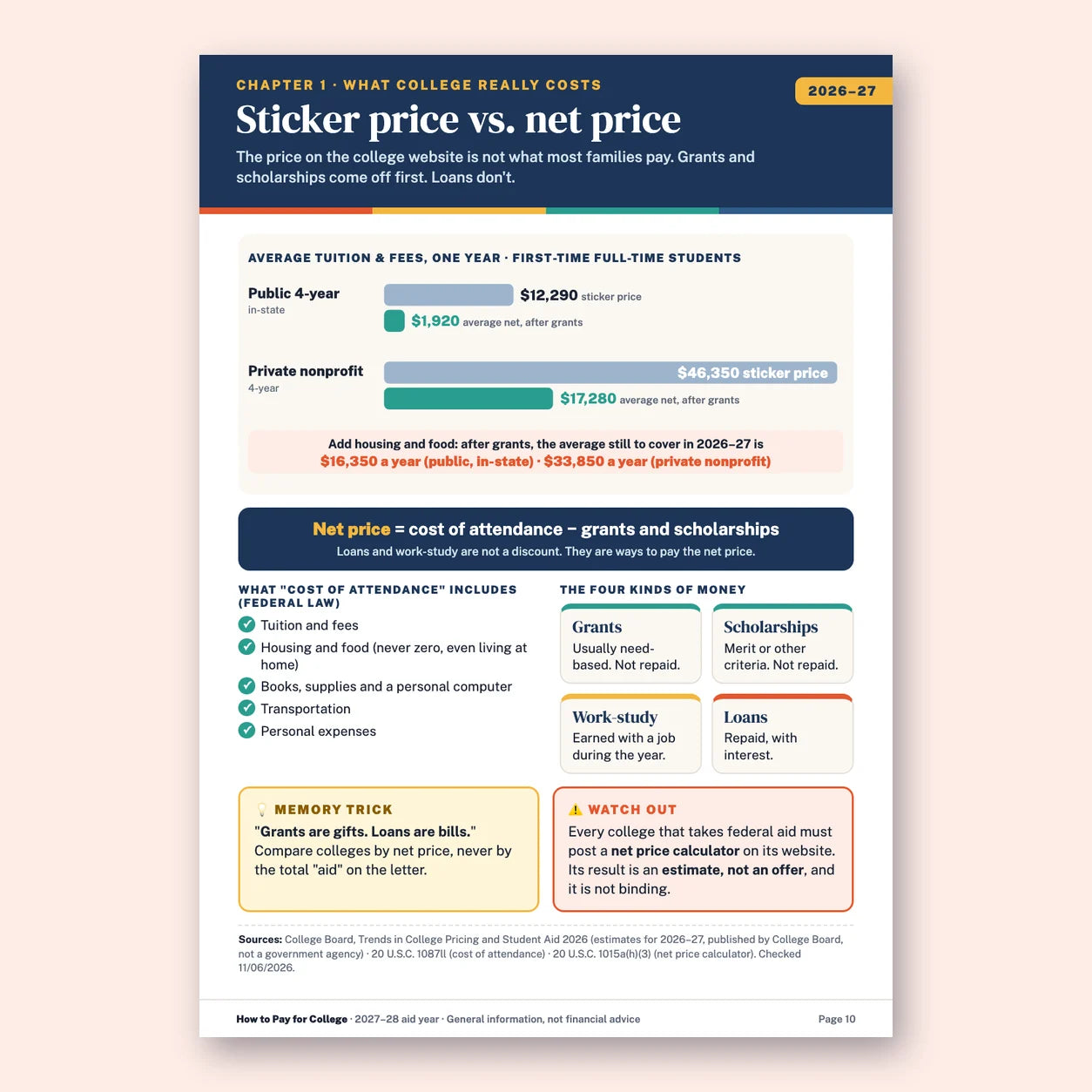
After grants, a year still costs $16,350 (public, in-state) to $33,850 (private) on average (College Board, 2026). This illustrated guide covers the 2027–28 FAFSA, the CSS Profile, Pell, aid offers, appeals, the new Parent PLUS limits, 529 plans and tax credits. 200 pages. eBook or printed book.
The book at home, the PDF on the student's phone · $79.99
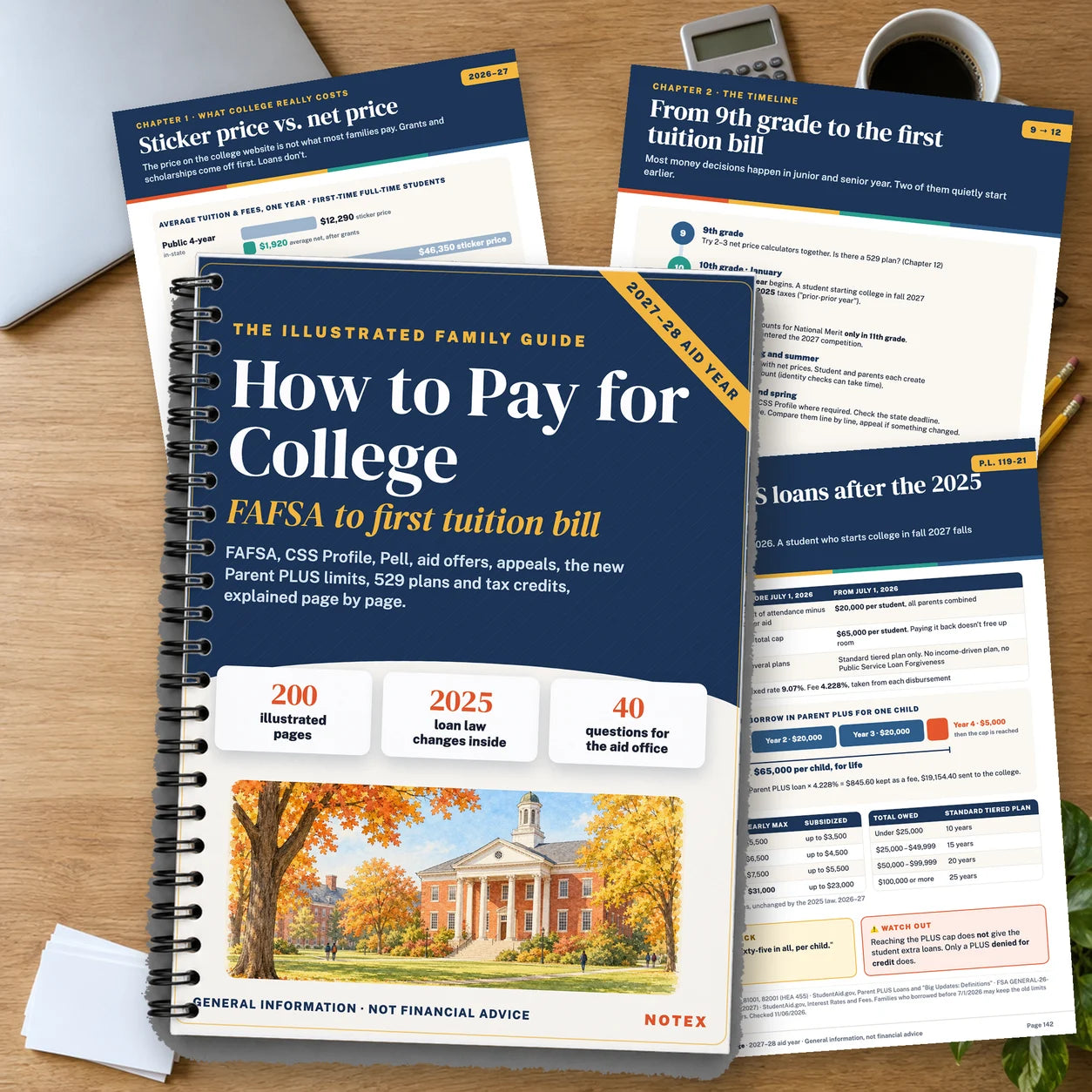
Not a wall of financial-aid jargon. One topic per page.
Every page works the same way, so a parent can find the answer in two minutes at the kitchen table, with the laptop open.
This is what the pages look like.
For the parents who end up handling the forms.
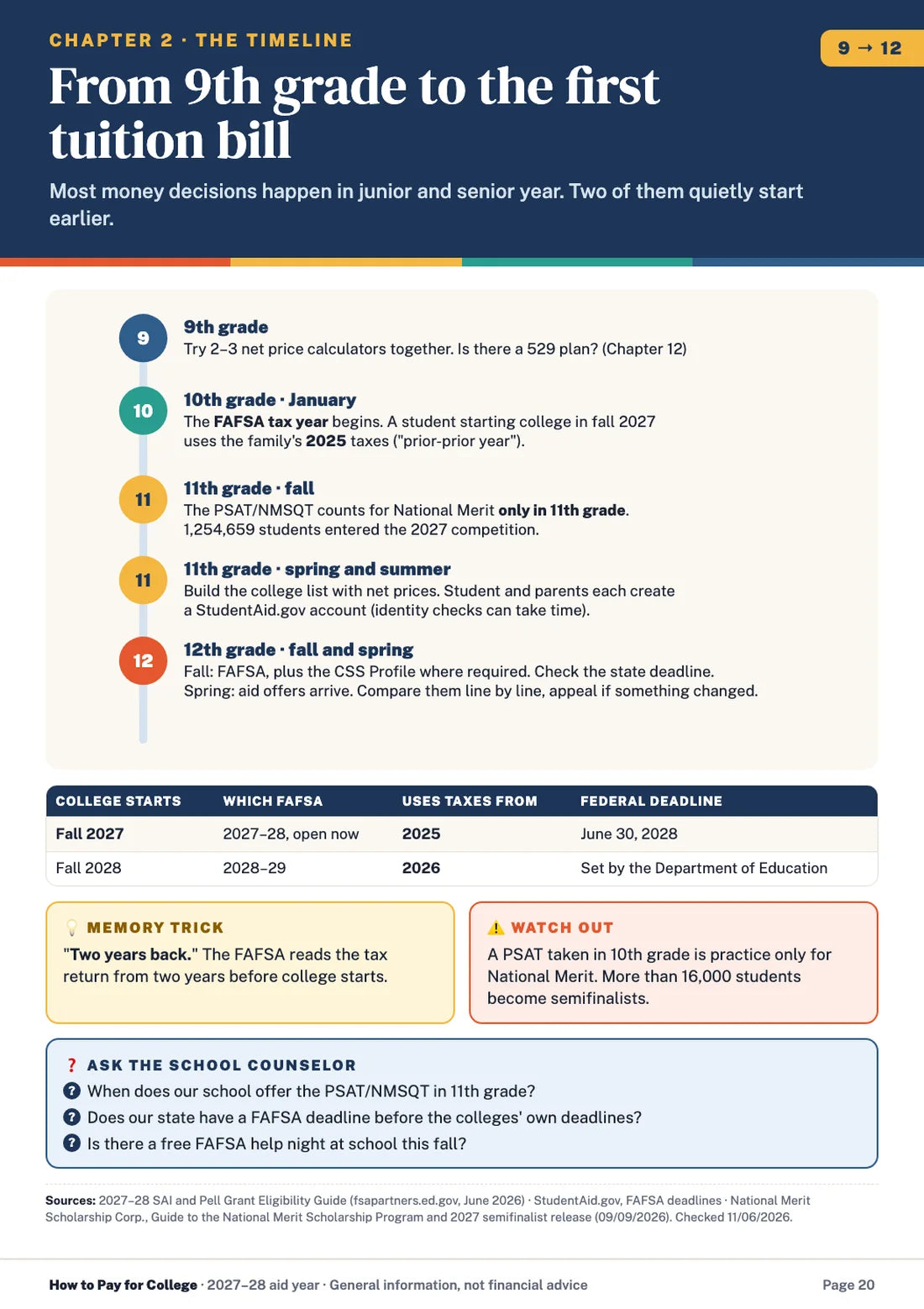
Before the tax year that counts
The FAFSA reads the tax return from two years before college starts. For a student starting in fall 2027, that's 2025. Knowing it early leaves time to plan.
Building the college list
Net price calculators, the PSAT/NMSQT that counts only in 11th grade, which colleges ask for the CSS Profile, and the accounts to create before senior year.
Forms in the fall, offers in the spring
FAFSA, CSS Profile and state deadlines, then the aid offers: how to compare them line by line and when to ask for a review.
What's worth knowing before senior year.
These rules are written down in federal law and official guidance. The book explains each one with a diagram, the current numbers and the source.
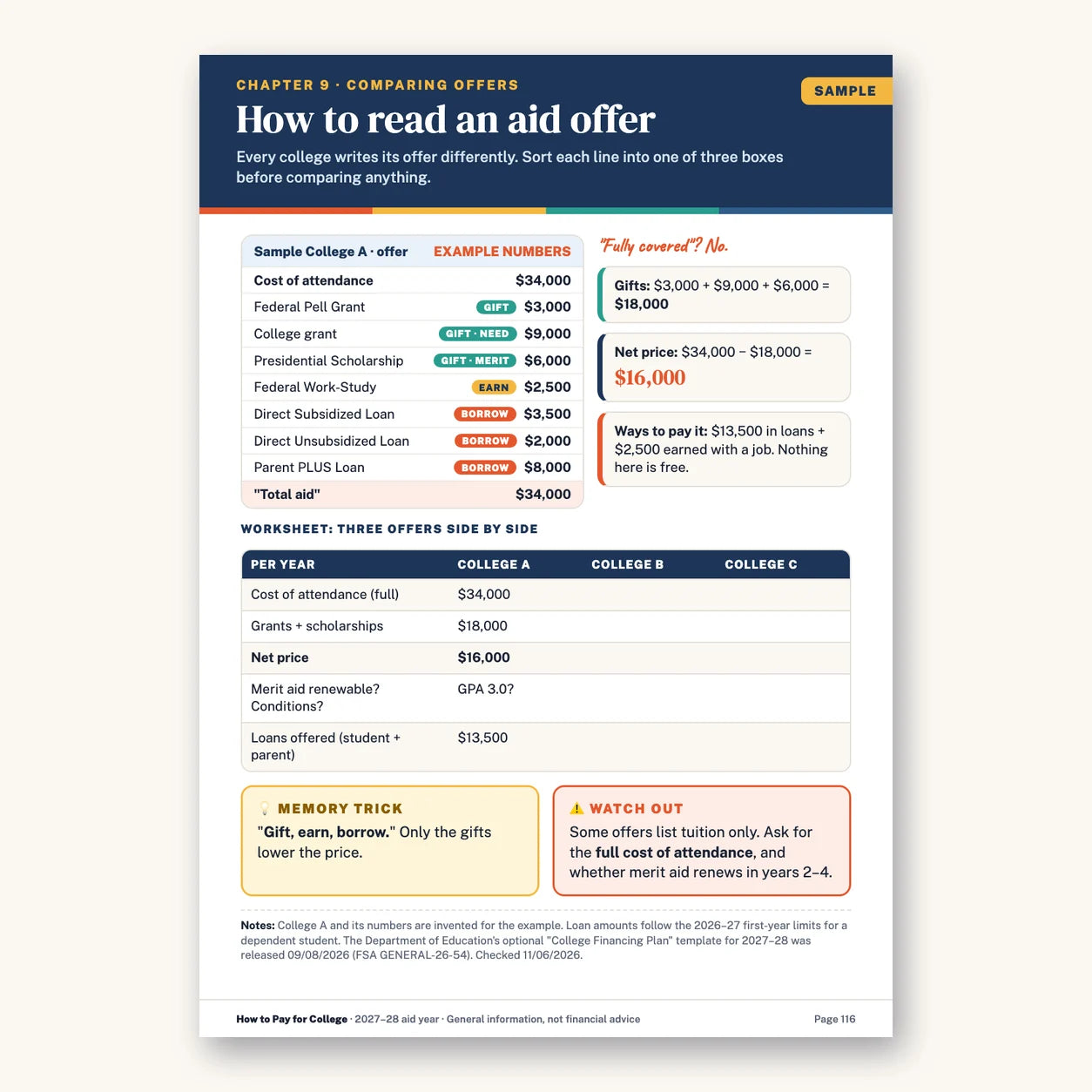
"Total aid" can include loans
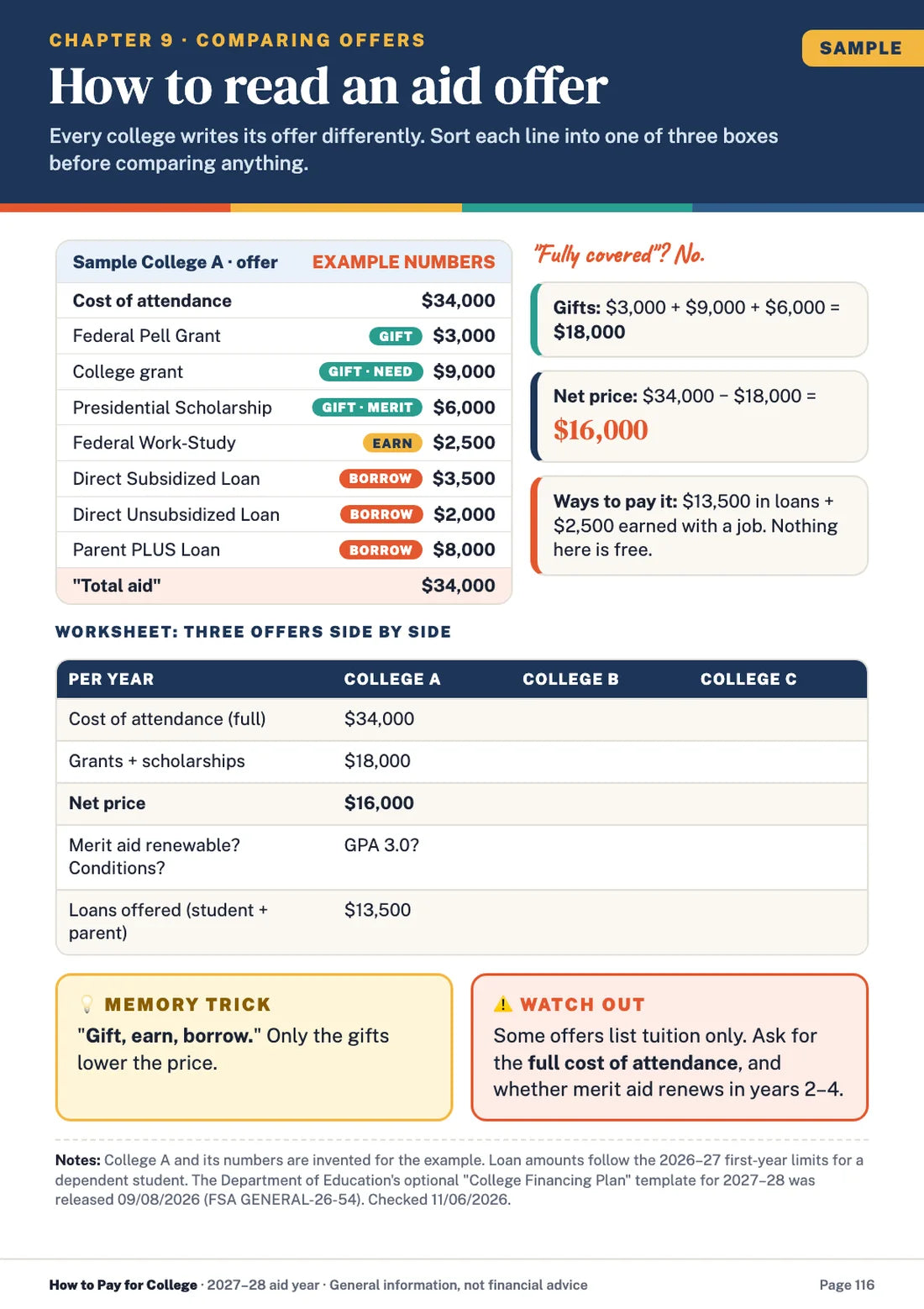
An offer can add grants, work-study, student loans and a Parent PLUS loan into one total. Only grants and scholarships lower the price. The rest is earned or repaid.
State dates come first
The federal FAFSA deadline is June 30, 2028, but several states set priority dates in early 2027, and some award grants until the money runs out.
New Parent PLUS caps
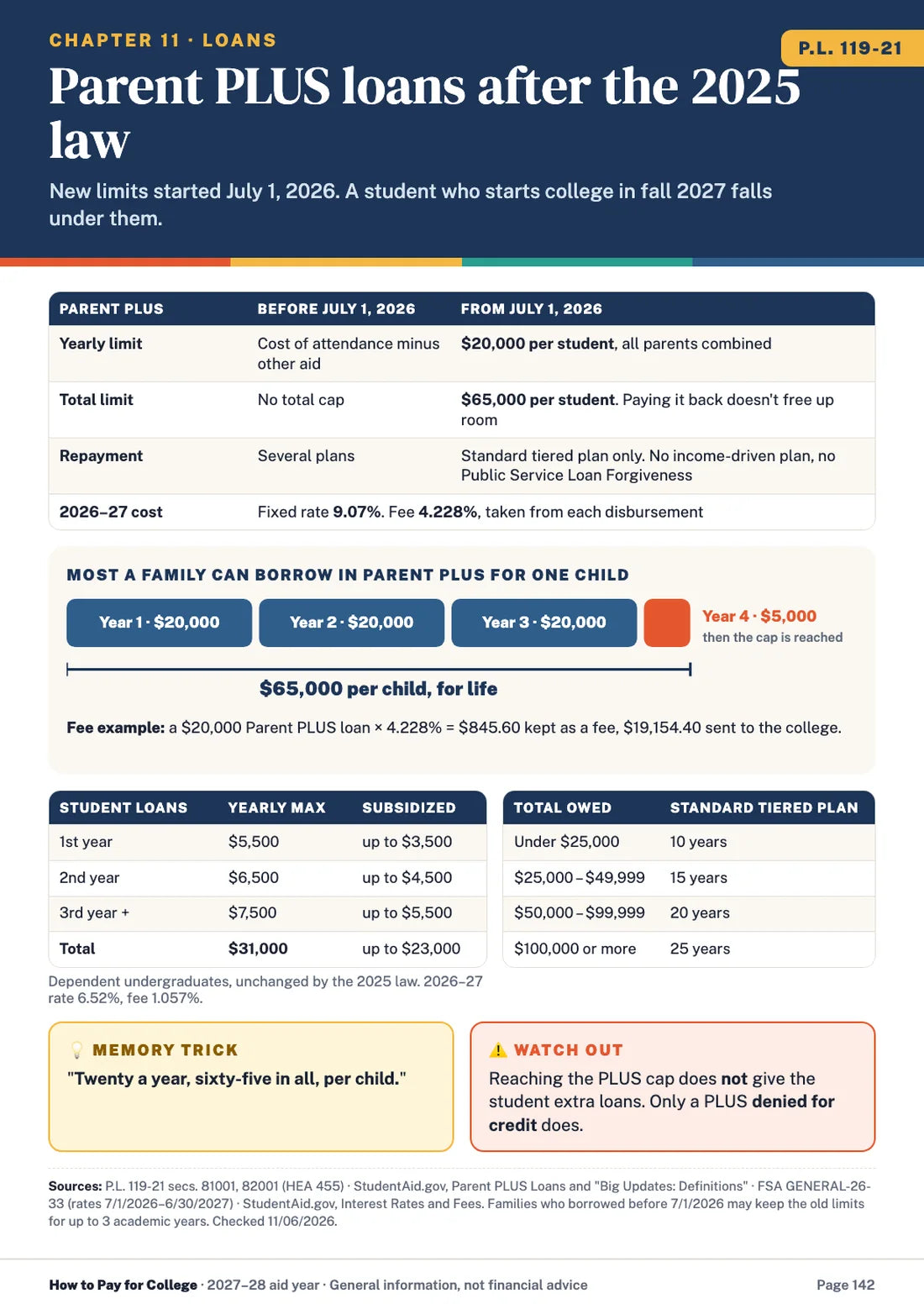
From July 1, 2026, Parent PLUS loans are capped at $20,000 a year and $65,000 in all per child, with only a standard repayment plan for new loans.
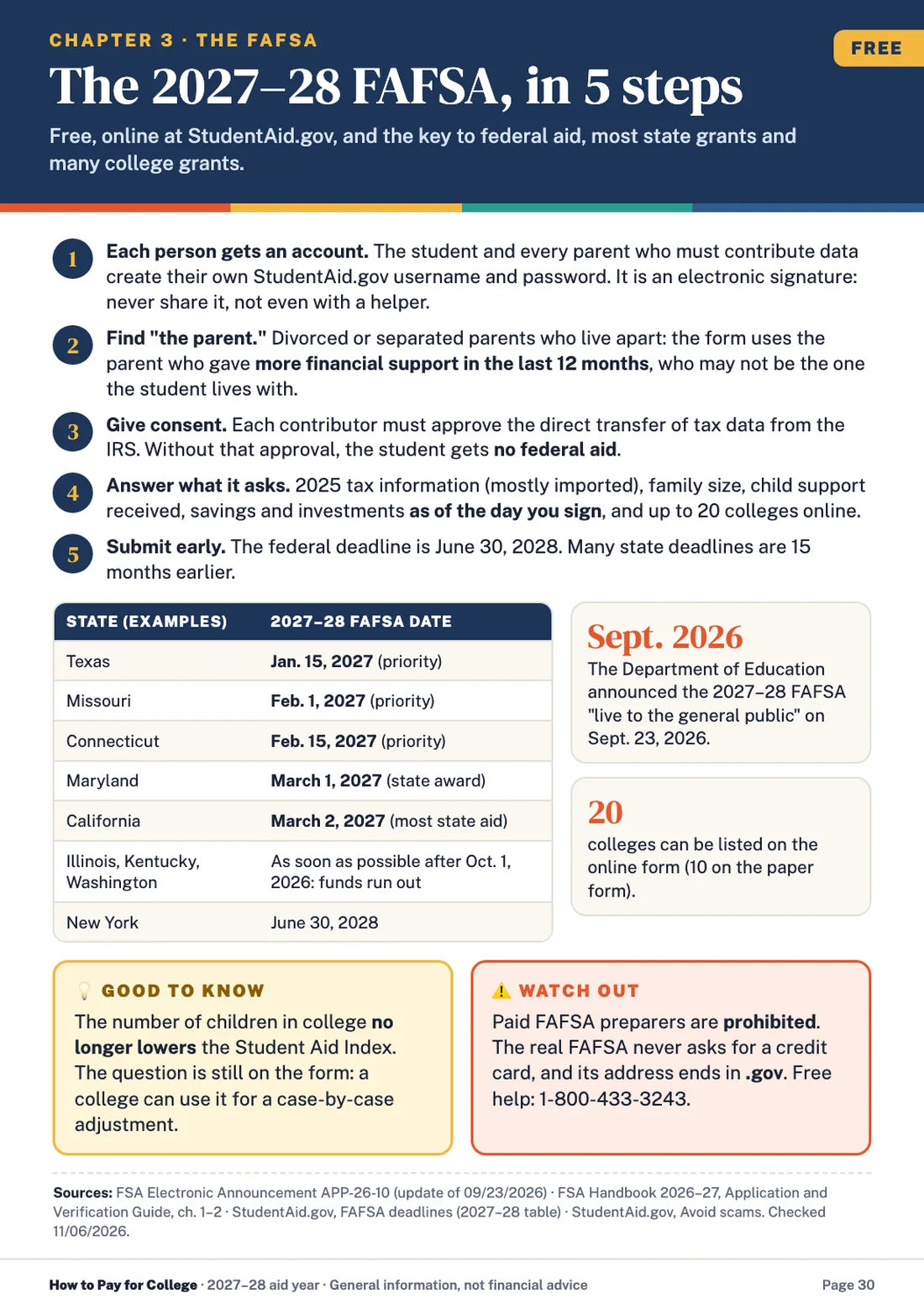
The 2027–28 FAFSA, in five steps.
Who counts as "the parent," who needs an account, what the consent means, and which deadline really matters for your state.
- Uses 2025 tax information; federal deadline June 30, 2028
- Divorced or separated parents: which parent the form uses
- The consent to IRS data: without it, no federal aid
- State deadlines, from Texas (Jan. 15, 2027) to New York
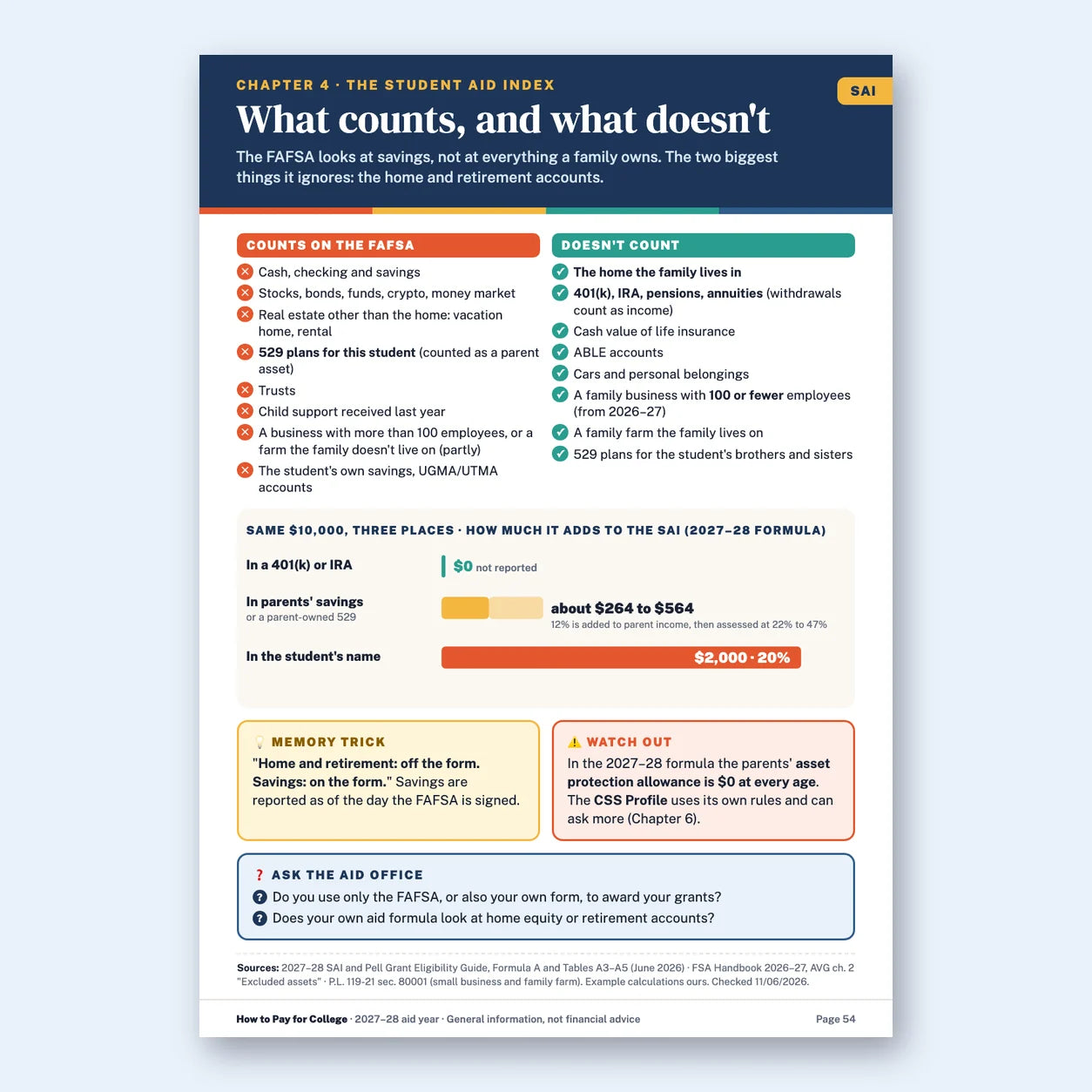
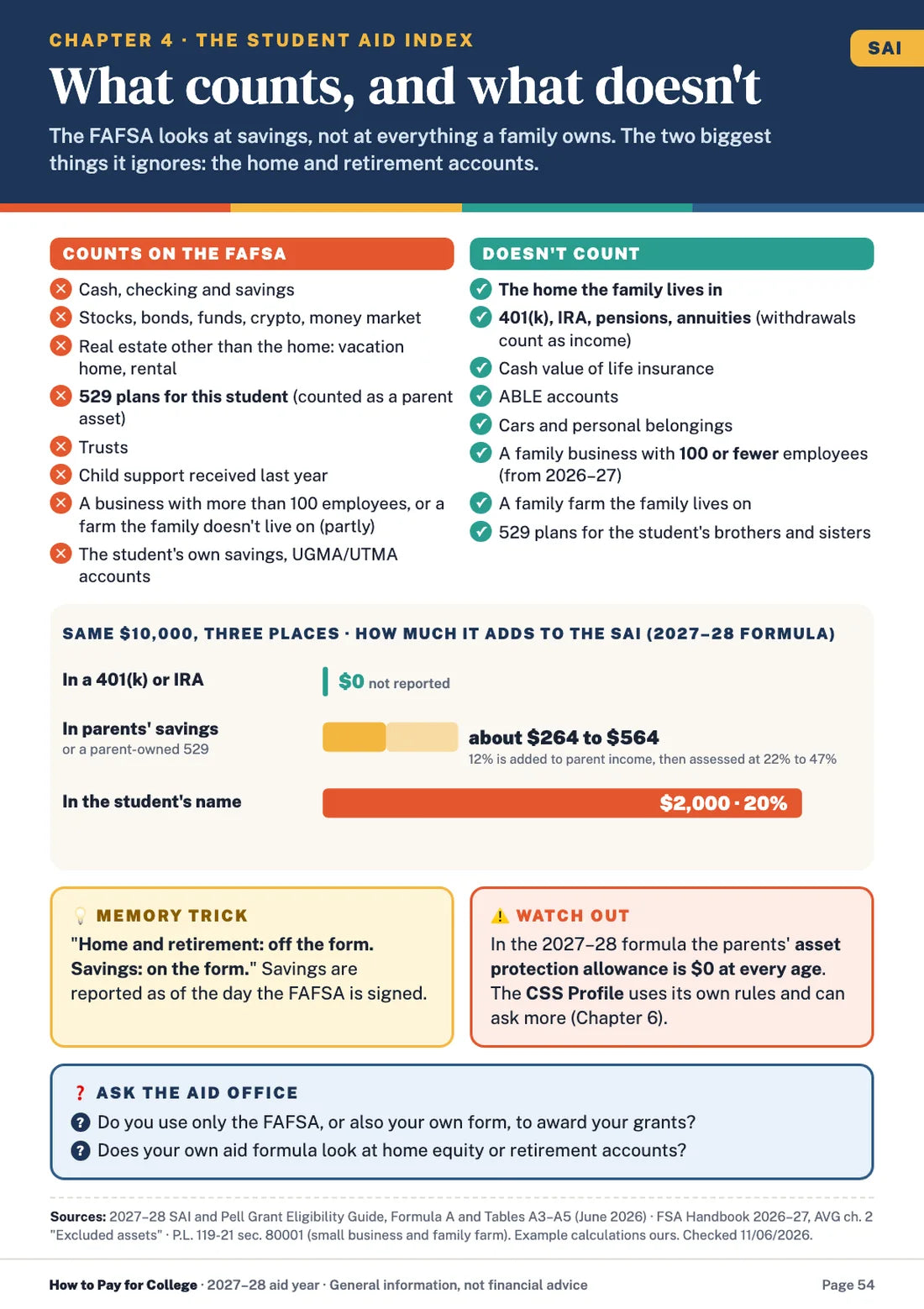
What the FAFSA counts, and what it ignores.
The home, retirement accounts, 529 plans, a family business: where each one goes, and how much a dollar of savings adds to the Student Aid Index.
- The home and 401(k)/IRA accounts: not reported
- A parent-owned 529 for the student: a parent asset
- Family businesses with 100 or fewer employees: excluded from 2026–27
- The same $10,000 in three places, side by side
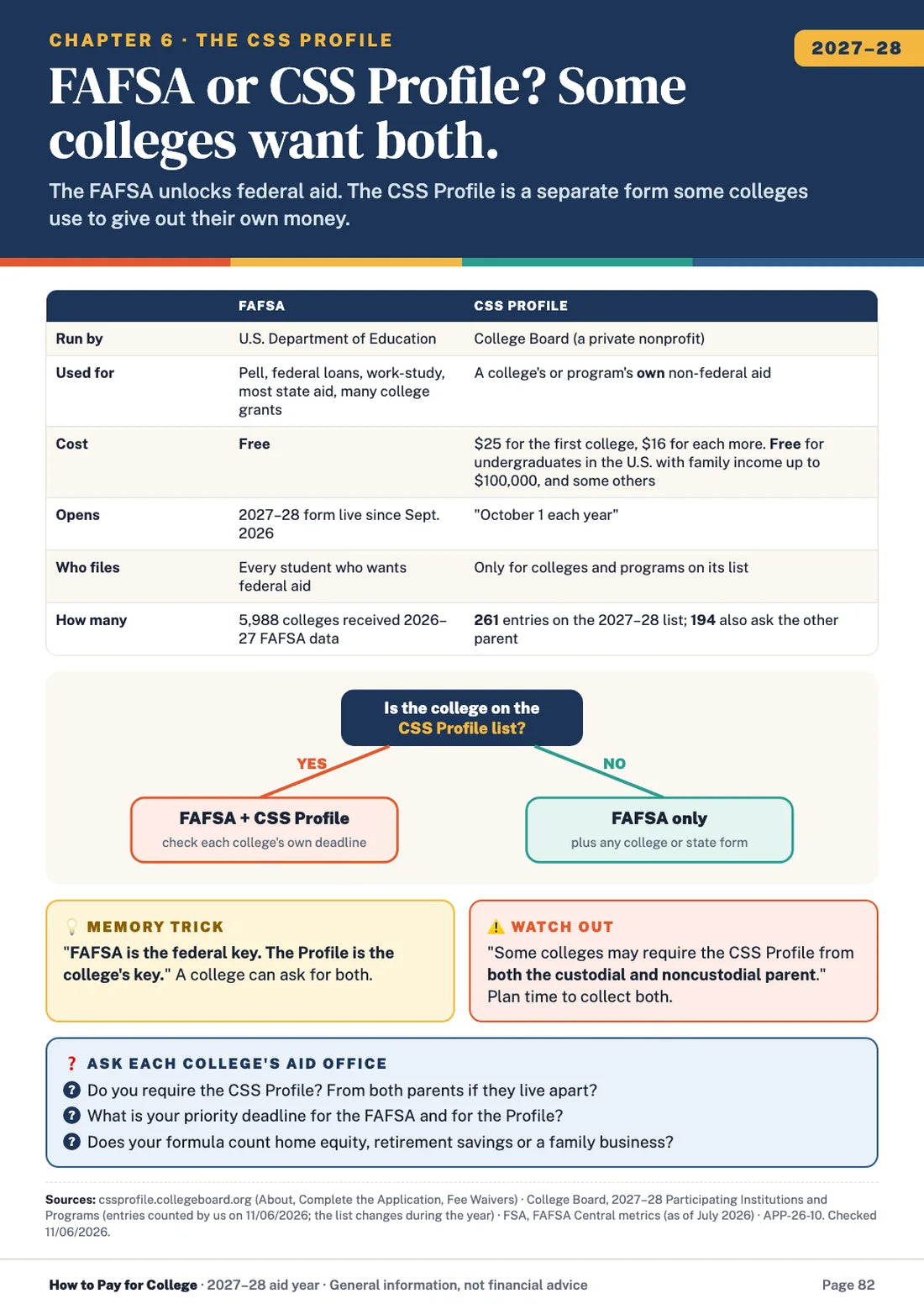
When a college wants a second form.
What the CSS Profile is for, what it costs, when it's free, and why some colleges ask both parents to fill it out.
- $25 for the first college, $16 for each more; free up to $100,000 family income
- 261 entries on the 2027–28 participating list
- The questions to ask each college's aid office
Read the offer before you celebrate it.
An annotated sample offer: every line sorted into gift, earn or borrow, and a worksheet to compare three colleges by net price.
- Need-based grants vs. merit scholarships
- Is the scholarship renewable? The conditions to ask about
- Offers that show tuition only, not the full cost
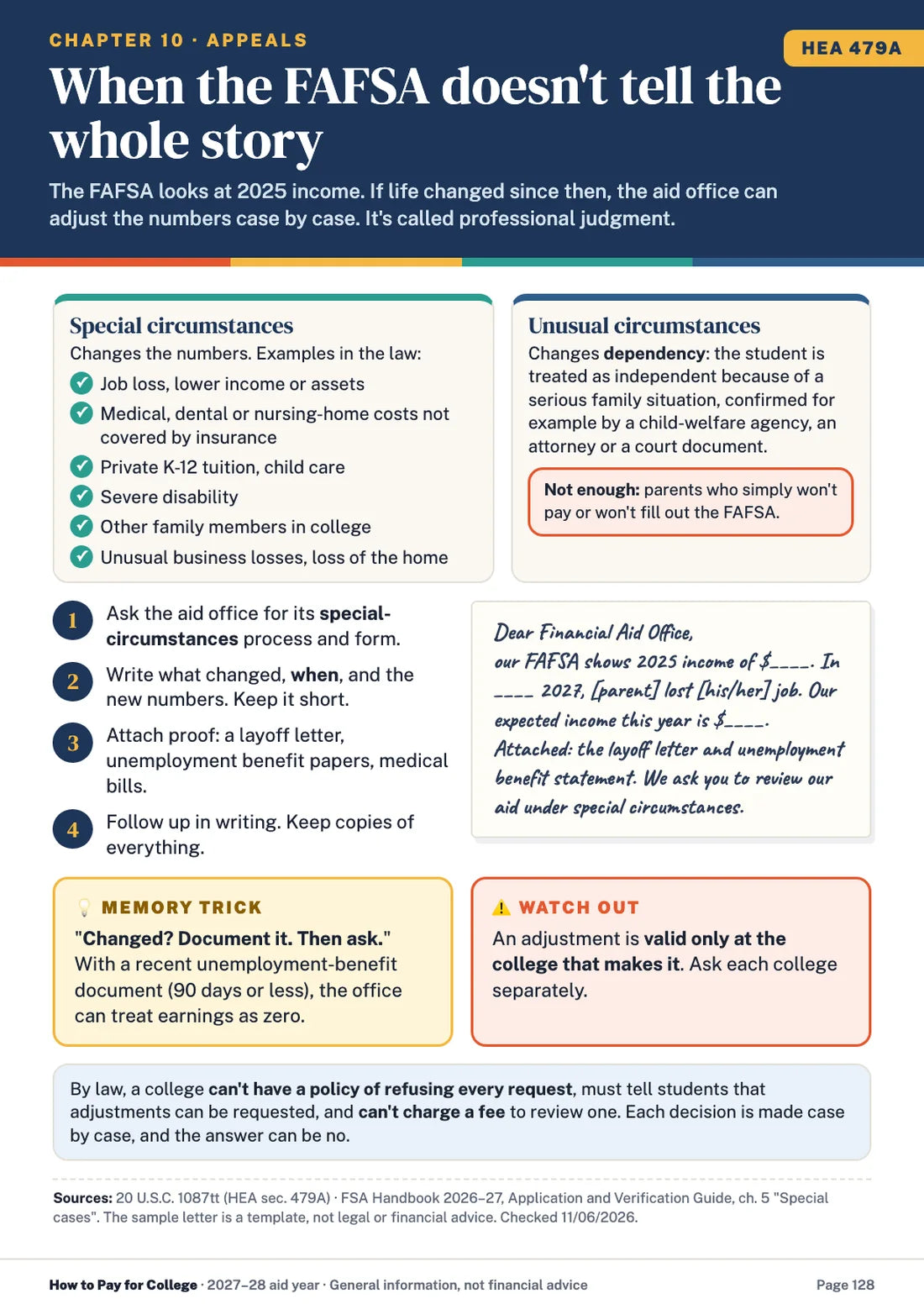
- Then: how to ask for a review if something changed
The new Parent PLUS limits, on one page.
What changed on July 1, 2026, what stayed the same for student loans, and what a loan really costs with its fee.
- $20,000 a year and $65,000 in all, per child, all parents combined
- New Parent PLUS: standard tiered repayment only
- Student loans: $5,500 / $6,500 / $7,500 a year, $31,000 in total
- 2026–27 rates and fees, with a worked example
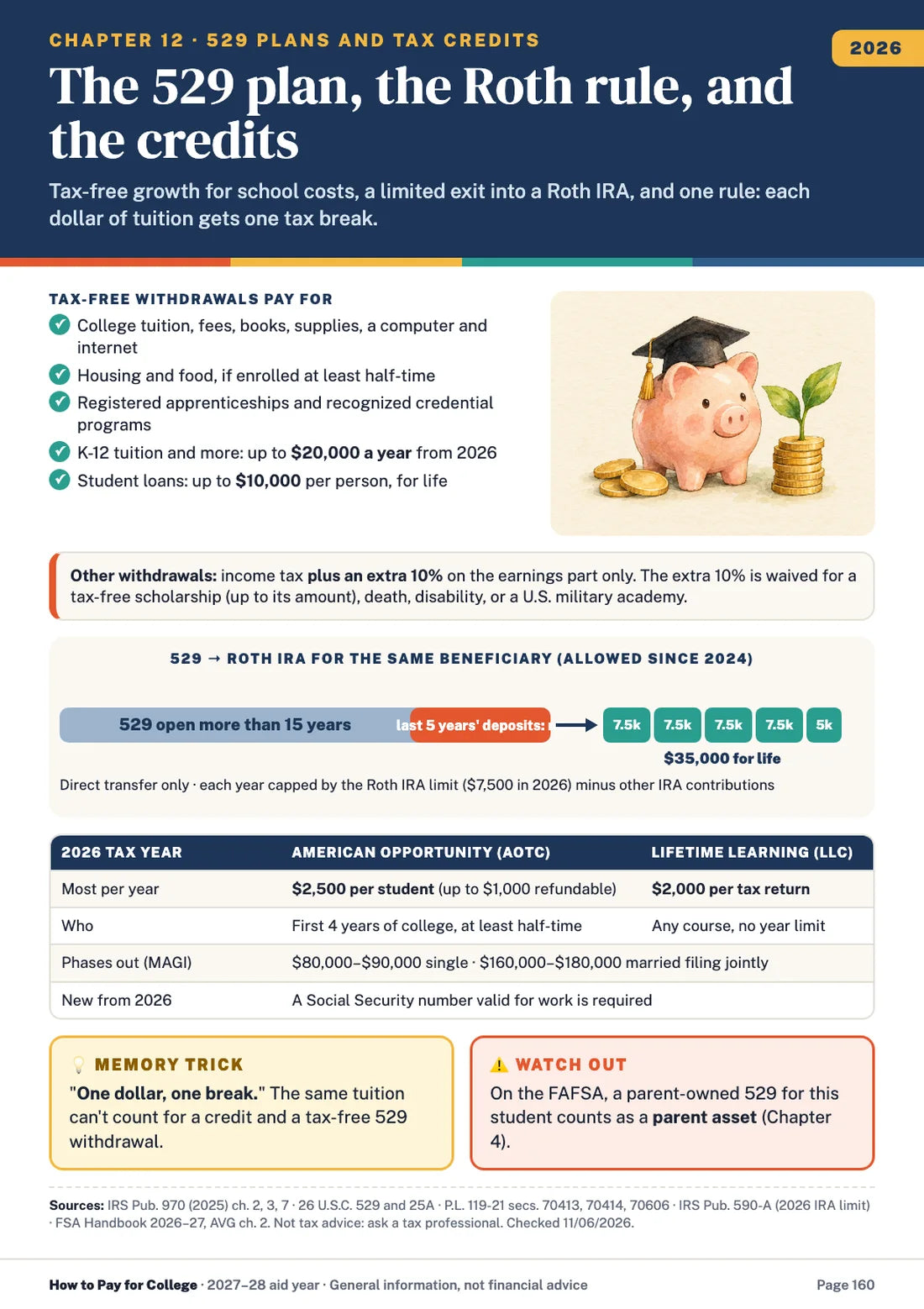
One dollar of tuition, one tax break.
What a 529 can pay for, what a wrong withdrawal costs, the 529-to-Roth rule, and the American Opportunity and Lifetime Learning credits.
- K-12 limit up to $20,000 a year from 2026
- 529 to Roth IRA: 15 years, $35,000 for life
- AOTC up to $2,500 per student; LLC up to $2,000 per return
- New from 2026: a Social Security number valid for work

Parent and student look at the same page.
The student fills in their part of the FAFSA, the parents fill in theirs, and everyone works from the same checklist and the same deadlines.
- Built on laws, regulations and agency pages, cited on every page
- Reviewed every year: aid amounts and rates change every year
- We don't sell loans and we don't get paid by colleges or lenders
From the first FAFSA to the first tuition bill, in one guide.
Full table of contents
On screen, on paper, or both.
Color PDF, right after payment
Open it on a phone, tablet or computer, next to the FAFSA. Print the worksheets as many times as you need.
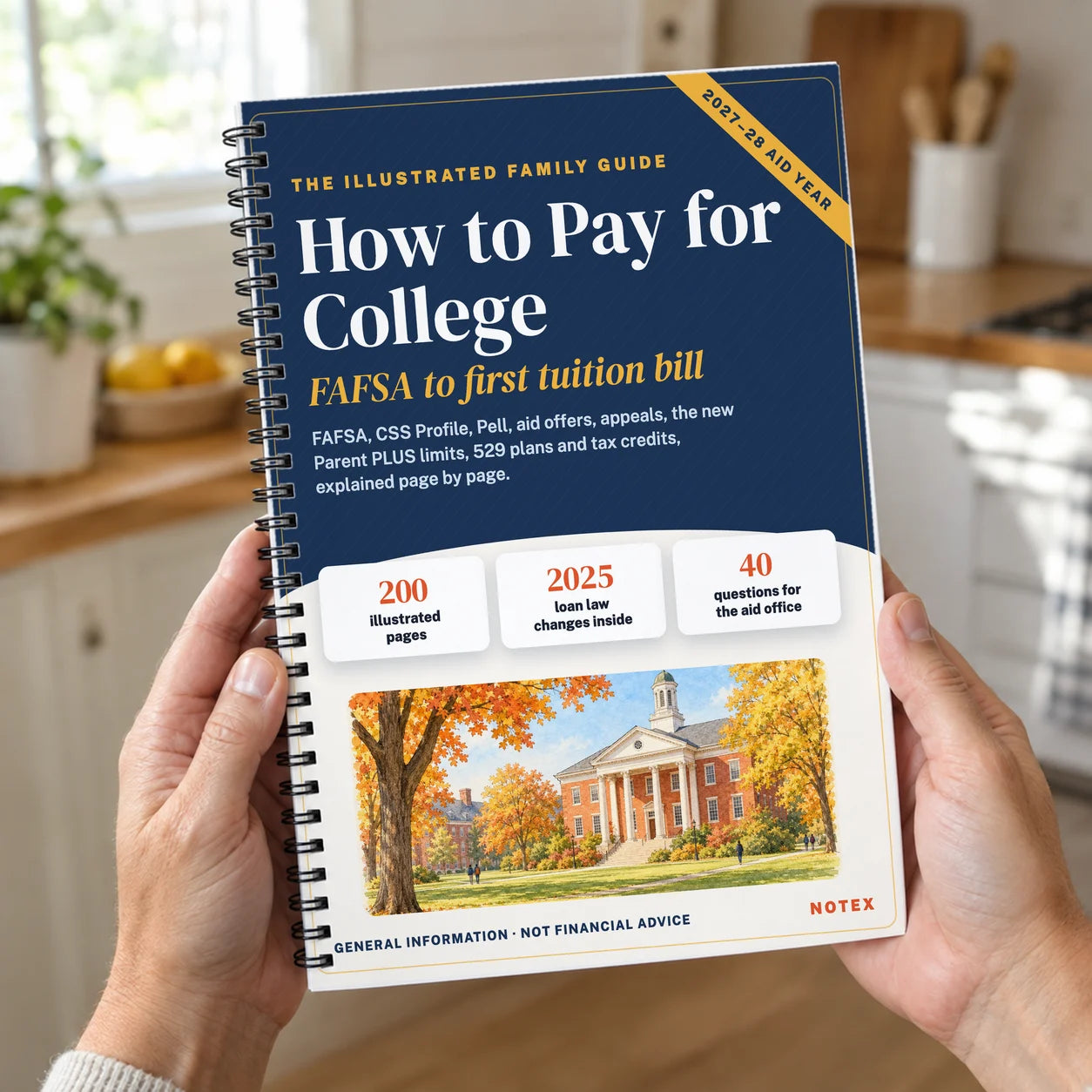
200 color pages, spiral-bound
Lies flat next to the laptop. Free US shipping, about 5–8 business days. Want both? Printed + eBook for $79.99.
The worksheets and the appeal letter.
Fill them in as the forms and offers arrive: one place for deadlines, net prices and the numbers from each college.
- FAFSA and CSS Profile deadline tracker
- Offer comparison sheet and net price log
- Appeal letter template for special circumstances
- With the eBook: print them again whenever you need
See 10 real pages, free.
Sticker vs. net price, the 9th–12th grade timeline, the FAFSA in 5 steps, what counts on the FAFSA, the Pell Grant, FAFSA vs. CSS Profile, how to read an aid offer, appeals, Parent PLUS after the 2025 law, and 529 plans with the tax credits. Read them and decide with the pages in front of you.
See the 10 pages ↓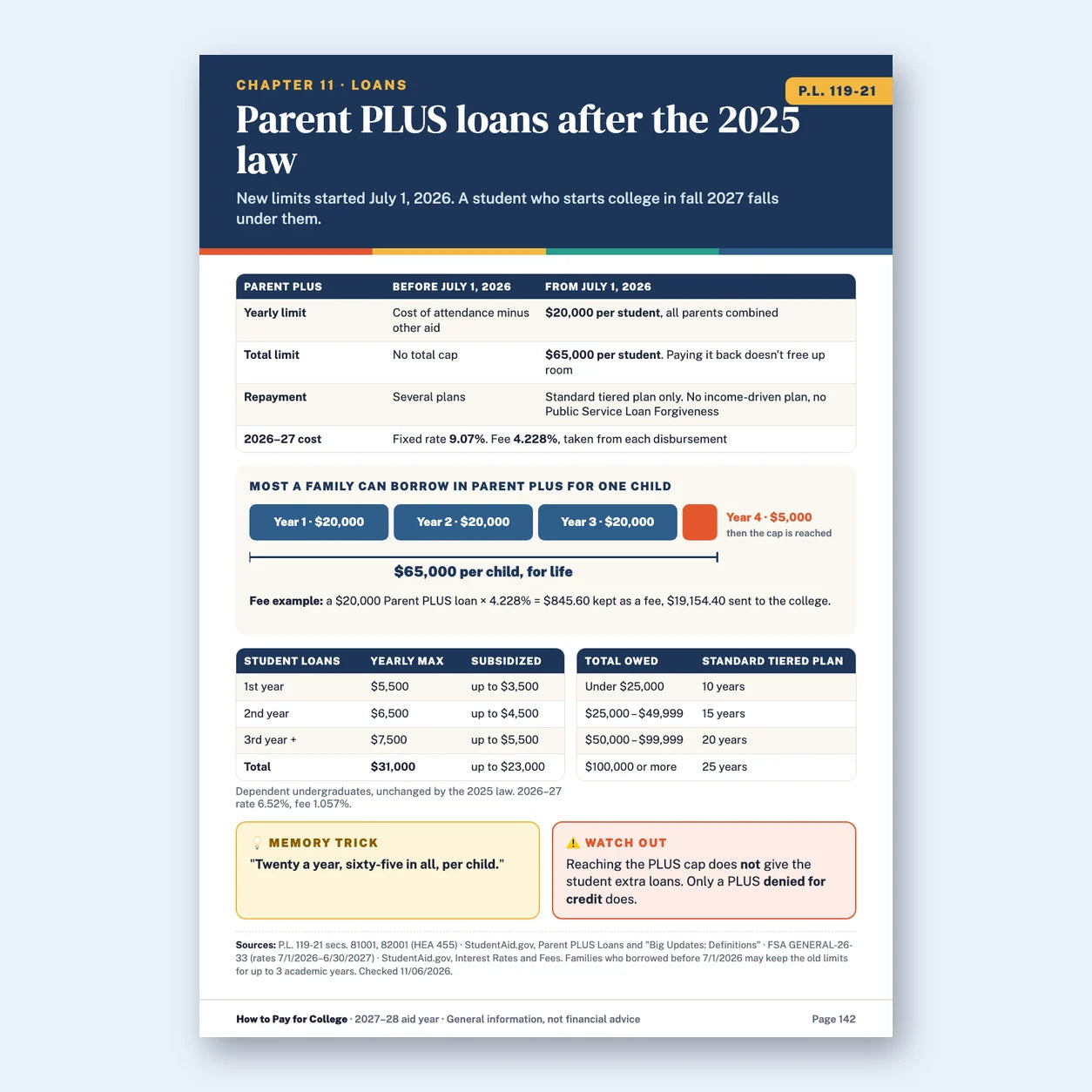
How is it different?
| What it has | This guide | StudentAid.gov and college sites | Books on Amazon | Paid aid consultants |
|---|---|---|---|---|
| FAFSA, CSS Profile, offers, loans, 529s and taxes in one place | ✓ | Spread across many sites | Varies | Varies |
| Charts, timelines and diagrams | ✓ | Varies | Mostly text | — |
| The 2025 loan-law changes | ✓ | ✓ | Varies; some popular titles date from 2022 | Varies |
| Questions to ask each aid office | ✓ (40) | — | Varies | — |
| Advice on your family's own situation | ✗ General information | ✗ | ✗ | ✓ |
| Price | From $39.99 | Free | About $13 to $31 | Can cost well over $1,000, per StudentAid.gov |
You can start reading tonight.
You pay
Secure checkout, no account, no subscription. One payment.
You open the eBook
If you chose the eBook, the download link arrives by email. Open it on a phone, tablet or computer.
The book arrives
If you chose the printed book, it ships free to your US address.
Every form, offer and loan rule, explained for the whole family.
- 200 illustrated color pages, 15 chapters
- FAFSA, Student Aid Index, Pell, CSS Profile, net price calculators
- Merit vs. need aid, reading offers, appeals
- Federal loans and the 2025 Parent PLUS limits
- 529 plans, the 529-to-Roth rule, AOTC and LLC tax credits
- Scholarship-scam red flags, a 9th–12th grade timeline, 40 questions for the aid office
- Printed book: spiral-bound, lies flat
What parents ask before buying
Is this financial advice?
No. This guide provides general information, not financial, tax, or legal advice. It explains federal rules and official guidance; every family's situation is different. For your own case, talk to each college's financial aid office and, for taxes, a tax professional.
Which FAFSA year does it cover?
The 2027–28 FAFSA, for students starting college between July 1, 2027 and June 30, 2028. It uses 2025 tax information, and the federal deadline is June 30, 2028. State and college deadlines can be much earlier. Younger students follow the same steps with later tax years, and the timeline chapter shows which one.
Does it cover the 2025 law changes?
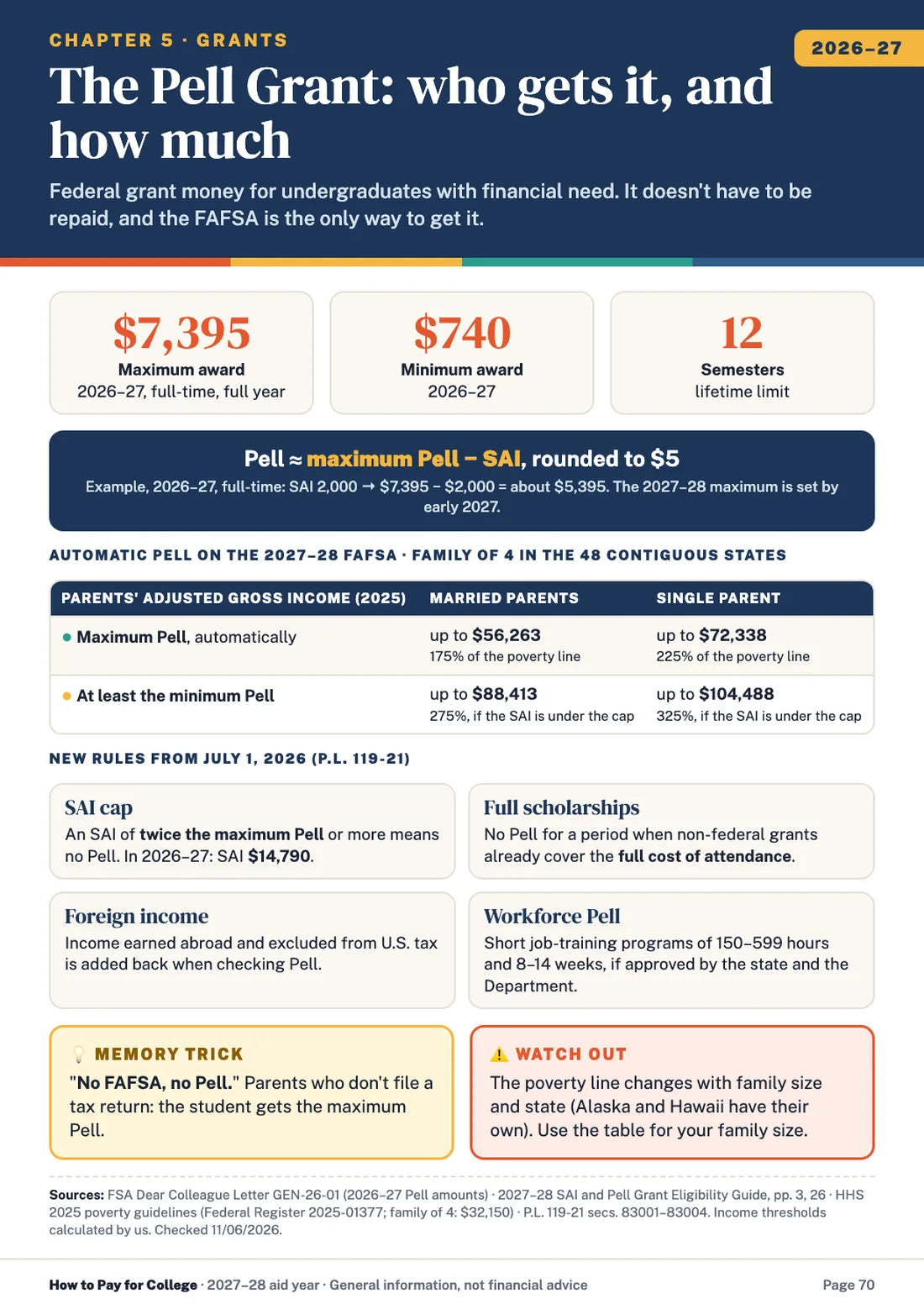
Yes. The new Parent PLUS limits from July 1, 2026 ($20,000 a year and $65,000 in all per child), repayment rules for new loans, the Pell changes, the small-business and family-farm exclusion on the FAFSA, the new 529 uses and the Social Security number rule for the education tax credits, each with the section of P.L. 119-21.
Will it tell us how much aid we'll get?
No, and no book can promise an amount. Aid depends on your numbers, your state and each college. The guide shows how the rules work and how to use the official estimators and each college's net price calculator, whose result is an estimate, not an offer.
Our child applies to private colleges. Does it cover the CSS Profile?
Yes. A full chapter on what the CSS Profile is, what it costs and when it's free, how to check which colleges require it, and the questions to ask about how each college's own formula works.
We are divorced. Does it help?
Yes. It explains which parent the FAFSA uses (the one who gave more financial support in the last 12 months) and why some colleges ask both parents for the CSS Profile.
Are you affiliated with the Department of Education or FAFSA?
No. We are not affiliated with or endorsed by the U.S. Department of Education, Federal Student Aid, the College Board or any college. The FAFSA is free at StudentAid.gov, and free help is available at 1-800-433-3243.
Are the numbers up to date?
The figures were checked on November 6, 2026 against official sources such as studentaid.gov, fsapartners.ed.gov, irs.gov and the text of P.L. 119-21, and each page shows its source. Some 2027–28 amounts, like the maximum Pell Grant and new loan rates, are announced later: the book shows the 2026–27 figures and says so.
Can you look at our situation and tell us what to do?
No. We can't advise on individual cases. The book is built so you can bring the right pages and questions to each college's financial aid office.
Do you sell loans or get paid by colleges?
No. We sell the guide only. We don't sell loans or financial products, and we don't receive referral fees from colleges or lenders.
Can I read it on my phone?
Yes. The eBook is a color PDF that opens on a phone, tablet or computer. You can print the worksheets and any page you want.
When does the printed book arrive?
The printed book ships free to US addresses, usually in about 5–8 business days. The eBook arrives by email right after payment.
What if it's not right for us?
You have a 30-day guarantee. Write to us within 30 days and we'll refund you. No questions, no forms.
Ready to see every way your family can pay for college?
200 illustrated pages, 2027–28 rules with sources, 40 questions for the aid office. 30-day guarantee.
From $39.99 · eBook or printed