A full year of science.
Print, cut, glue, teach.
The whole year of science for grades 3, 4 and 5: 90 cut-and-glue notebook lessons, 20–30 minutes each, with a reading, a foldable, a diagram and a quick check. One PDF, black & white or color.
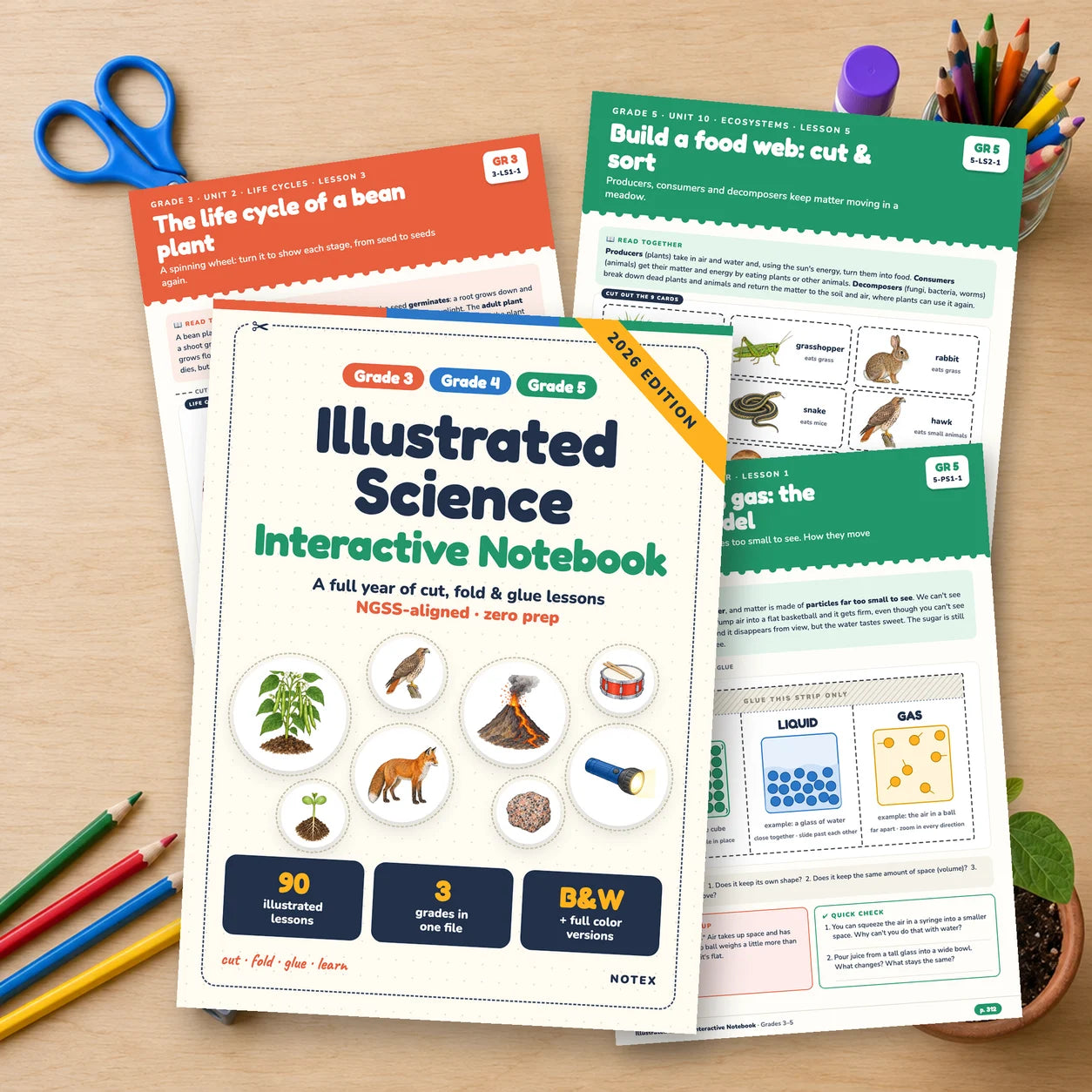
Not a worksheet. A notebook page kids build.
Every lesson works the same way, so after week one your class knows the routine and you barely have to explain anything.
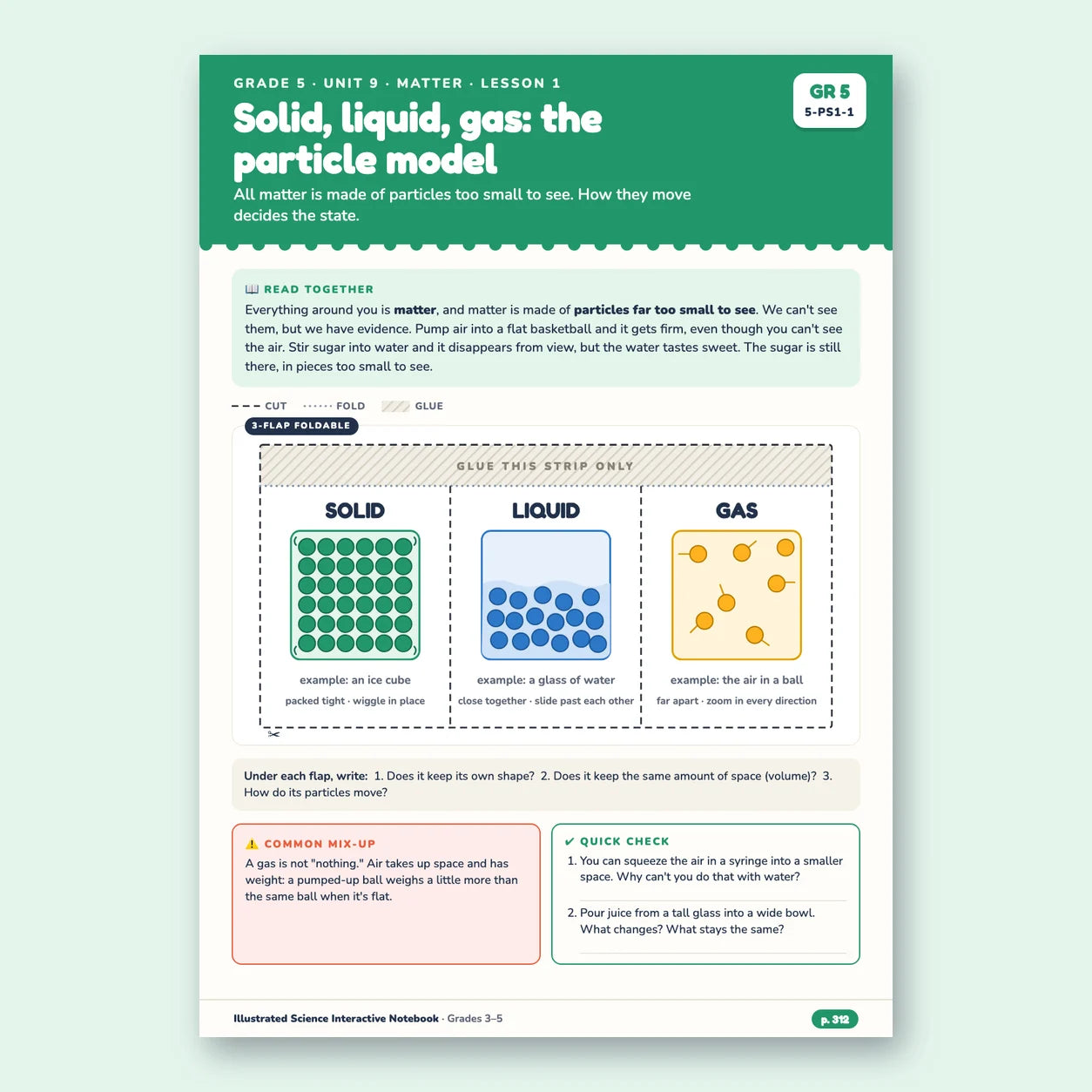
See exactly what you're printing.
If you teach science in grades 3–5, yes.
The whole year, already planned
Lessons in order for each grade, with a pacing calendar. You know what to teach on Monday without building it on Sunday.
Built for 20–30 minutes
Read for 5, build for 10, label for 10, check for 5. If you only have 20 minutes, the reading and the foldable stand on their own.
Pictures do half the work
Every diagram comes with a word bank, so students who are learning English or need support can still label and finish the page.
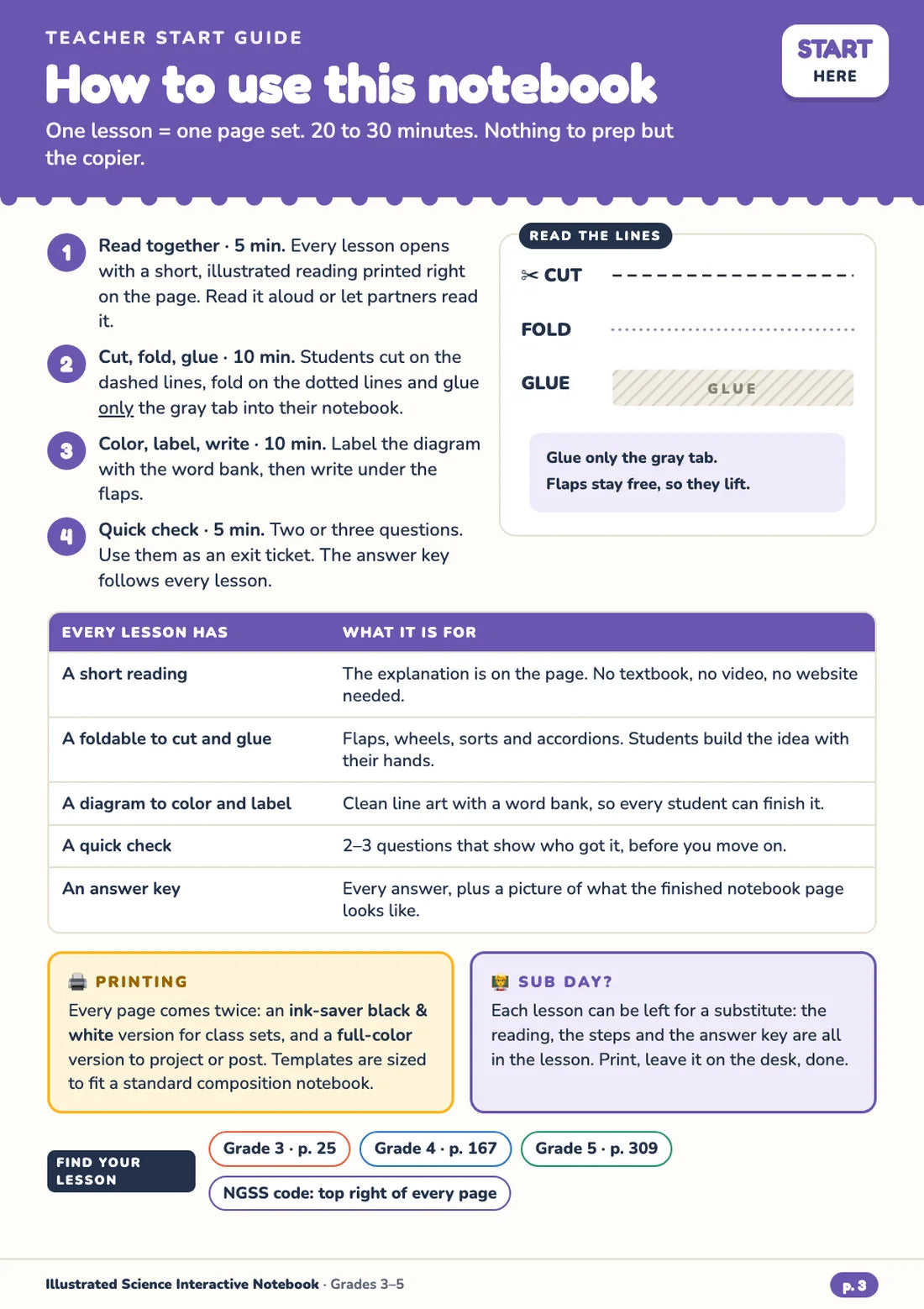
One lesson, 20 to 30 minutes.
Nothing to cut out ahead of time, nothing to look up. Print the pages for the lesson and hand them out. The steps are printed on the page, so the lesson can also be left for a substitute.
Read together
A short reading on the page, written for grades 3–5. Read it aloud or let partners read it. The key words are in bold.
Build and label
Students cut, fold and glue the foldable, then color and label the diagram with the word bank and write under the flaps.
Quick check
Two or three questions to use as an exit ticket. The answer key, with a picture of the finished page, follows every lesson.
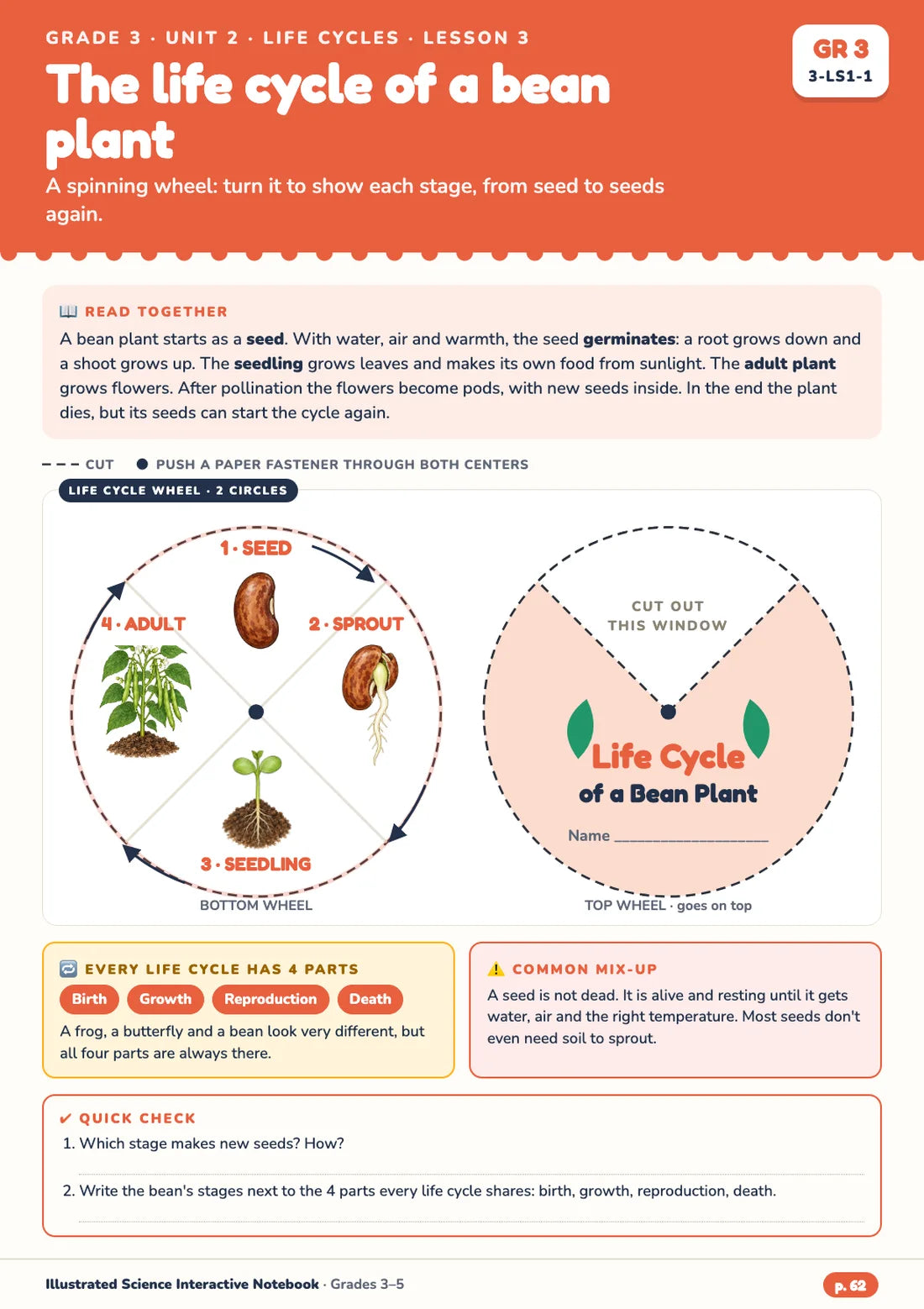
A wheel they turn, a cycle they remember.
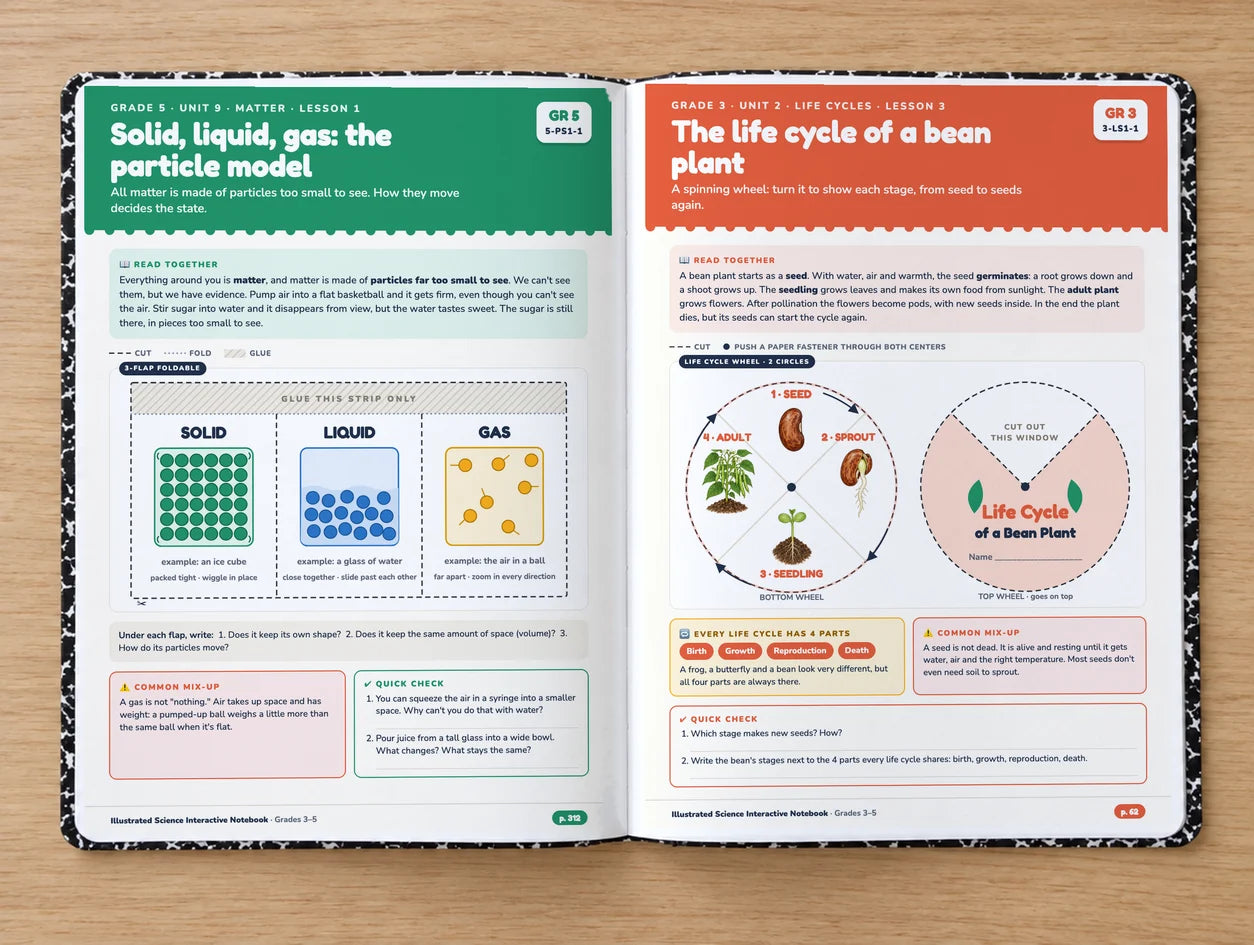
Four drawn stages of a bean plant on the bottom wheel, a window on the top wheel, one paper fastener in the middle. Turn it and the cycle comes around again.
- Life cycles of plants and animals: birth, growth, reproduction, death (3-LS1-1)
- Inherited traits and how the environment changes them (3-LS3-1, 3-LS3-2)
- Fossils, habitats and survival (3-LS4-1 to 3-LS4-4)
- Common mix-up named on the page: "a seed is not dead, it's resting"
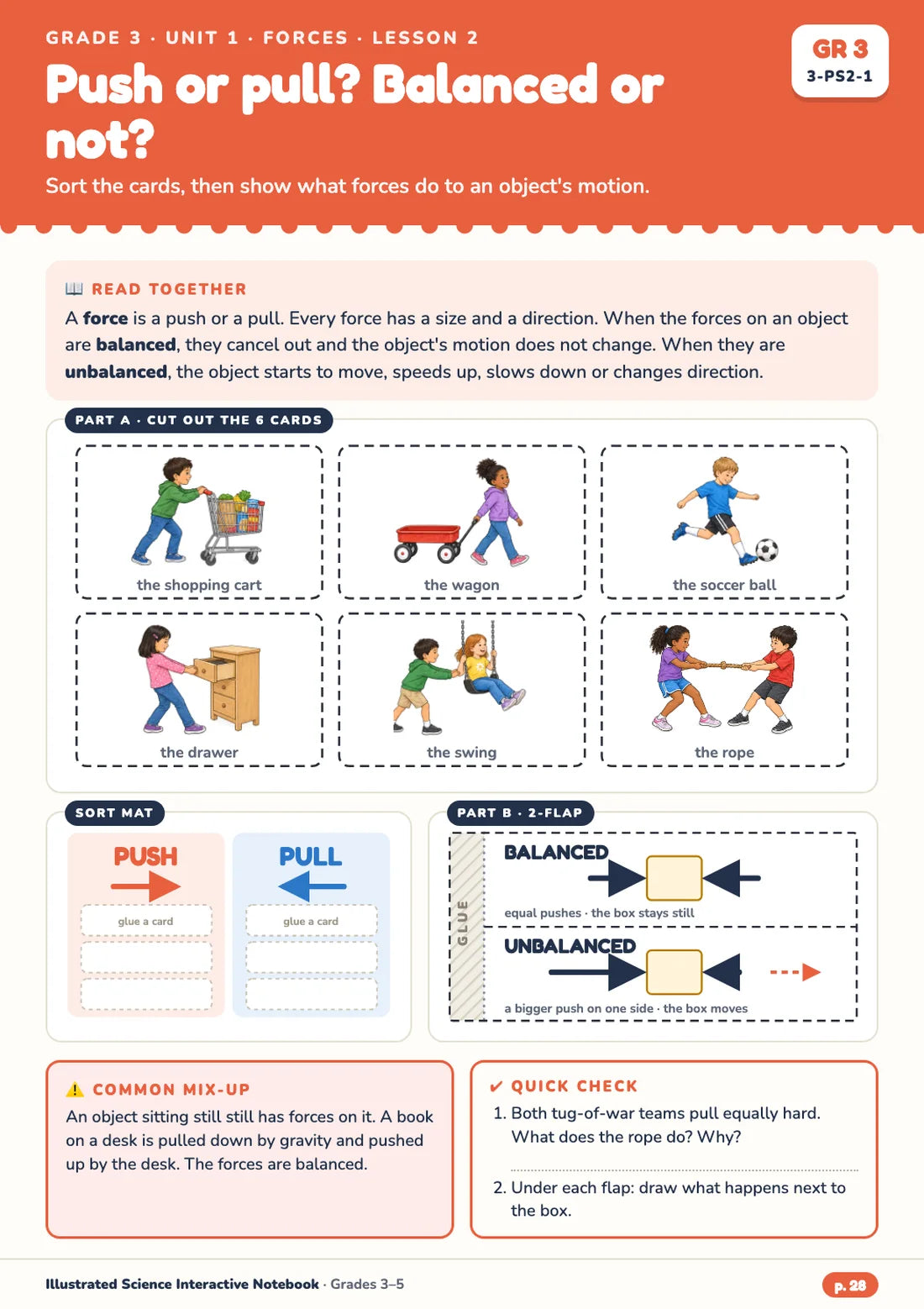
Sort it, glue it, explain it.
Six illustrated cards to sort into push and pull, then a 2-flap that shows what balanced and unbalanced forces do to a box.
- Balanced and unbalanced forces (3-PS2-1)
- Patterns of motion you can predict (3-PS2-2)
- Magnets and static electricity, plus a magnet design problem (3-PS2-3, 3-PS2-4)
- Weather, seasons and climate in Unit 4 (3-ESS2-1, 3-ESS2-2, 3-ESS3-1)
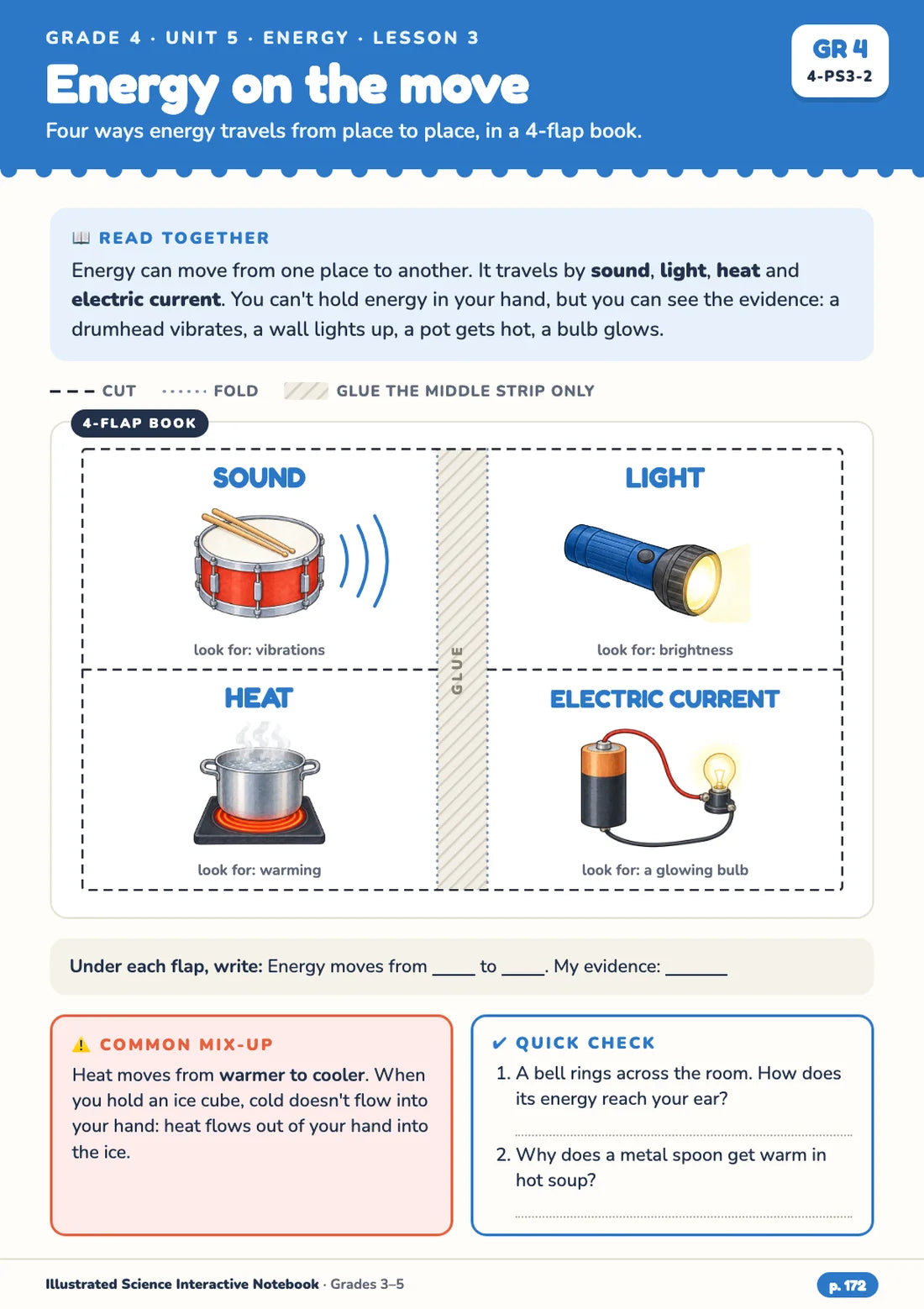
Four flaps, four ways energy travels.
Sound, light, heat and electric current, each with a drawing and the evidence to look for. Under each flap: "Energy moves from ___ to ___."
- Speed, energy and collisions (4-PS3-1, 4-PS3-3)
- Energy moving by sound, light, heat and current (4-PS3-2)
- Waves, and how light lets us see (4-PS4-1, 4-PS4-2, 4-PS4-3)
- Structures, senses and the brain (4-LS1-1, 4-LS1-2)
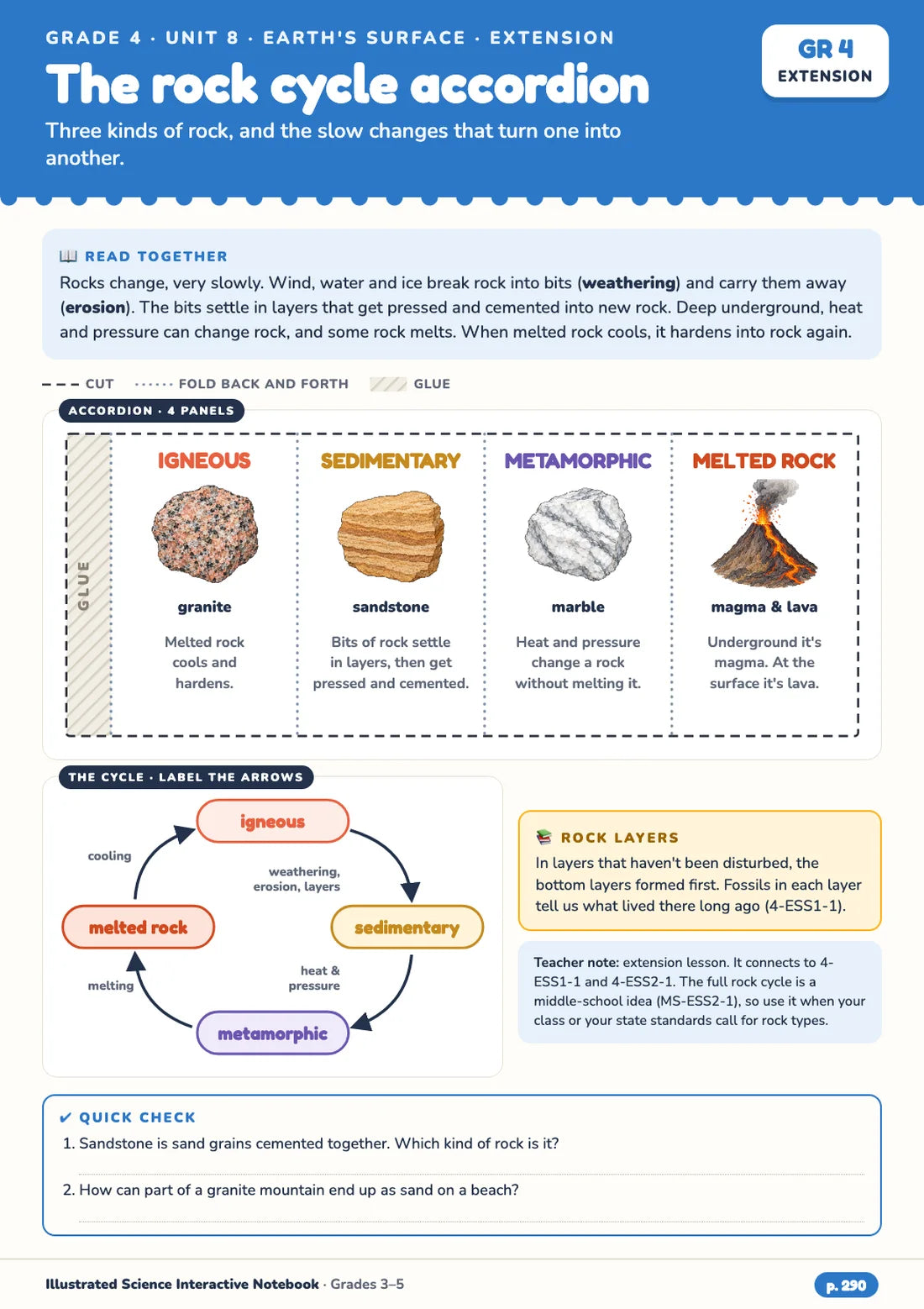
Rock layers, weathering, erosion.
Rocks and landforms change slowly. Students see it in rock layers, fossils and the way water, ice and wind carry the land away.
- Rock layers and fossils as evidence of change (4-ESS1-1)
- Weathering and erosion (4-ESS2-1) and maps of Earth's features (4-ESS2-2)
- Natural hazards and energy resources (4-ESS3-1, 4-ESS3-2)
- Rock cycle accordion as a marked extension lesson, for classes that study rock types
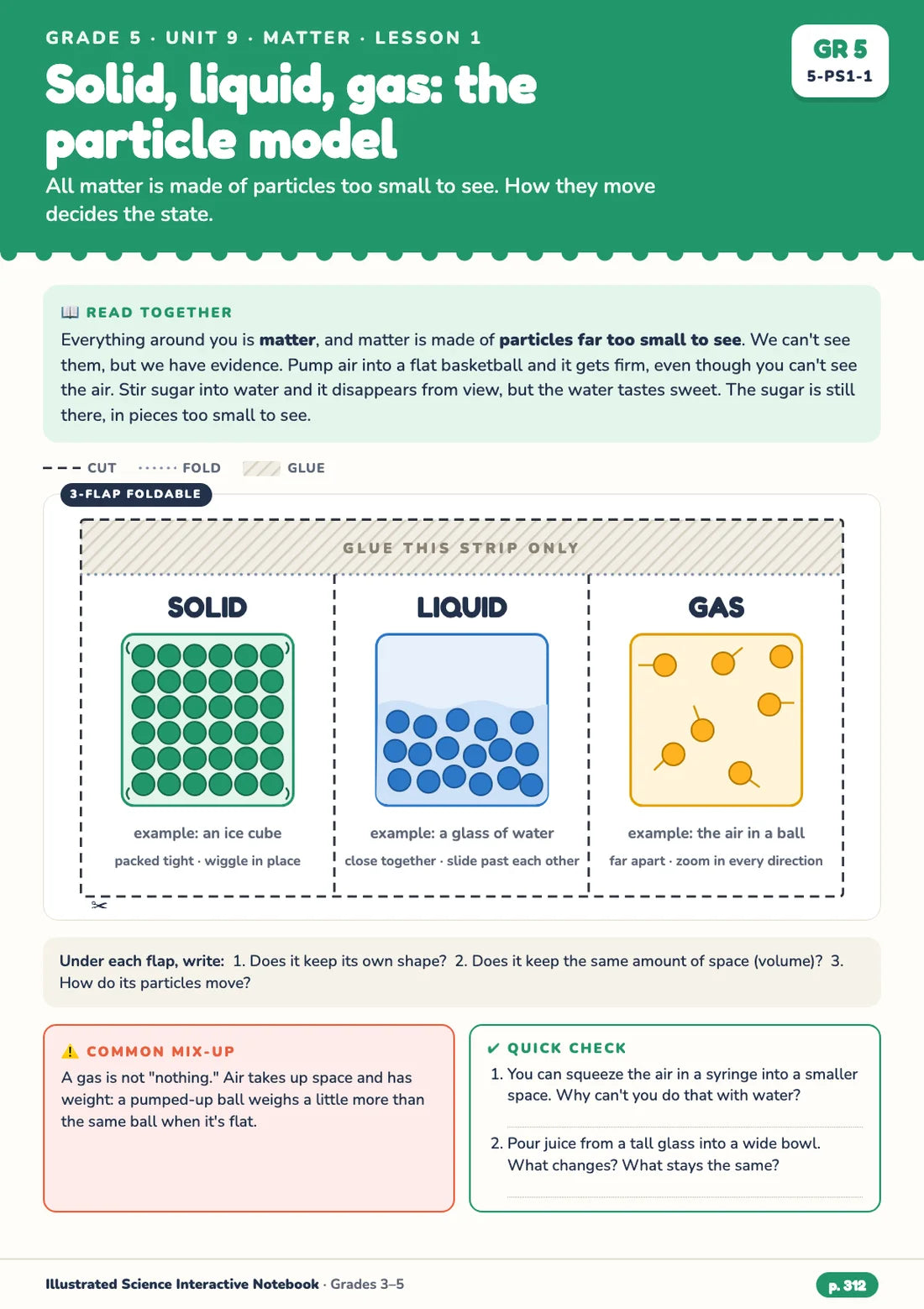
Particles too small to see, drawn big.
Three flaps, three particle models. Under each flap students write whether it keeps its shape, keeps its volume, and how the particles move.
- Matter is made of particles too small to see (5-PS1-1)
- Weight is conserved when things heat, cool or mix (5-PS1-2)
- Identifying materials by their properties, and new substances (5-PS1-3, 5-PS1-4)
- Gravity pulls down (5-PS2-1)
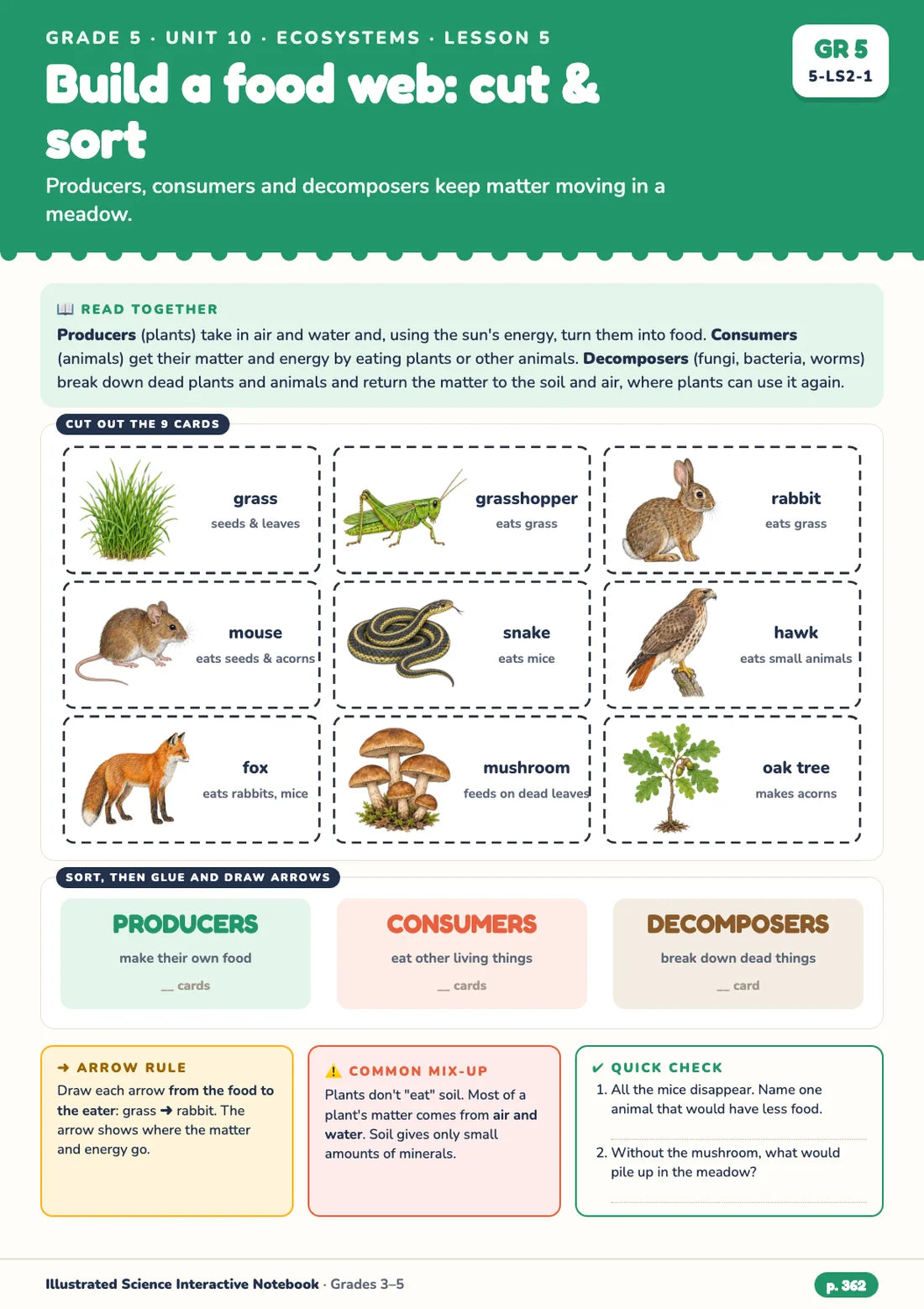
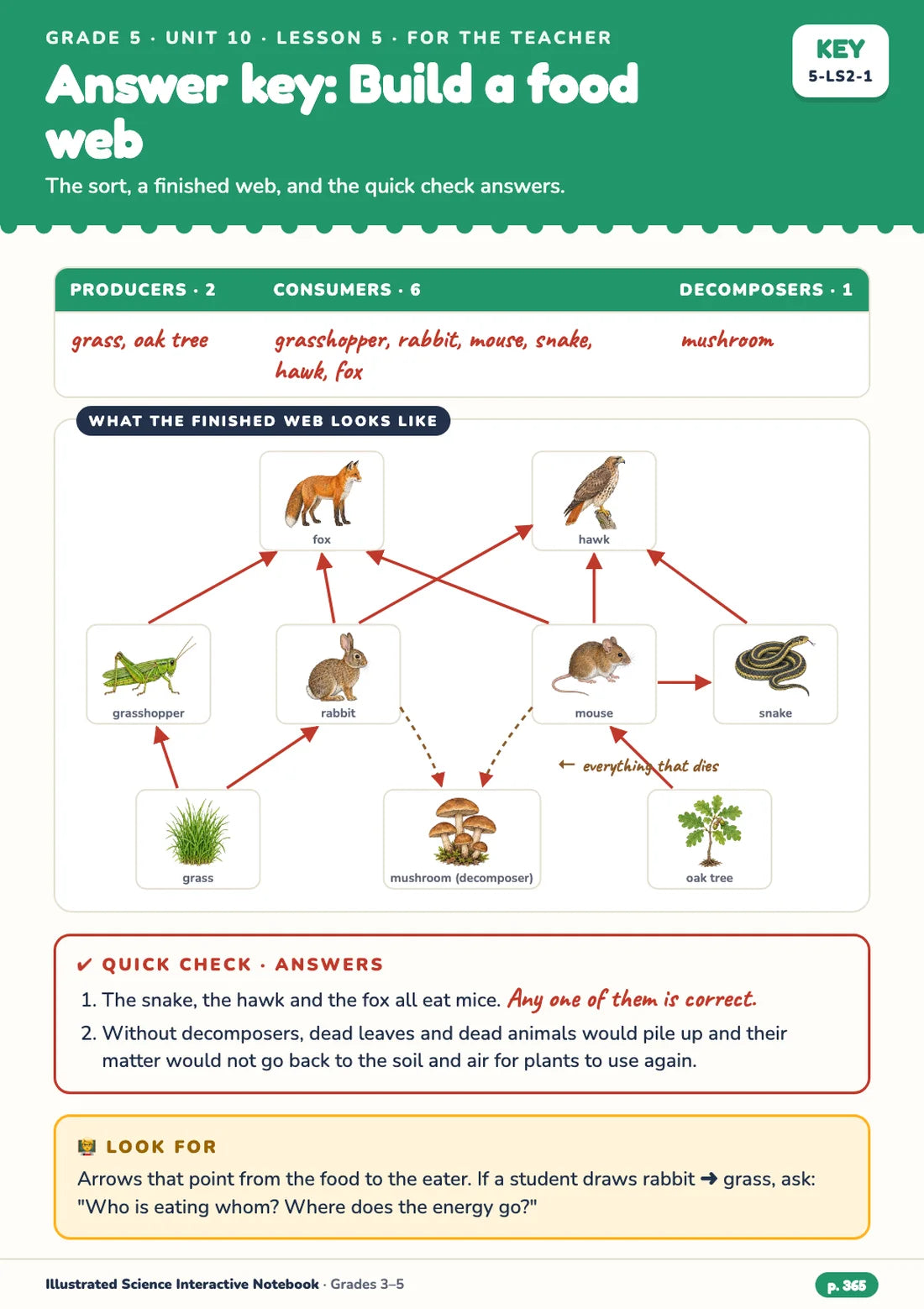
Nine cards make one food web.
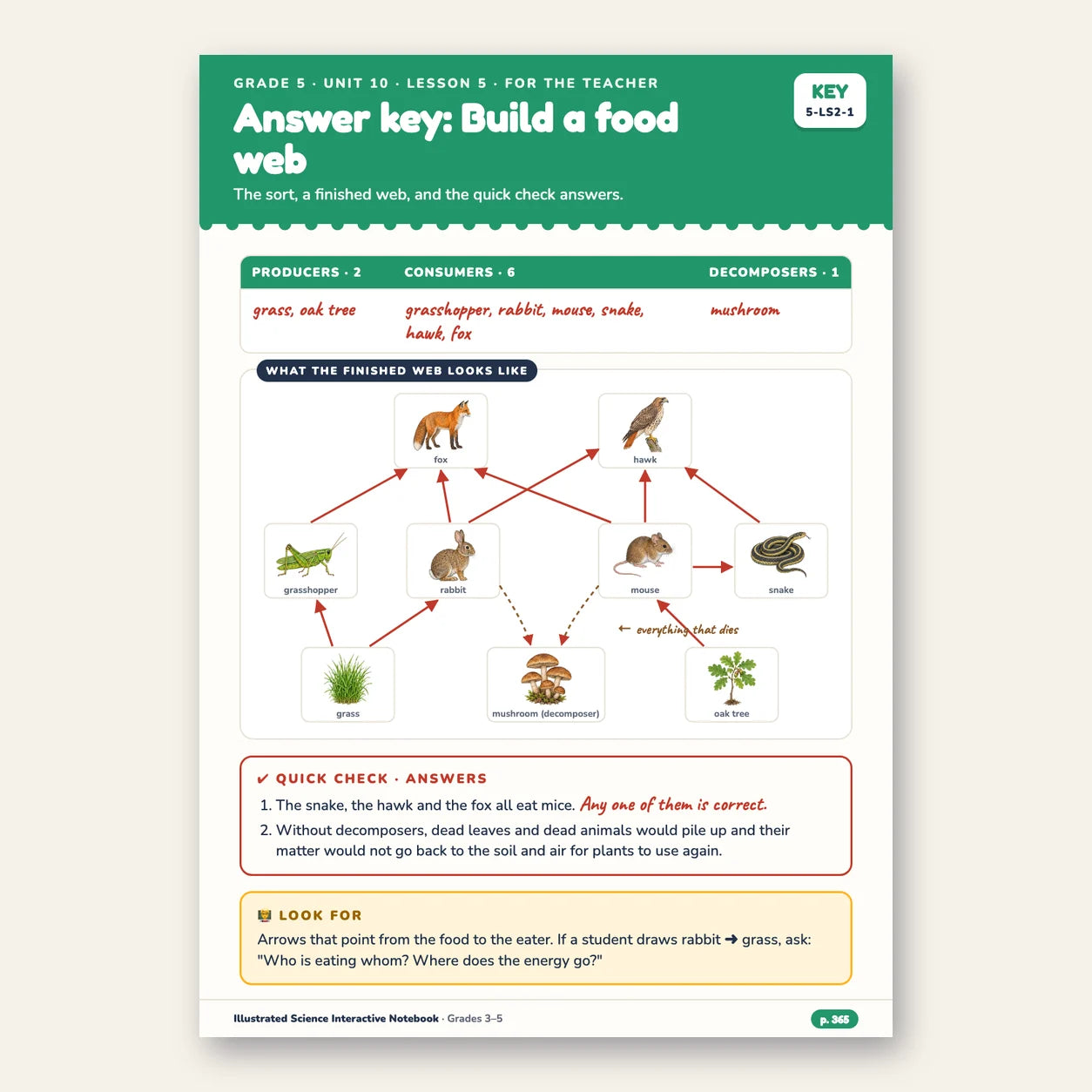
Grass, oak, grasshopper, rabbit, mouse, snake, hawk, fox and mushroom. Cut, sort, glue, then draw the arrows from the food to the eater.
- Energy in food was once energy from the sun (5-PS3-1)
- Plants grow mostly from air and water (5-LS1-1) and matter moves in an ecosystem (5-LS2-1)
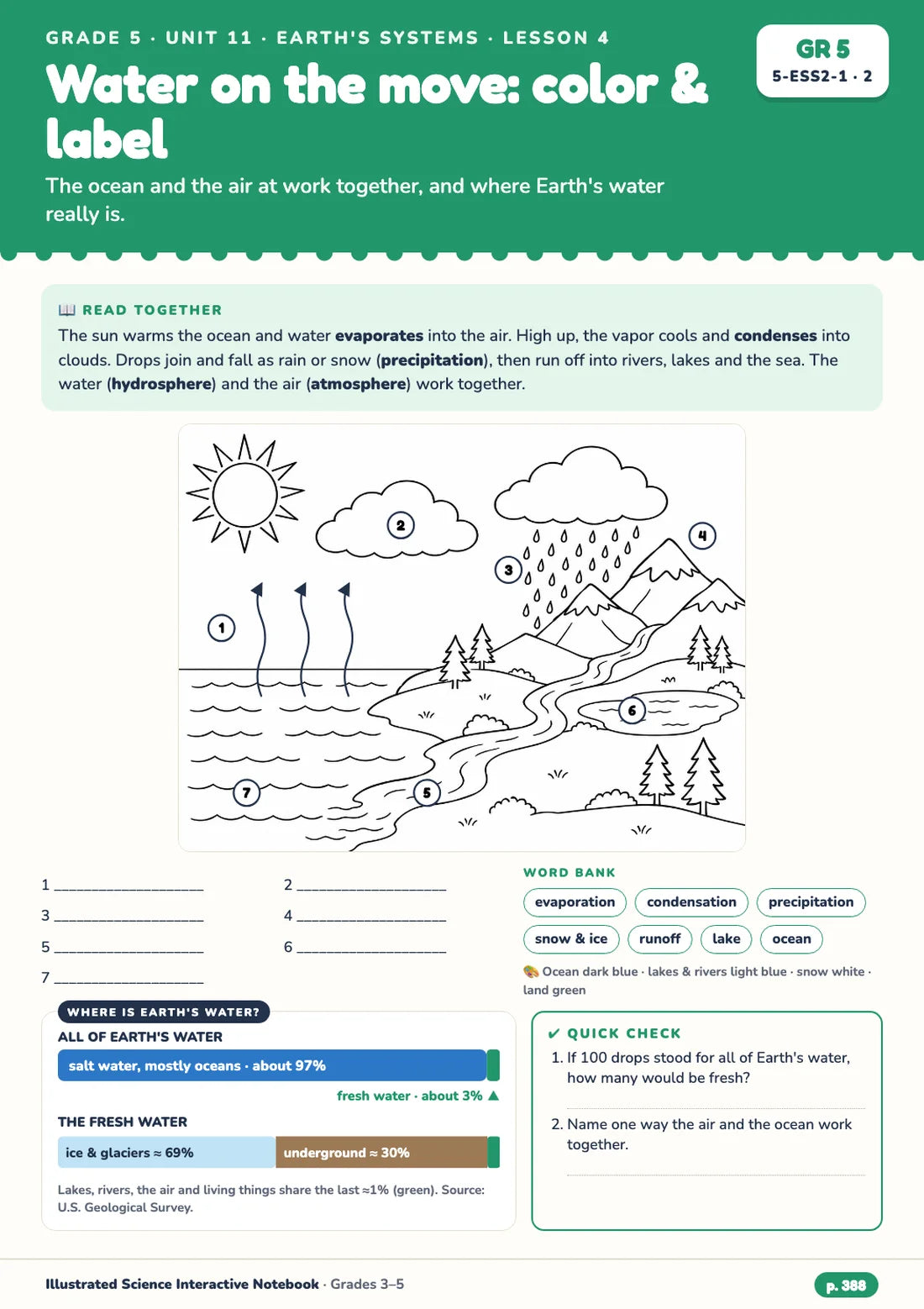
- Earth's systems and where the water is (5-ESS2-1, 5-ESS2-2, 5-ESS3-1)
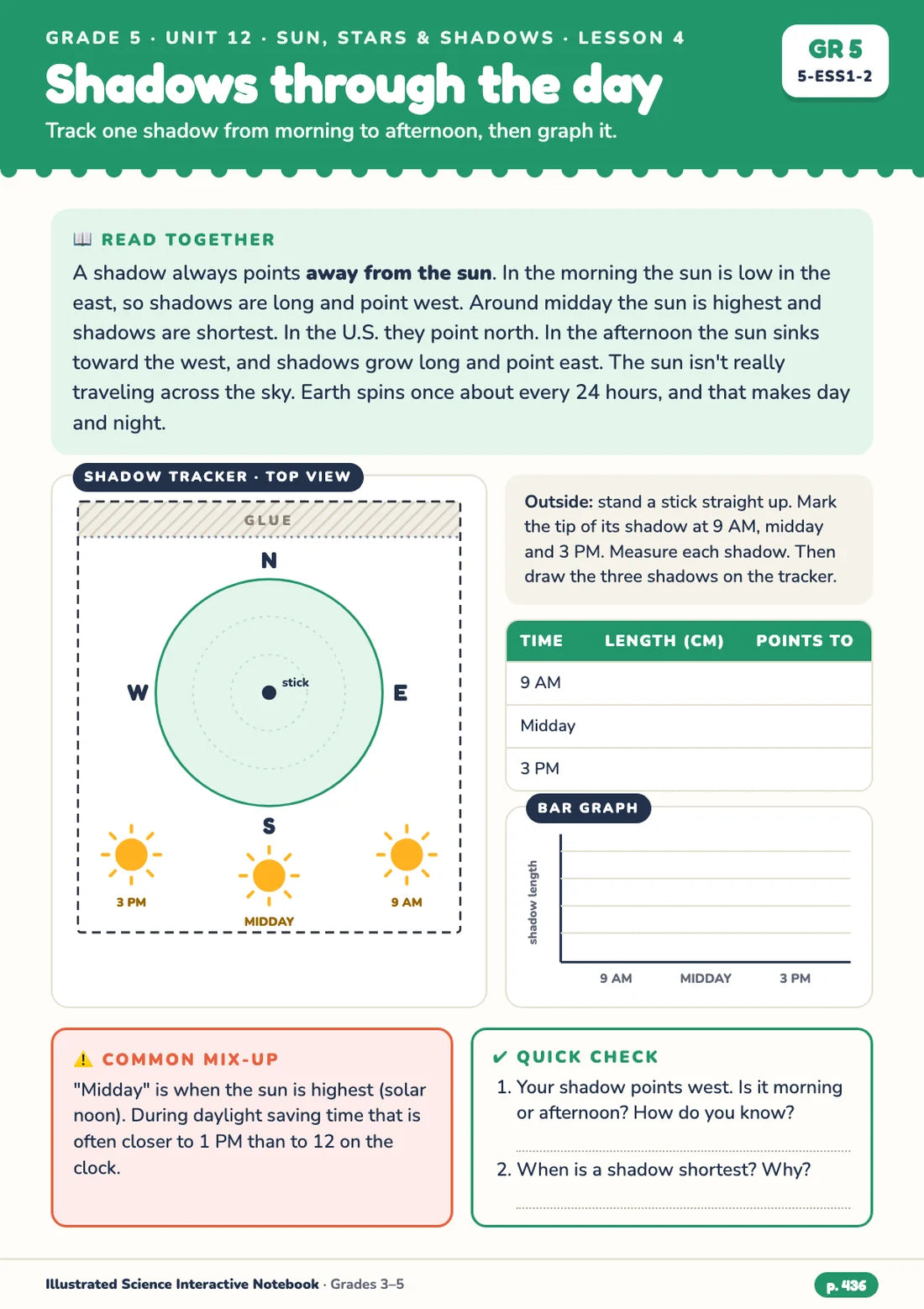
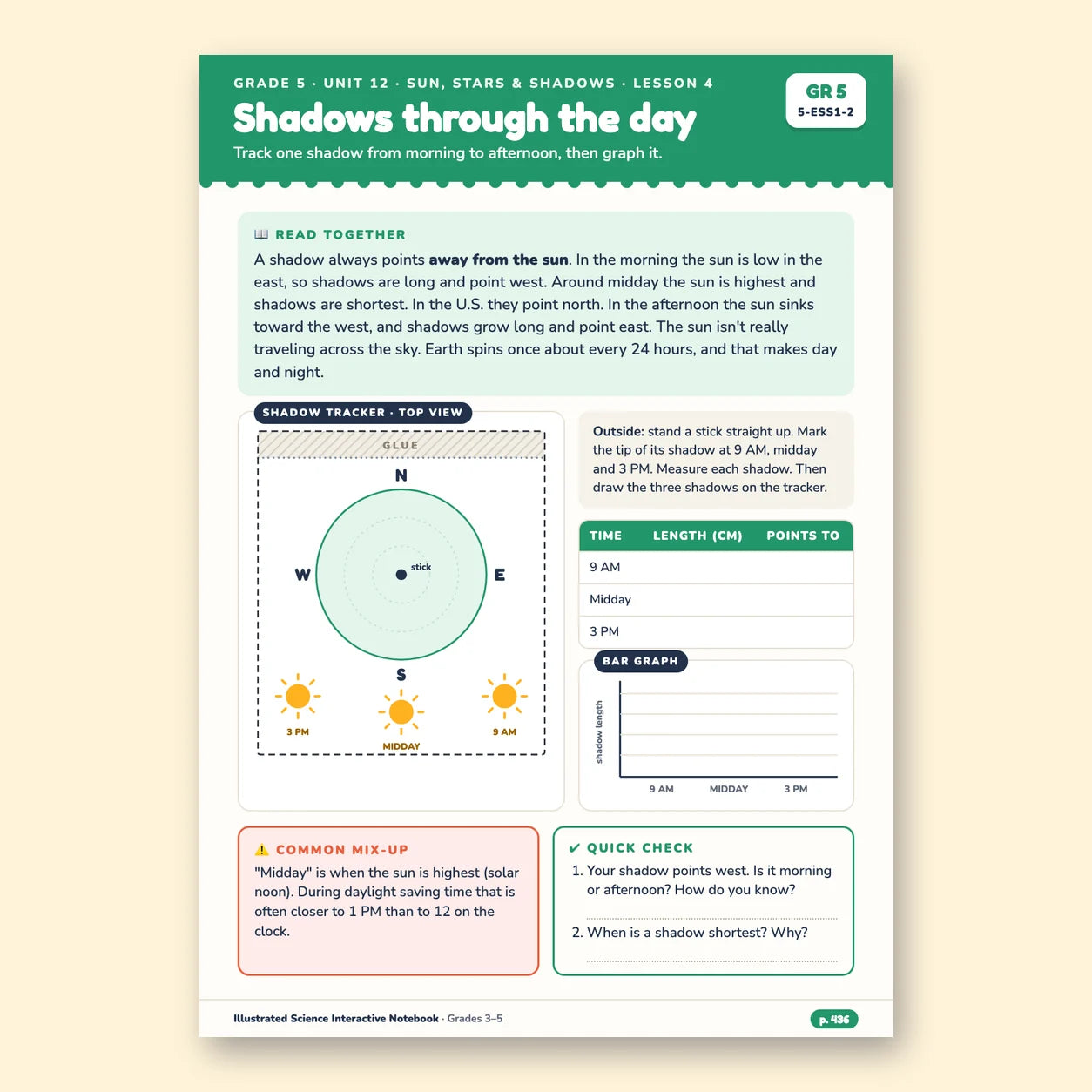
- The sun and stars, shadows, day and night (5-ESS1-1, 5-ESS1-2)
By June, every student has a science book they made.
The notebook becomes their own reference. They flip back to the food web before a test, and you can see in a few seconds who understood which lesson.
- Illustrations that are clear and accurate, not clip art
- Line art in the ink-saver version, so class sets don't drain your printer
- Every page checked against the NGSS clarification statements
Three grades, one download.
Standards map, by grade
| Grade | Unit | NGSS performance expectations | Pages |
|---|---|---|---|
| Teacher | Start Guide: setup, pacing, NGSS map | All grades 3–5 | 1–24 |
| Grade 3 | 1 · Forces & magnets | 3-PS2-1, 3-PS2-2, 3-PS2-3, 3-PS2-4 | 25–58 |
| Grade 3 | 2 · Life cycles & traits | 3-LS1-1, 3-LS3-1, 3-LS3-2 | 59–90 |
| Grade 3 | 3 · Groups, fossils & survival | 3-LS2-1, 3-LS4-1, 3-LS4-2, 3-LS4-3, 3-LS4-4 | 91–128 |
| Grade 3 | 4 · Weather & climate | 3-ESS2-1, 3-ESS2-2, 3-ESS3-1 | 129–166 |
| Grade 4 | 5 · Energy & energy resources | 4-PS3-1, 4-PS3-2, 4-PS3-3, 4-PS3-4, 4-ESS3-1 | 167–206 |
| Grade 4 | 6 · Waves & light | 4-PS4-1, 4-PS4-2, 4-PS4-3 | 207–234 |
| Grade 4 | 7 · Structures & senses | 4-LS1-1, 4-LS1-2 | 235–266 |
| Grade 4 | 8 · Earth's surface (+ rock cycle extension) | 4-ESS1-1, 4-ESS2-1, 4-ESS2-2, 4-ESS3-2 | 267–308 |
| Grade 5 | 9 · Matter | 5-PS1-1, 5-PS1-2, 5-PS1-3, 5-PS1-4 | 309–346 |
| Grade 5 | 10 · Energy & matter in ecosystems | 5-PS3-1, 5-LS1-1, 5-LS2-1 | 347–382 |
| Grade 5 | 11 · Earth's systems & water | 5-ESS2-1, 5-ESS2-2, 5-ESS3-1 | 383–414 |
| Grade 5 | 12 · Gravity, sun, stars & shadows | 5-PS2-1, 5-ESS1-1, 5-ESS1-2 | 415–452 |
Engineering design (3-5-ETS1-1, -2, -3) runs through all three grades as design challenges inside the units.
Also in the download
For your class, or for your whole grade team.
One teacher, every year you teach
The full PDF for grades 3–5. Print and copy it for your own students, this year and every year after.
Up to 4 teachers at one school
Same PDF, licensed for your whole team: plan together and use the same notebook in every classroom.
An answer key that shows the finished page.
Not just a list of answers. You see what the sort, the web or the diagram should look like when it's done, plus what to look for when a student gets it wrong.
- Answers to every quick check
- A picture of the finished notebook page
- "Look for" notes on the usual mistakes
See 10 real pages, free.
The teacher guide, a 3-flap, a life cycle wheel, a push-and-pull sort, a color-and-label diagram, a food web, a 4-flap book, a rock cycle accordion, a shadow tracker and an answer key. Open them full size and decide with the pages in front of you.
See the 10 pages ↓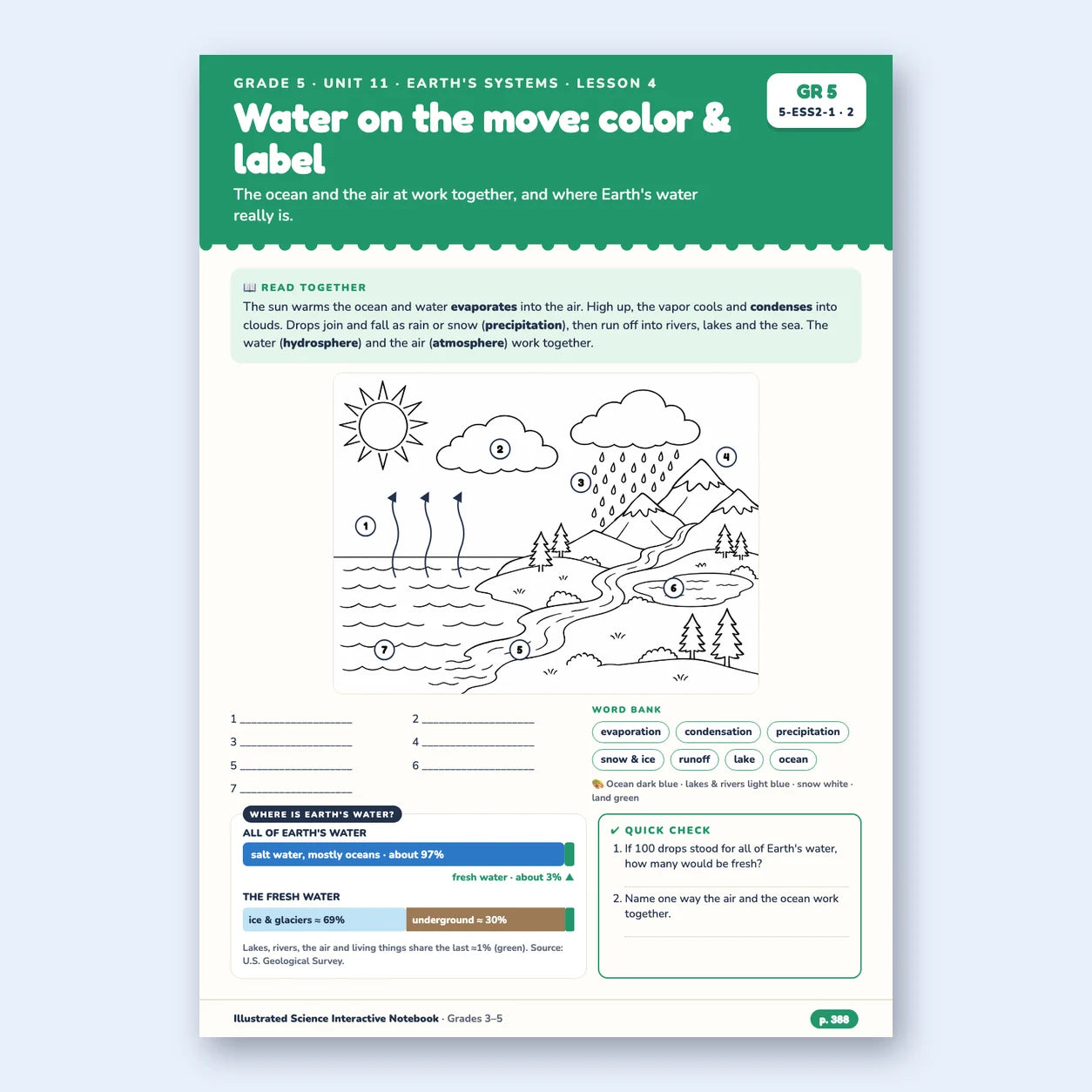
What makes it different?
| What you get | This notebook | Single-topic units | District textbook | Free worksheets |
|---|---|---|---|---|
| A full year for grades 3, 4 and 5 | ✓ | One topic at a time | ✓ | ✗ |
| Reading + foldable + diagram + check in every lesson | ✓ | Varies | Reading first | One sheet |
| NGSS code on every page | ✓ | Varies | Varies | Rarely |
| Answer key for every lesson | ✓ | Varies | ✓ | Varies |
| Ink-saver black & white version | ✓ | Varies | — | Varies |
| Price | $49.95 for the year | $4–12 per unit | District-priced | Free |
Teach your first lesson tomorrow.
Check out
Secure checkout. No account to create and no subscription: you pay once.
Download the PDF
The download link arrives by email. Open the Teacher Start Guide and pick your grade.
Print one lesson
Print the pages for lesson 1, hand them out with scissors and glue sticks, and teach.
The whole year of science, ready to print.
- 90 illustrated lessons, 30 per grade, 452 pages
- Built on the NGSS performance expectations for grades 3, 4 and 5
- A reading, a foldable, a color-and-label diagram and a quick check in every lesson
- An answer key with the finished page after every lesson
- Ink-saver black & white and full-color versions
- Teacher Start Guide with 36-week pacing calendars and an NGSS map
- Student notebook covers and table of contents pages
- Single-teacher or grade-level team license
What teachers ask before buying
What does the single-teacher license allow?
One teacher can print and copy the pages for the students they teach, every year. Sharing the PDF with other teachers, or posting it where others can download it, isn't included. For a grade-level team of up to 4 teachers at the same school, choose the team license.
Can I print it in black and white?
Yes. Every page comes in an ink-saver black & white version, made with line art and very few dark areas, for class sets. The full-color version is there to project or post.
Is there a Google Slides or digital version?
No. This is a printable PDF, made to be cut, folded and glued into a paper notebook. You can project a page from the PDF, but there is no Google Slides or interactive digital version.
Does it match my state's standards?
It is built on the NGSS performance expectations for grades 3–5, and every page shows its code. Many states use the NGSS or standards based on the same framework. If your state has its own standards, the code on every page makes it quick to match each lesson. Check your state's list before you buy, and if it doesn't fit, the 30-day guarantee covers you.
Are there answer keys?
Yes, after every lesson: the answers to the quick check, a picture of what the finished notebook page should look like, and notes on the usual mistakes.
How long does a lesson take?
20 to 30 minutes: about 5 to read, 10 to 20 to build and label, and 5 for the quick check. With a shorter block, the reading and the foldable work on their own.
What supplies do students need?
Scissors, glue sticks, colored pencils and a composition notebook. A few lessons use a brass paper fastener (for the wheels) or simple things like a stick for the shadow tracker. The supply list for the year is in the Teacher Start Guide.
I teach only one grade. Is it still worth it?
Each grade is a full year on its own, 30 lessons with its own pacing calendar. The other two grades help if you loop, teach a combined class, or have students who need review or a challenge.
Does it include experiments and lab kits?
No. It's a notebook: readings, foldables, diagrams and checks. A few lessons ask students to observe or measure something simple, like a shadow. It works next to any experiments you already do.
What if it isn't right for my class?
You have a 30-day guarantee. Email us within 30 days and we'll refund you. No questions, no forms.
Get ready for "Is it science time yet?"
90 illustrated lessons for grades 3–5. Zero prep. 30-day guarantee.
$49.95 · instant PDF