Science isn't your strong suit?
It doesn't have to be.
A full year of secular science for all your kids at once. 72 lessons: you read the script, do a mini-experiment with kitchen items, and each child fills in the same page at their own level. PDF or printed set.
The books on your shelf, the PDF to print extra student pages · $89.99

One lesson. Every kid at your table.
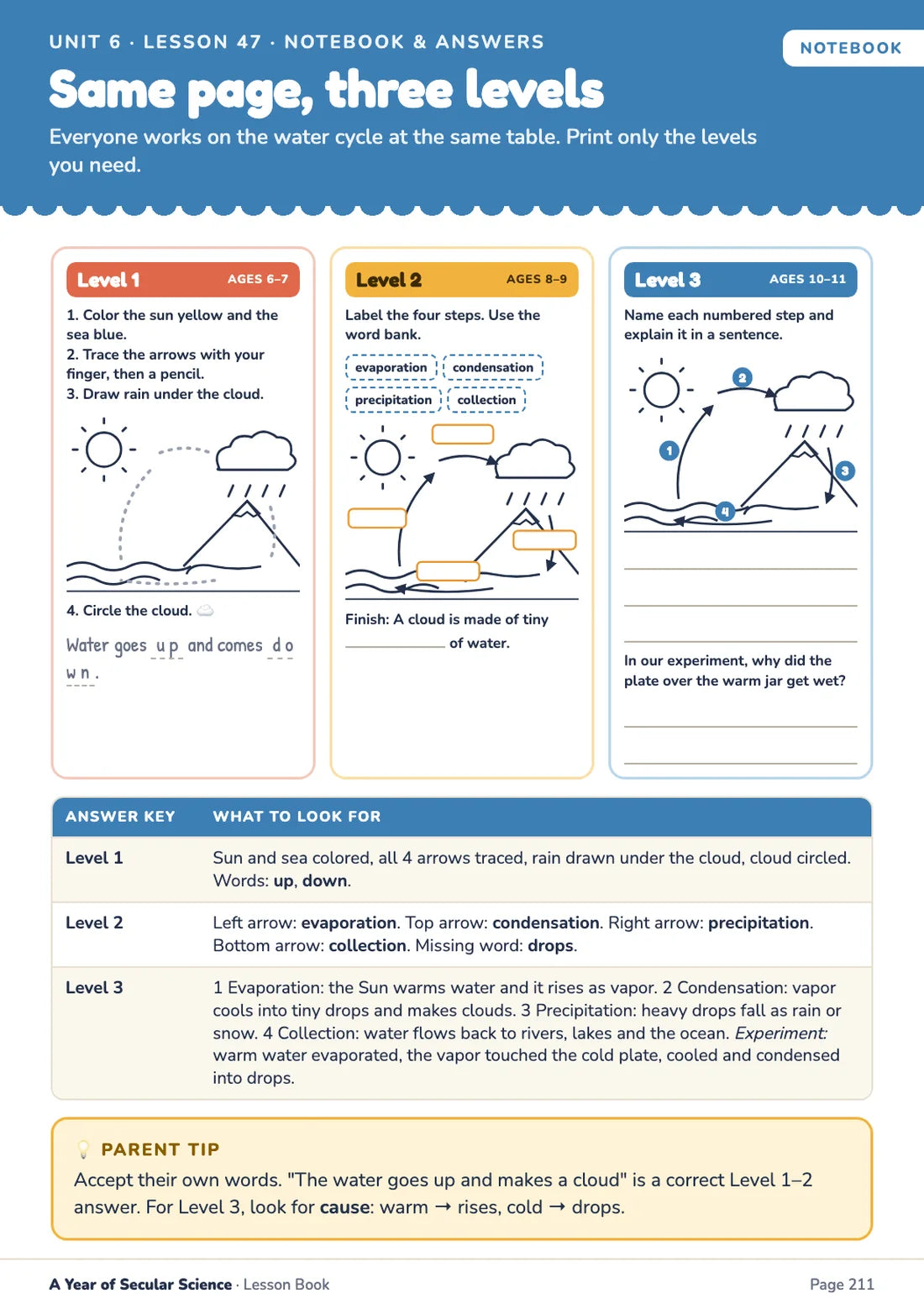
Your 6-year-old colors and traces. Your 8-year-old labels. Your 10-year-old explains. Same drawing, same topic, three levels, side by side.
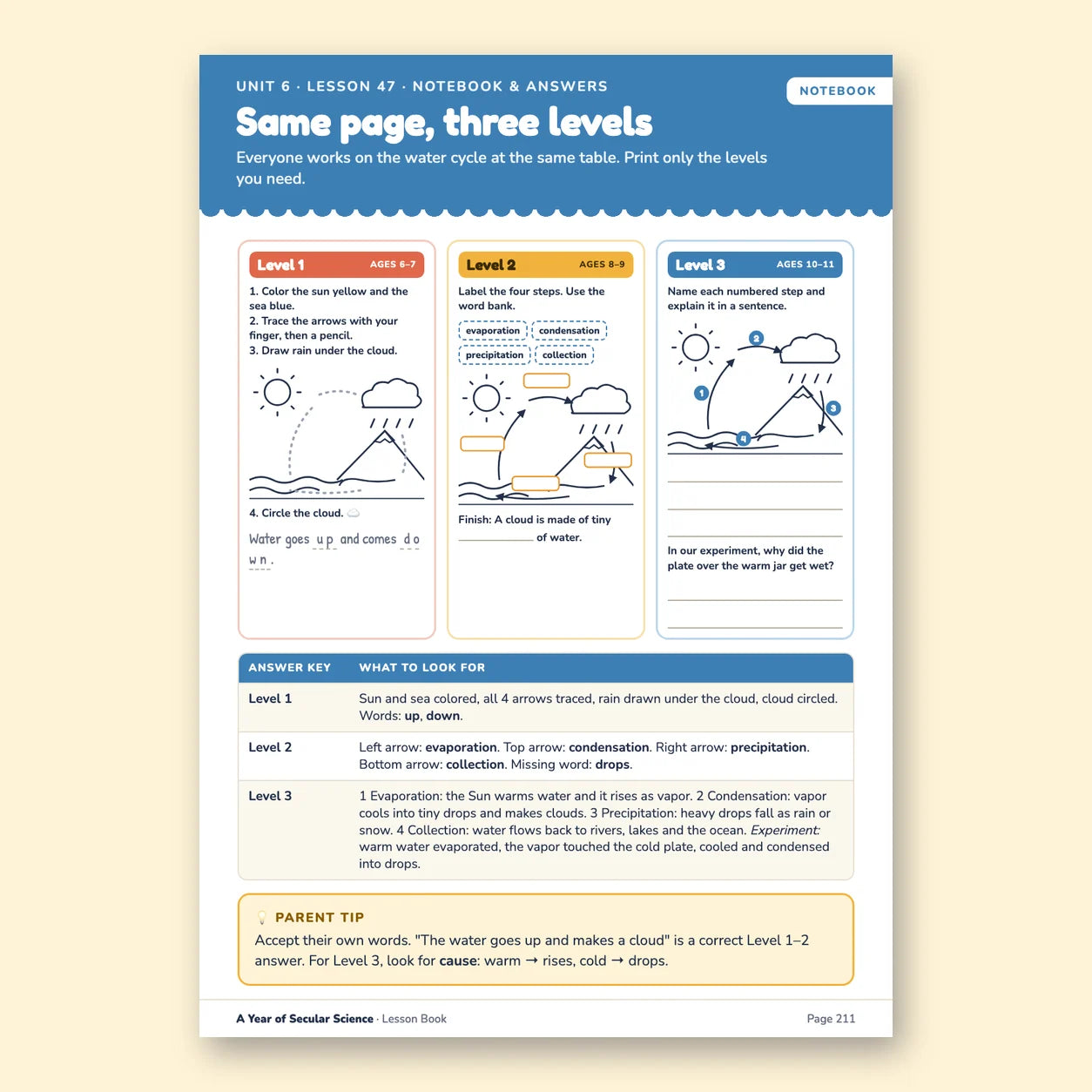
This is what you'll print.
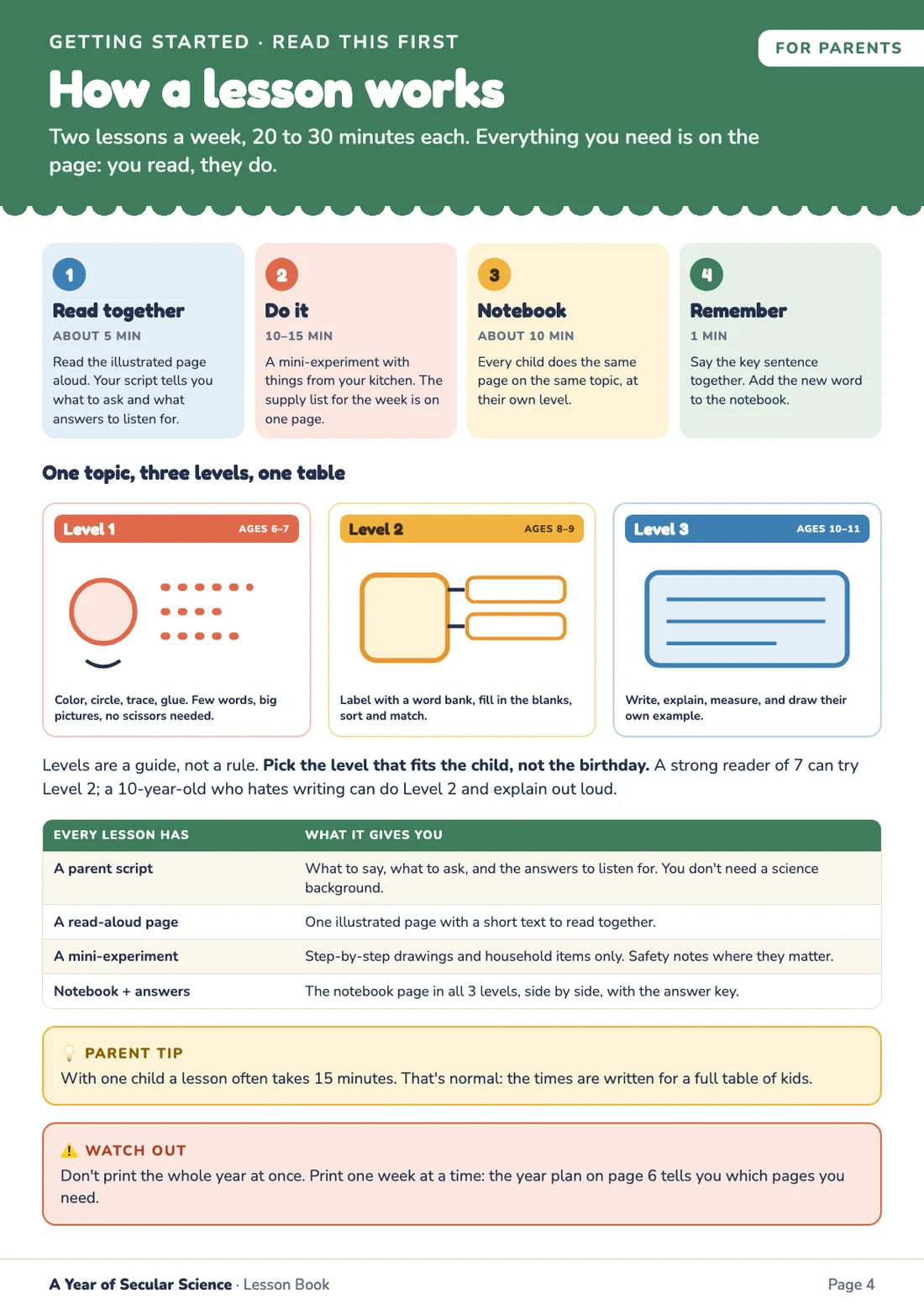
If you homeschool kids between 6 and 11, yes.
Someone already planned it
Every lesson is decided for you: what to read, what to do, what to ask. Open the book on Monday morning and teach.
One lesson, not three
Everyone learns the same topic at the same table. Each child works at their level, and the little one isn't left out.
Science, taught as science
Evolution, fossils, the age of the Earth and the Big Bang, explained honestly and at kid size. No religious content, no detours.
Two lessons a week. About an hour in total.
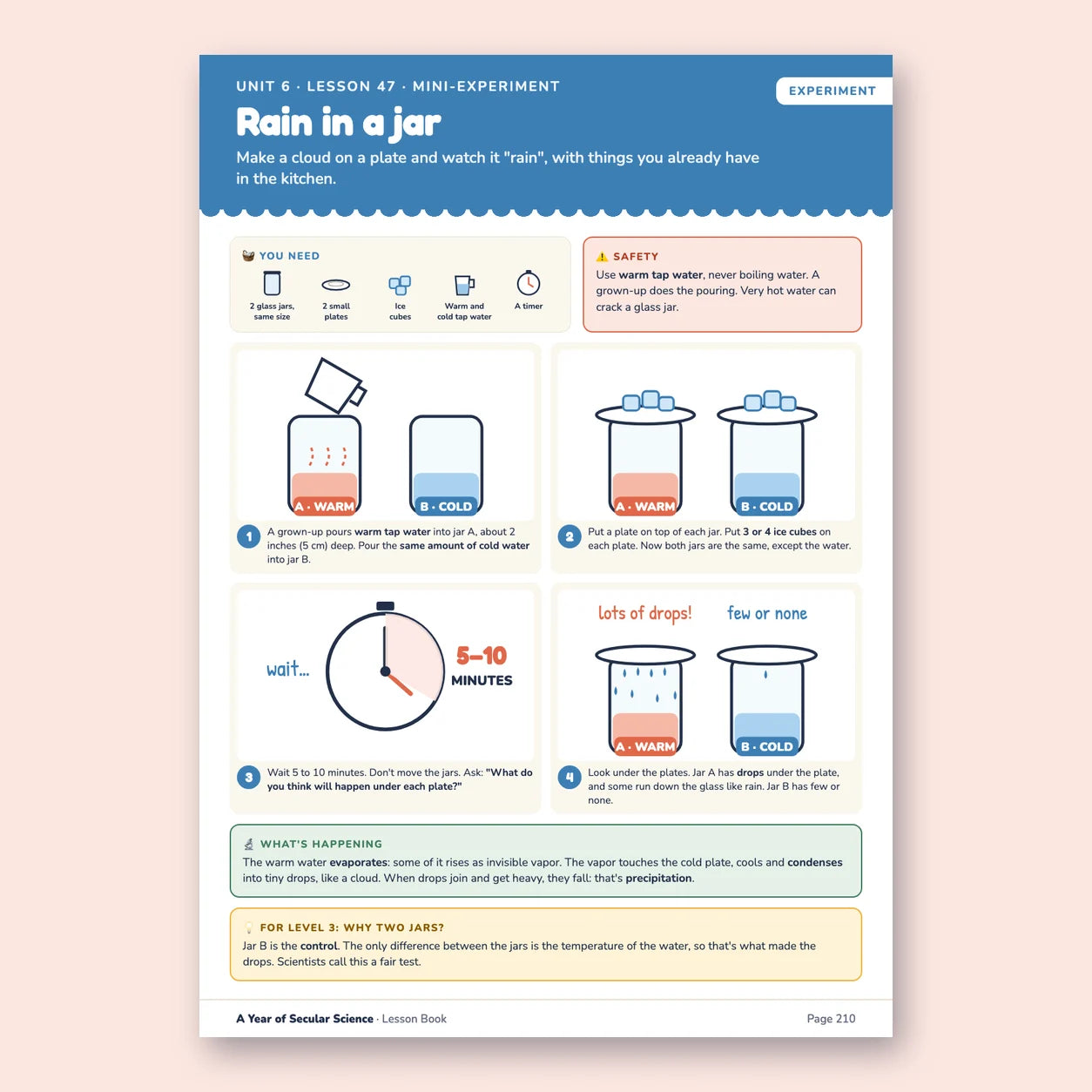
Here is week 24, in the middle of the unit on Earth, water and weather. Every week in the year works the same way.
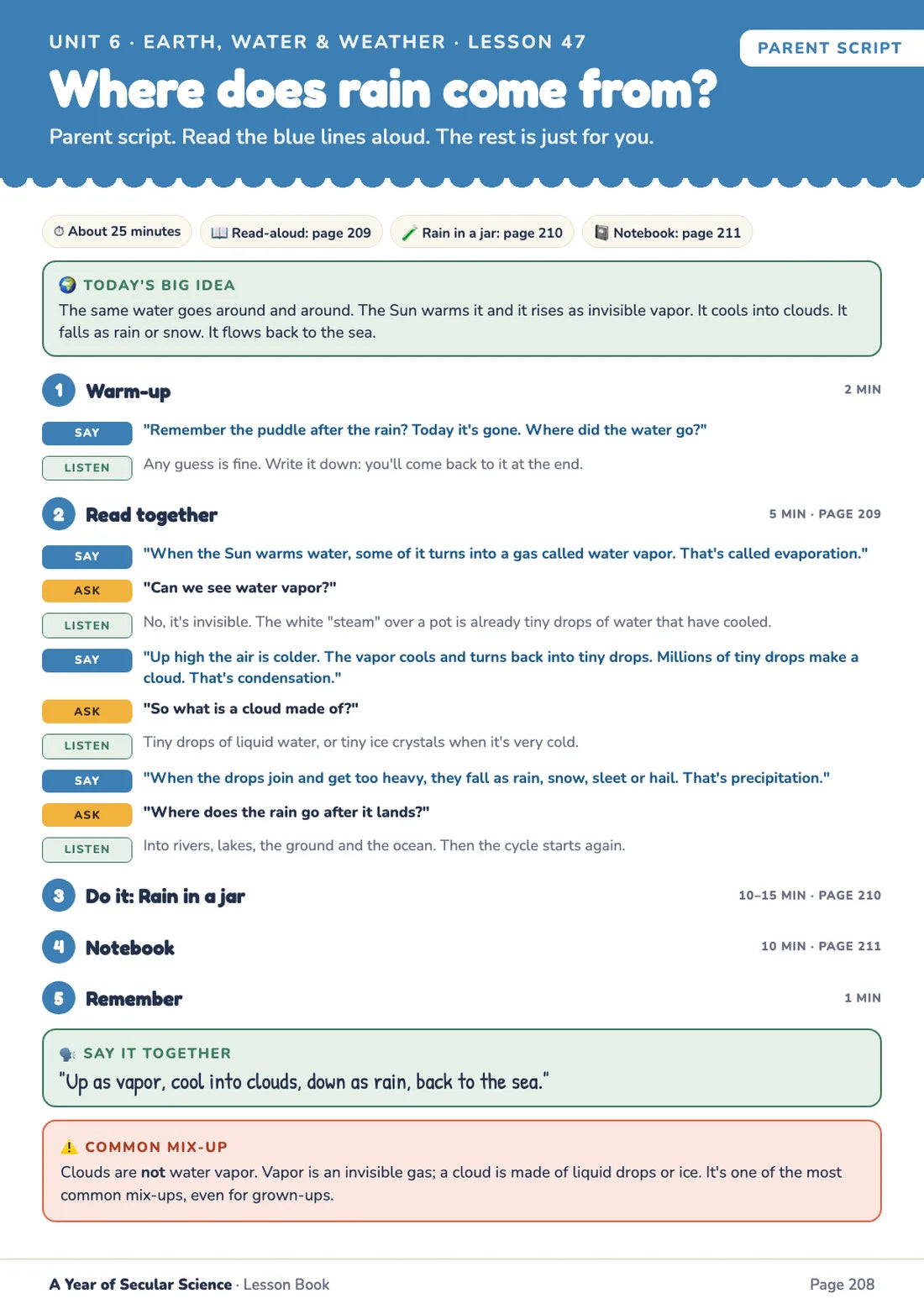
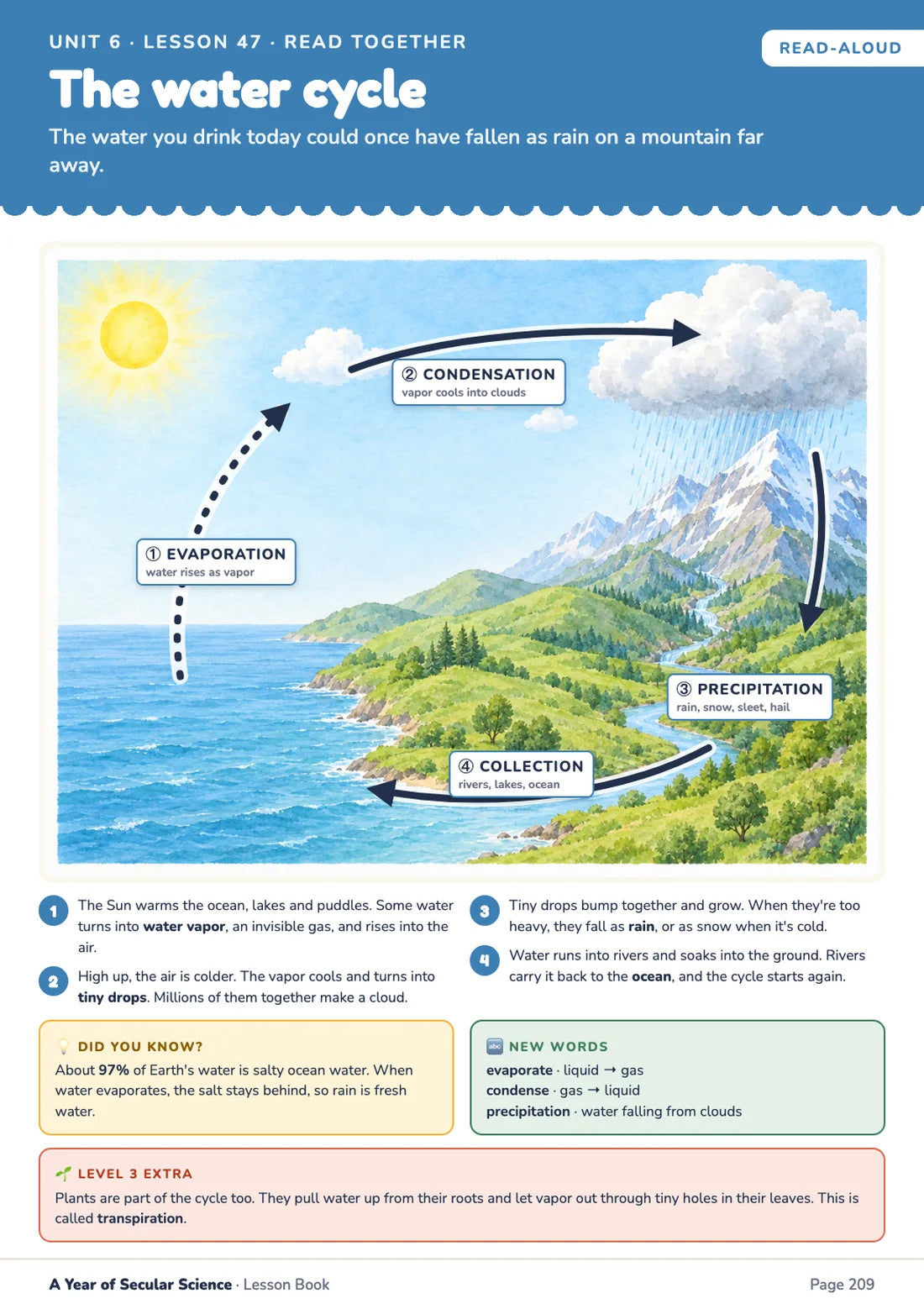
Where does rain come from?
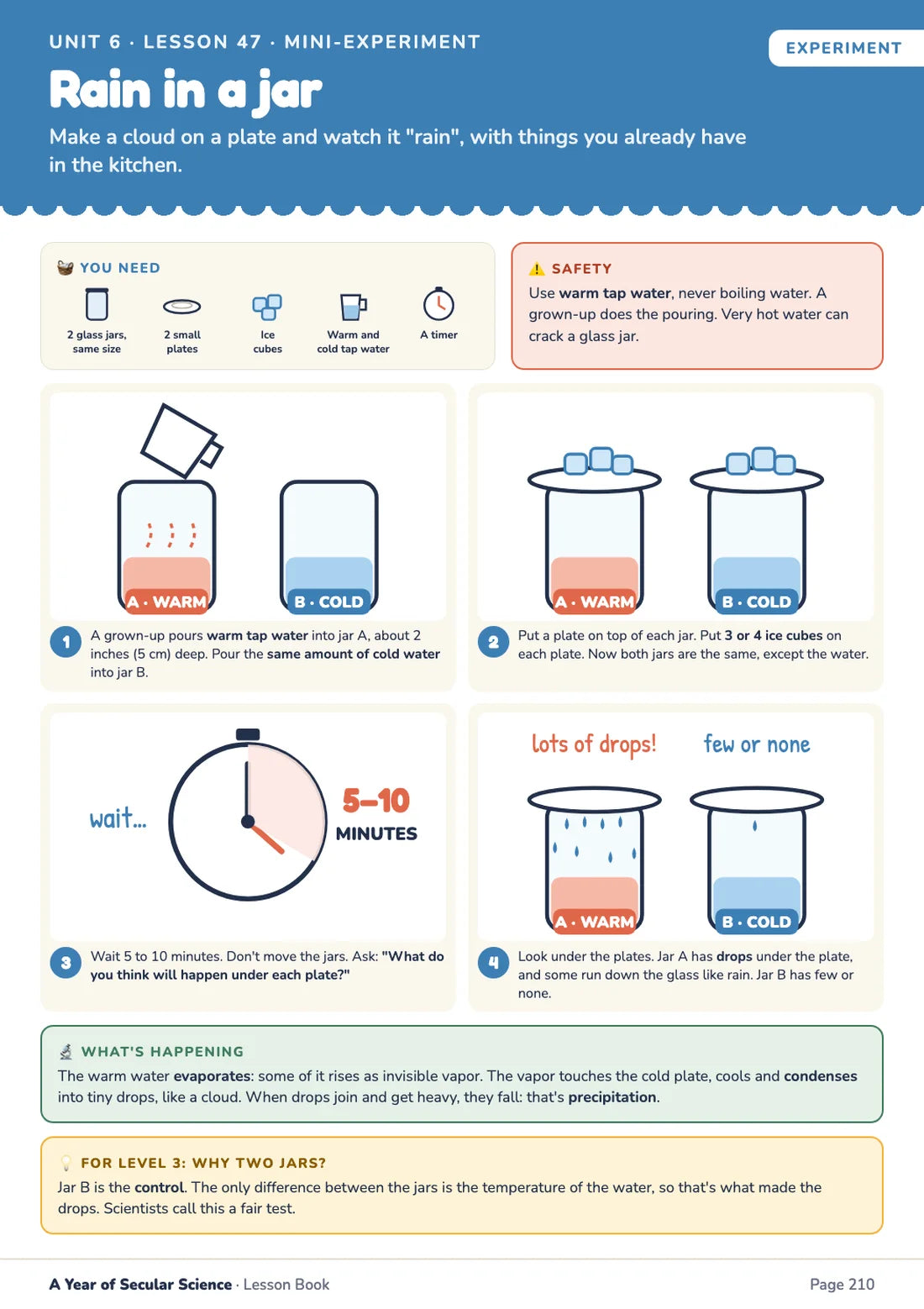
Read the water cycle page together, make rain in a jar with warm water, a plate and ice, then the notebook page at each child's level.
Clouds
Read about the main kinds of clouds, take a 10-minute cloud-watching walk, then sort and label the clouds in the notebook.
Print and gather
The week's supply list fits on one page. Print only the notebook pages for the levels you need, and you're ready.
You read the blue lines. They do the discovering.
Each lesson starts with a one-page script. It tells you what to say, what to ask and what answers to listen for, so you never have to look anything up first.
- "Say", "Ask" and "Listen for" lines, in plain words
- The common mix-ups to watch for, like "clouds are water vapor"
- Times for each step, so you know how long it really takes
- A key sentence to say together at the end
Experiments with what's already in your kitchen.
Jars, ice, paper, a flashlight, a bag of seeds. No kits to order and no extra books to buy. Every step is drawn, so kids can follow the pictures.
- Household items only, listed for the whole week on one page
- Step-by-step drawings and "what you'll see"
- "What's happening": the science behind it in three sentences
- Safety notes where they matter, and fair tests for the older kids
The same page, at three levels.
All your kids work on the same topic at the same time. The drawing is the same; what they do with it changes with their age.
- Level 1, ages 6–7: color, circle, trace, glue. No scissors needed
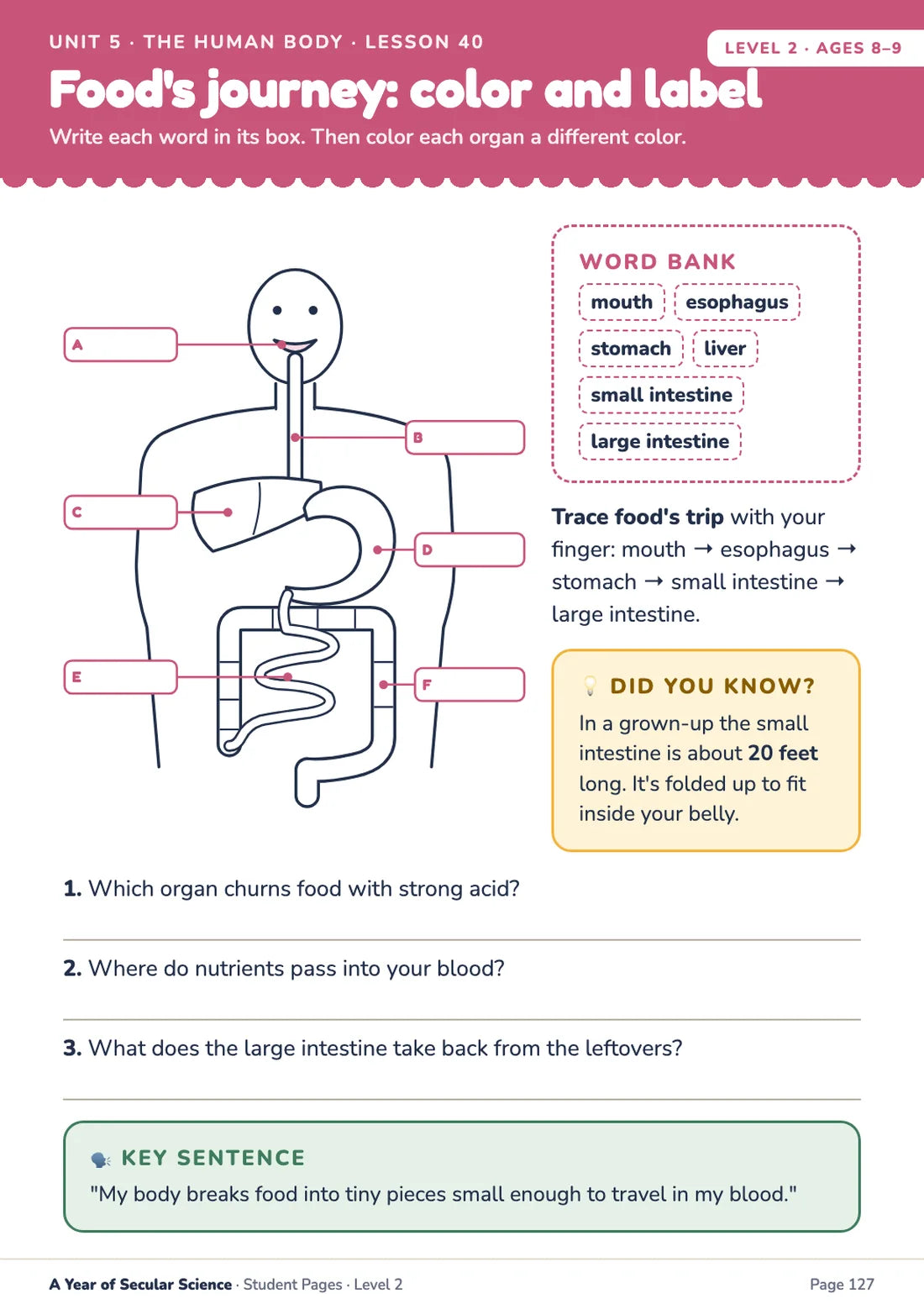
- Level 2, ages 8–9: label with a word bank, fill in, sort
- Level 3, ages 10–11: write, explain, draw their own example
- Answer key for every level, in kid words
Evolution and deep time, taught plainly.
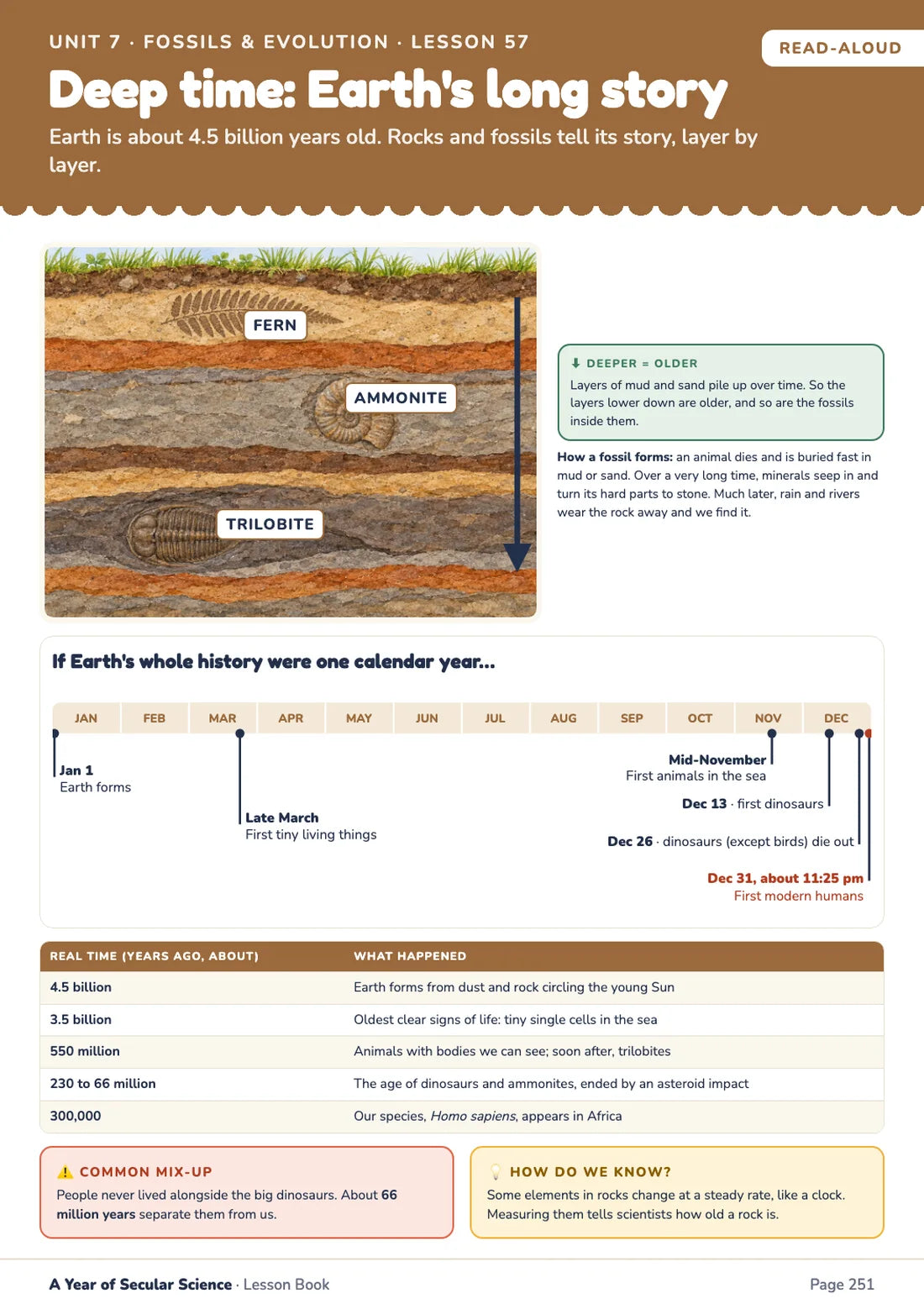
A whole unit on rocks, fossils and evolution, not a footnote. Earth is about 4.5 billion years old, and kids see what that means with a calendar they'll remember.
- Fossils, rock layers and how scientists date them
- How living things change over time, and natural selection
- Humans and the primate family
- The Sun, the galaxies and the Big Bang, in the space unit
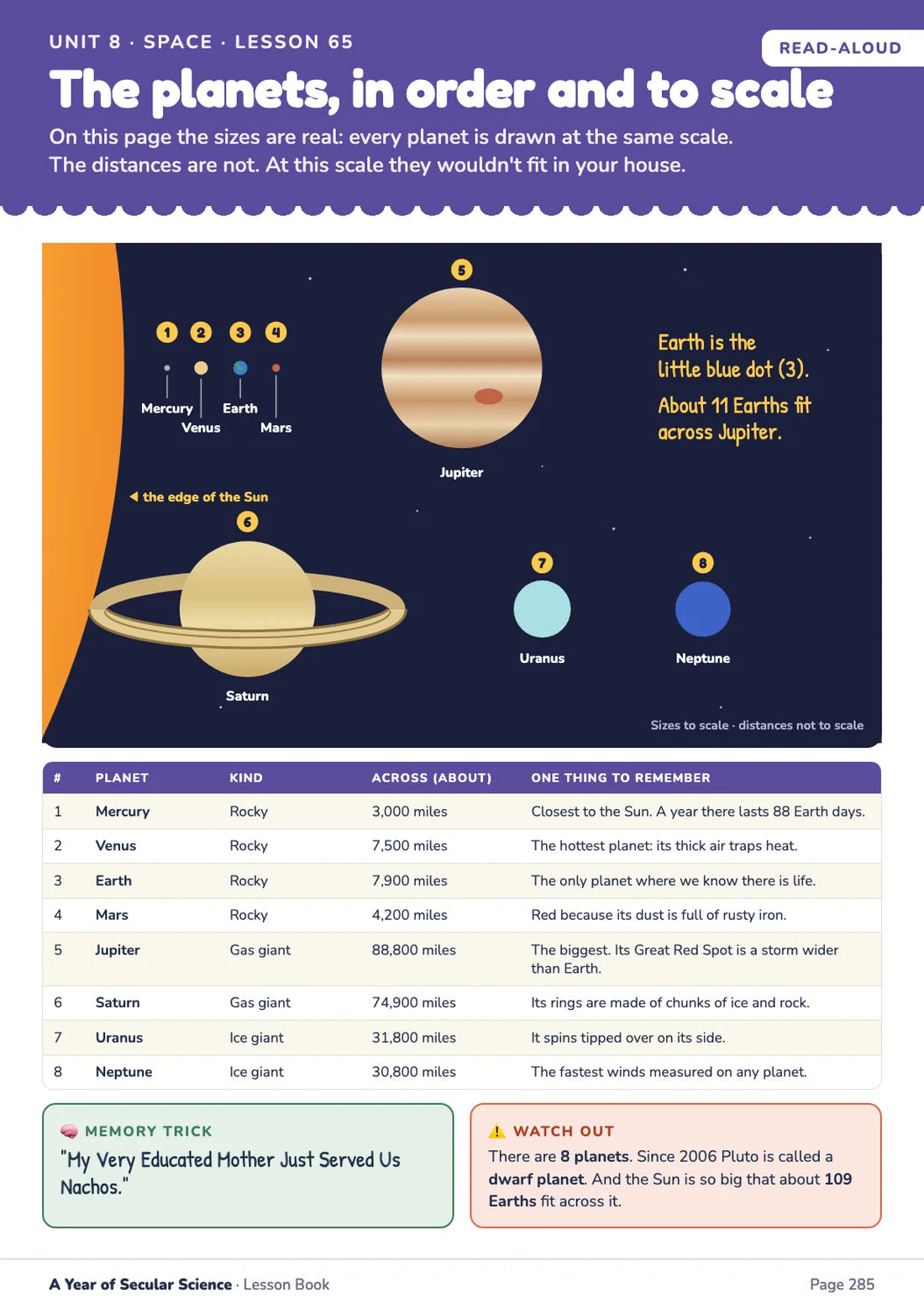
The planets, drawn to scale.
Most posters show planets the same size. Here every planet is drawn at the real scale, so kids see that about 11 Earths fit across Jupiter, and the Sun doesn't even fit on the page.
- Real sizes and the right order, with a memory trick
- One fact per planet that's easy to remember
- Up-to-date science: 8 planets, Pluto as a dwarf planet
- Clear notes on what is to scale and what isn't
Pages they color, label and keep.
Student pages are clean line art, made to be colored, labeled and filed in a binder. By June, each child has a science notebook of their own year.
- The human body, plants, animals, weather, rocks and space
- Life cycles, food chains, simple machines, circuits
- Line art that prints well in black and white
- A clear record of the year, one tab per unit

Short lessons. Real experiments. Everyone together.
Kids remember what they did with their hands and saw with their eyes. Twenty-five minutes, twice a week, adds up to a full year of science.
- Open-and-go: nothing to plan, nothing to look up
- One topic for the whole family, three levels of work
- Secular and evidence-based, from the first lesson to the last
A whole year of science, planned for you.
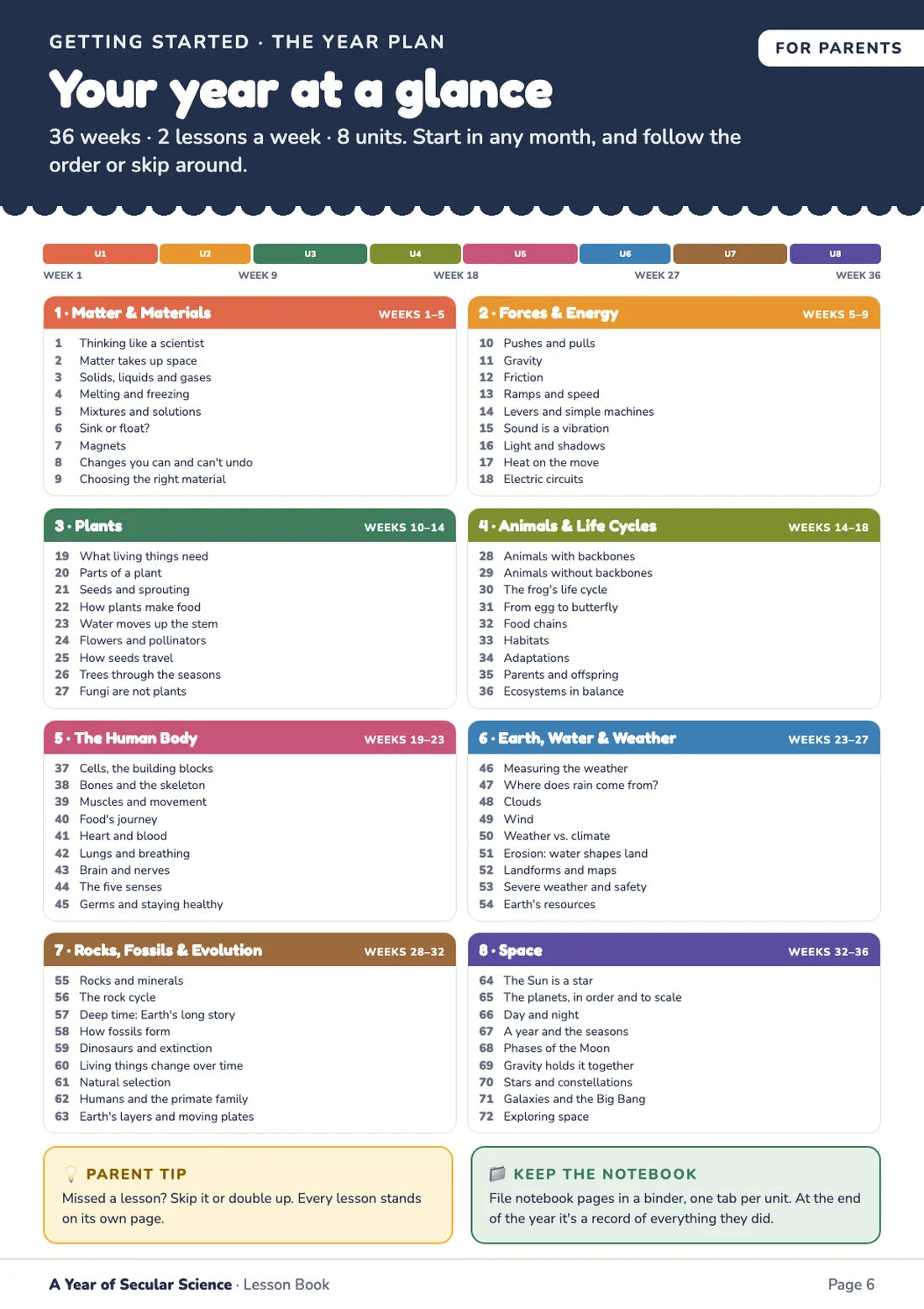
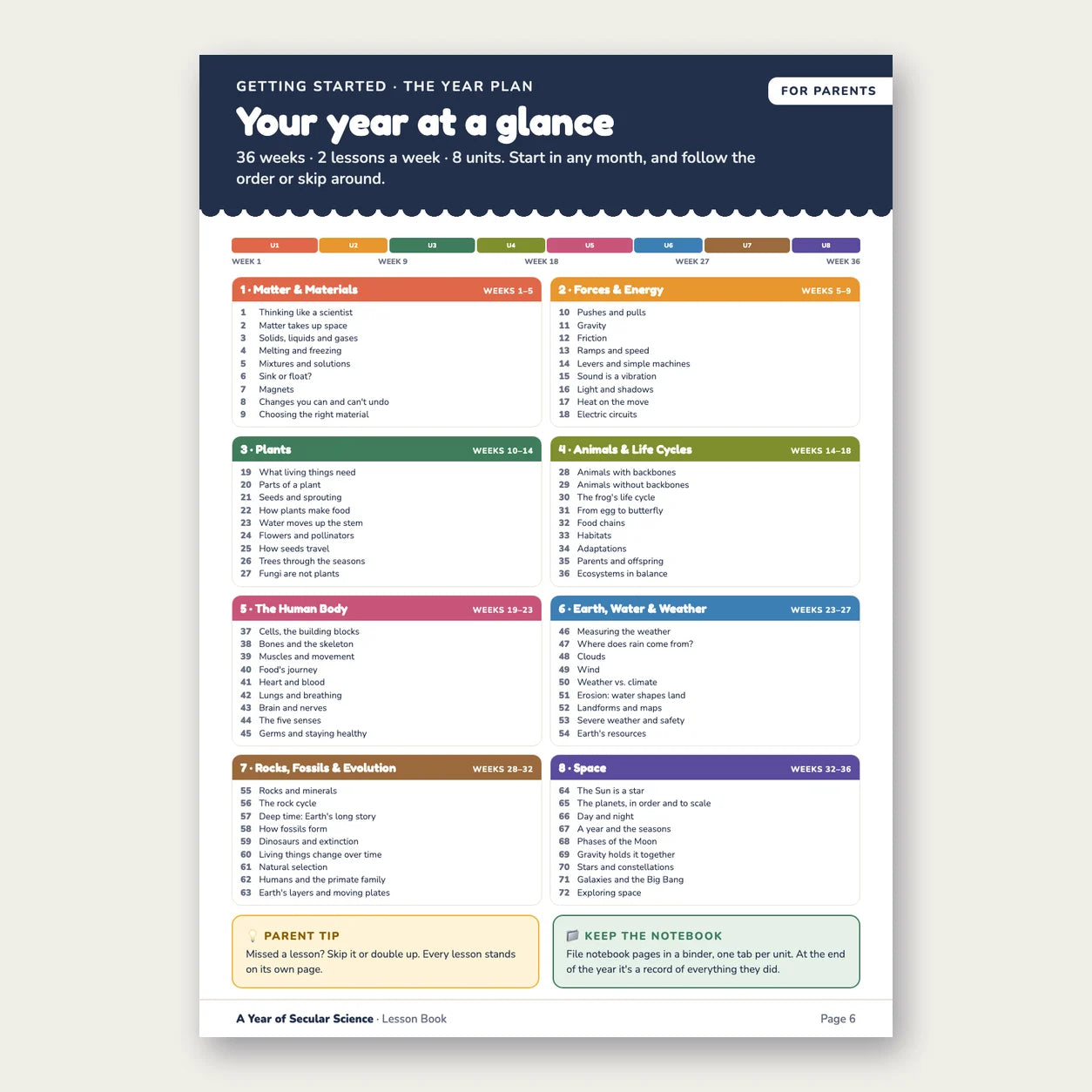
The year plan, unit by unit
Print at home, get the books, or both.
The whole year, right away
A family license: print the student pages for every child in your home, this year and next. Open it on a tablet or print one week at a time.
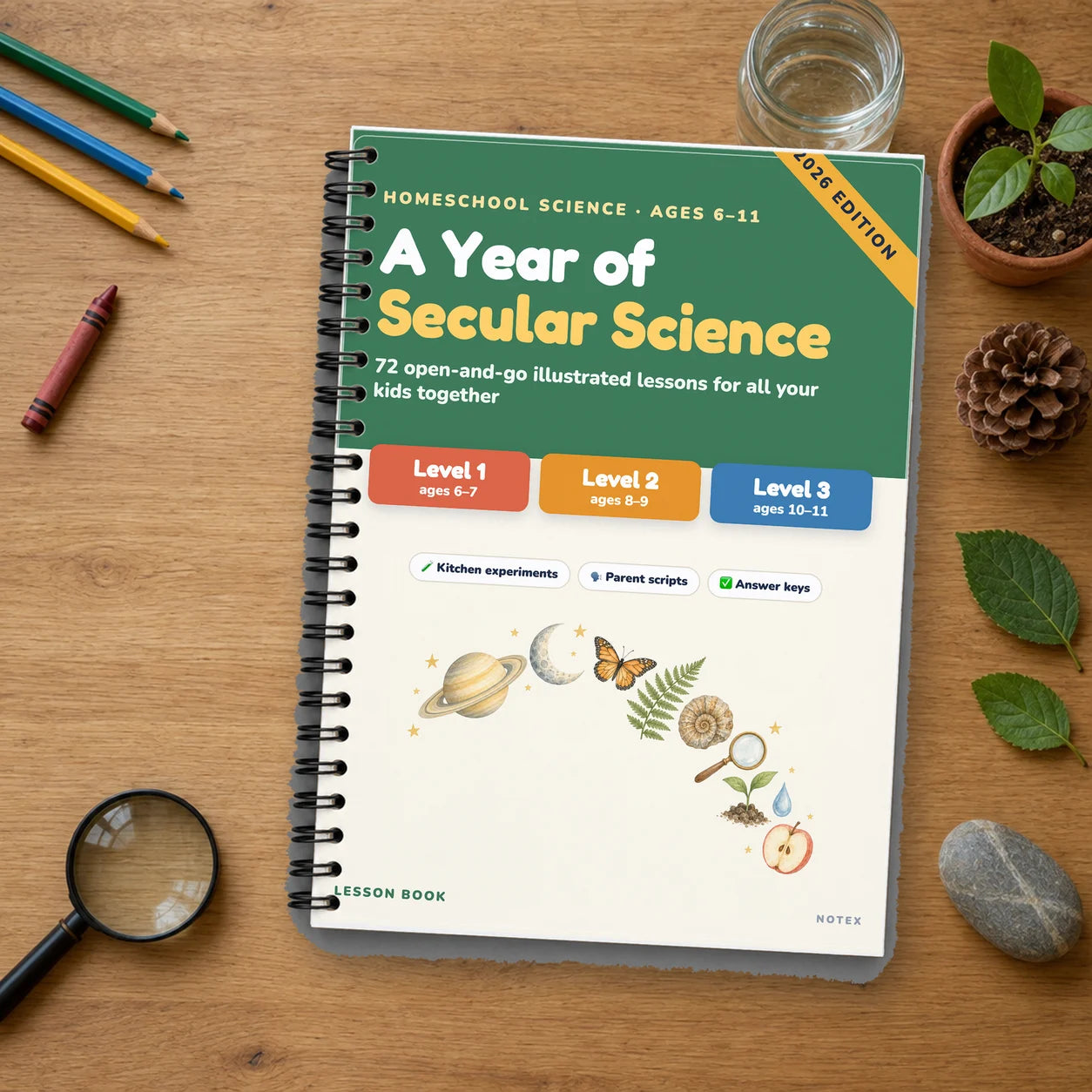
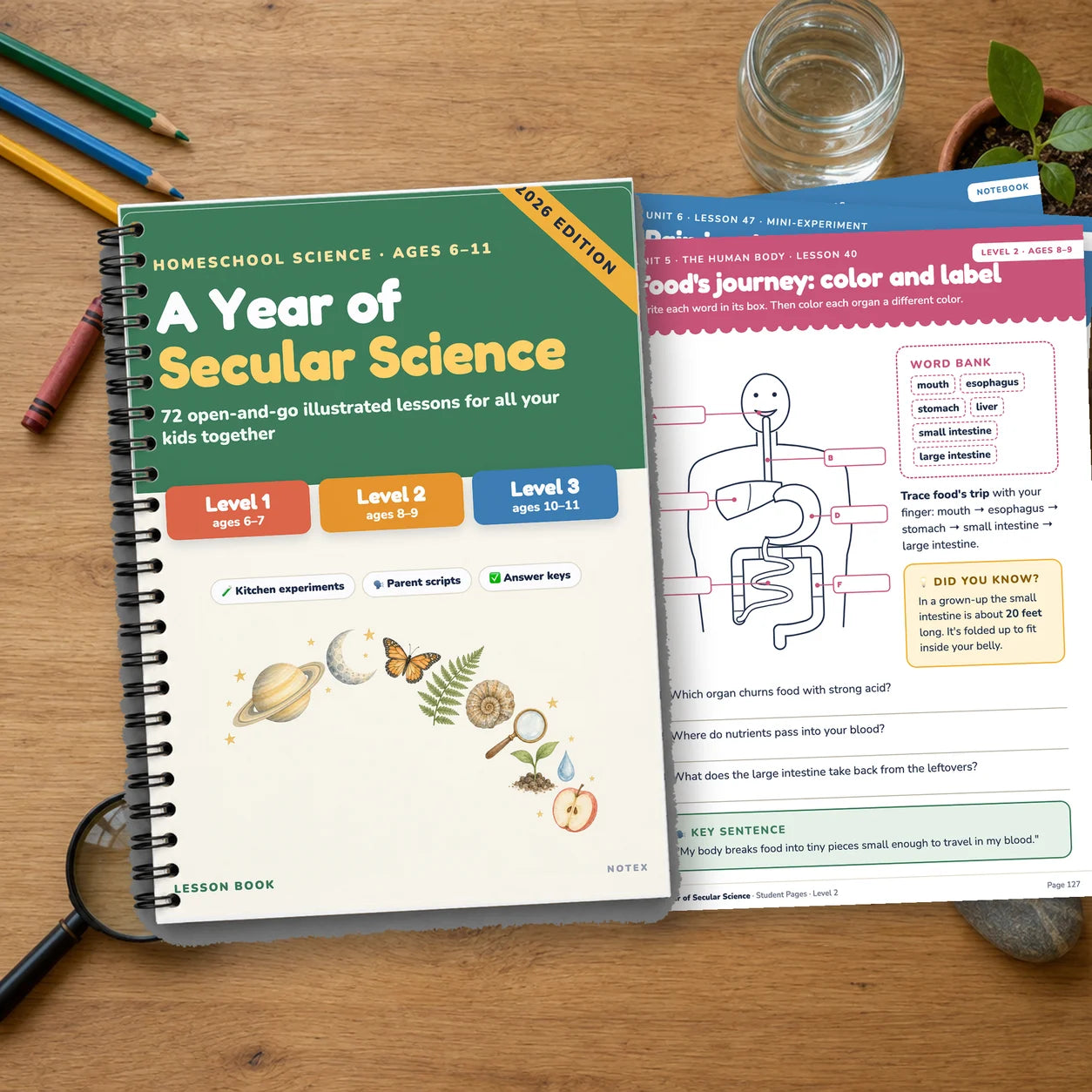
Two spiral-bound books
The Lesson Book and the Student Pages, in color, free US shipping. Want to print extra student pages for more kids? Printed + PDF is $89.99.
Print one week at a time.
The year plan tells you which pages each week needs. Student pages are line art, so they print well in black and white; the color pages are for reading together, and you can read those on a screen.
- A one-page supply list for each week
- Only print the levels your kids need
- Student pages work in black and white
See 10 real pages, free.
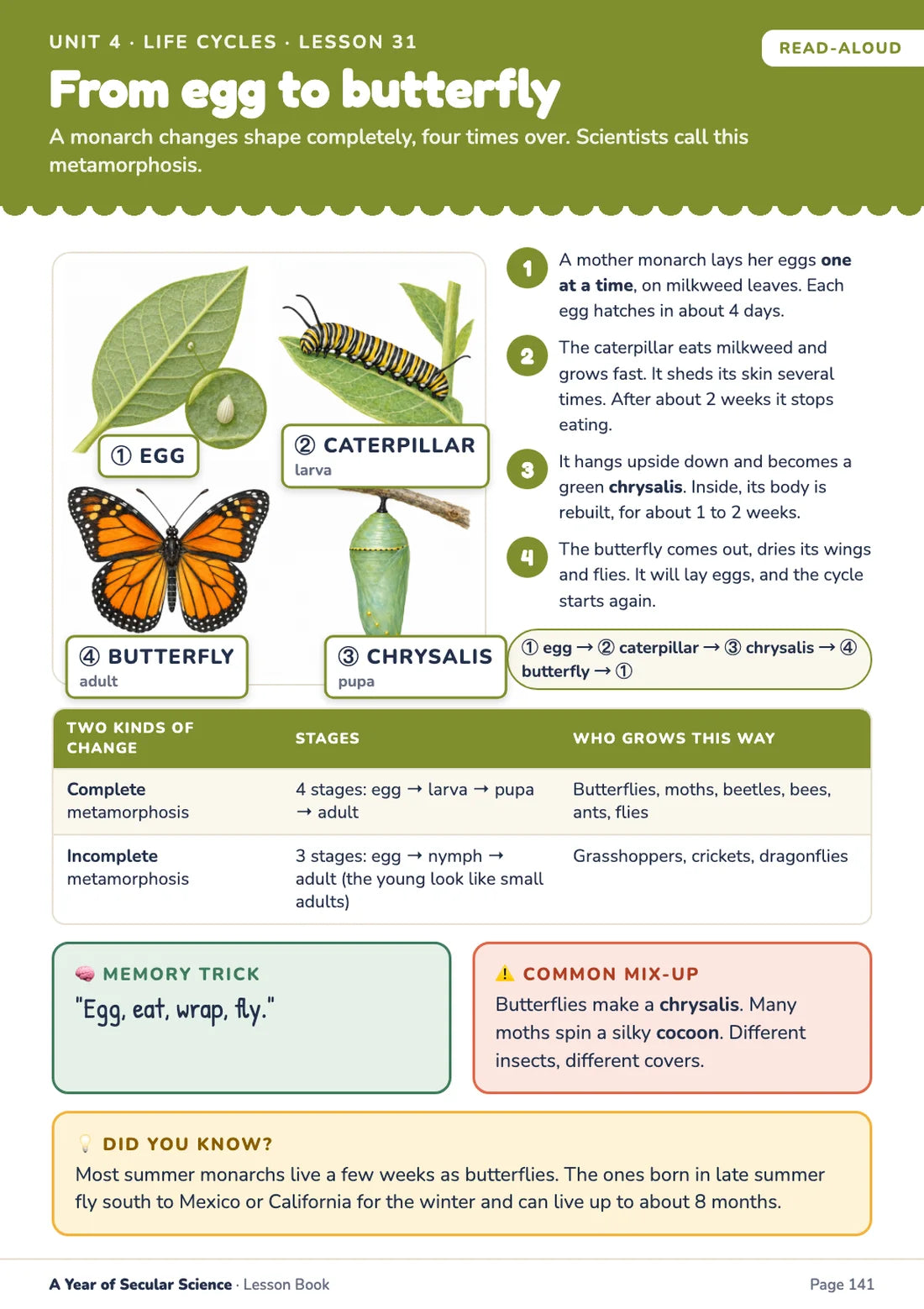
How a lesson works, a parent script, the water cycle, Rain in a jar, a notebook page in 3 levels, the planets to scale, the digestive system, the butterfly life cycle, deep time and the year plan. Look at them with your kids and decide with the pages in front of you.
See the 10 pages ↓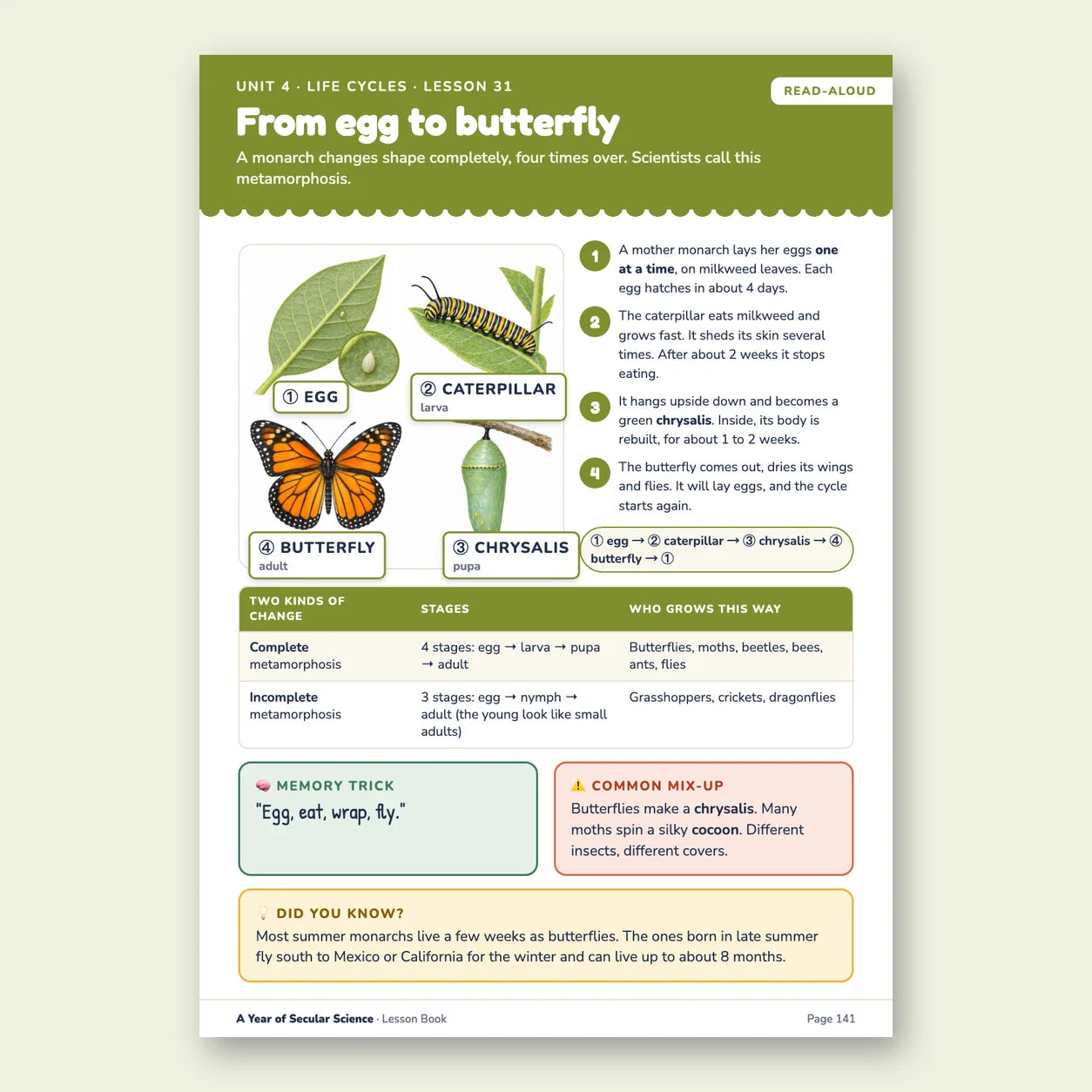
How is it different?
| What you get | A Year of Secular Science | Kit-based programs | Textbook programs | Free printables |
|---|---|---|---|---|
| Secular: evolution and Earth's age taught as science | ✓ | Varies | Varies | Varies |
| One lesson for ages 6 to 11, in 3 levels | ✓ | Varies | Usually one grade | Rarely |
| Parent script: what to say and ask | ✓ | Varies | Teacher guide sold separately | ✗ |
| Experiments with household items | ✓ (72) | Kit to buy | Varies | Varies |
| Answer keys for every page | ✓ | Varies | Varies | Rarely |
| Price for the whole family | From $44.99 | Often $100+ | Per child, per grade | Free, but you plan it all |
Science day can be tomorrow.
Check out
Secure payment, no account to create, no subscription. One payment.
Open the PDF
If you chose the PDF, the download link arrives by email. Print the year plan and week 1, and gather the supplies.
The books arrive
If you chose the printed set, we ship it to your home in the US, free.
Everything you need for a full year of science.
- 72 open-and-go illustrated lessons, 36 weeks, 8 units
- A parent script for every lesson: what to say, ask and listen for
- 72 mini-experiments with household items, drawn step by step
- Notebook pages in 3 levels: ages 6–7, 8–9 and 10–11
- Answer keys for every level
- Year plan, weekly supply lists and a glossary
- Secular and evidence-based: evolution, deep time, the Big Bang
- PDF: family license for all the kids in your home
What parents ask before buying
Is it really secular?
Yes. There is no religious content. Evolution, fossils, the age of the Earth (about 4.5 billion years) and the Big Bang are taught as science, plainly and at kid size, the way they're explained by scientists. It's a whole unit, not a footnote.
What ages is it for?
Ages 6 to 11, roughly grades 1 to 5. Every notebook page comes in three levels: ages 6–7, 8–9 and 10–11. Levels are a guide: a strong 7-year-old reader can try Level 2. Younger siblings often like to join in with Level 1 and a parent's help.
How long does a lesson take?
About 20 to 30 minutes: 5 minutes of reading together, 10–15 minutes of experiment and about 10 minutes of notebook. Two lessons a week. With one child it's often quicker.
Do I need a science background?
No. Every lesson has a parent script with what to say, what to ask and the answers to listen for, plus the common mix-ups to watch out for. You learn along with your kids.
What supplies do I need?
Things you already have at home: jars, ice, paper, tape, a flashlight, seeds, coins, a ruler. Each week has a one-page supply list. No kits to buy and no extra books, videos or websites needed.
Do I need to buy one for each child?
No. The PDF has a family license: print the student pages for all the children in your home, as many times as you need. With the printed set you get one copy of the Student Pages; for more kids, Printed + PDF lets you print extra pages.
Does it meet my state's requirements? Can I use ESA funds?
Homeschool rules are set by each state, so please check your state's law. Many families keep the notebook pages in a binder as a record of the year, but we can't promise it meets any specific requirement. Education savings accounts (ESA) and similar programs each have their own rules on what they cover and which sellers are approved. We are not an approved vendor of any ESA program right now, so check with your program before you buy.
How much printing is it? Will it use a lot of ink?
Print one week at a time: usually the notebook pages for the levels you need, plus the experiment page if you like. Student pages are line art and print well in black and white. The color read-aloud pages can be read from a tablet or screen instead of printed.
Is it a full curriculum?
Yes, for science: 72 lessons over 36 weeks, covering matter, forces and energy, plants, animals, the human body, Earth and weather, rocks and evolution, and space. You can start any week and follow the units in order or skip around.
When does the printed set arrive?
The printed set ships free to any US address and usually arrives in about 5 to 8 business days. The PDF arrives by email right after payment.
What if it's not right for us?
You have a 30-day money-back guarantee. Email us within 30 days and we'll refund you. No questions asked.
Ready for "When is science day?"
72 illustrated lessons, 72 kitchen experiments, 3 levels for all your kids. 30-day guarantee.
From $44.99 · PDF or printed